
Spekit delivers ROI 56% faster than Seismic
Updated August 2026


faster ROI with Spekit vs. Seismic according to G2 reviews across both companies
faster implementation of Spekit vs. Seismic according to G2 reviews across both companies
of Spekit customers on G2 reported seeing ROI compared with 90% of Seismic customers
Seismic's most common buyer complaints are one problem: reps can't find content, so they stop looking and fall back on saved copies, Drive, or Slack. Spekit surfaces knowledge and content inside Salesforce, Gmail, Gong, and the browser, so adoption doesn't depend on reps going anywhere.
Seismic depends on dedicated admin time: tagging taxonomies, content audits, re-uploads, provisioning. Buyers report needing dedicated headcount, sometimes more than one role, just for admin. Spekit's AI handles indexing, deduplication, and freshness scoring automatically, with no taxonomy to design or maintain. G2 rates Spekit ahead on ease of admin and ease of setup.
Expensive add-on modules, including AI, are just the beginning. Many customers complain that they end up with an "expensive Google Drive" replacement. With Spekit, AI, deal rooms, and analytics ship in standard, easy-to-understand licensing. And content engagement is tied to Salesforce pipeline in Spekit Analytics, so you can show revenue impact, not just what got viewed.
Trusted by revenue teams that scale. See all customer stories ->


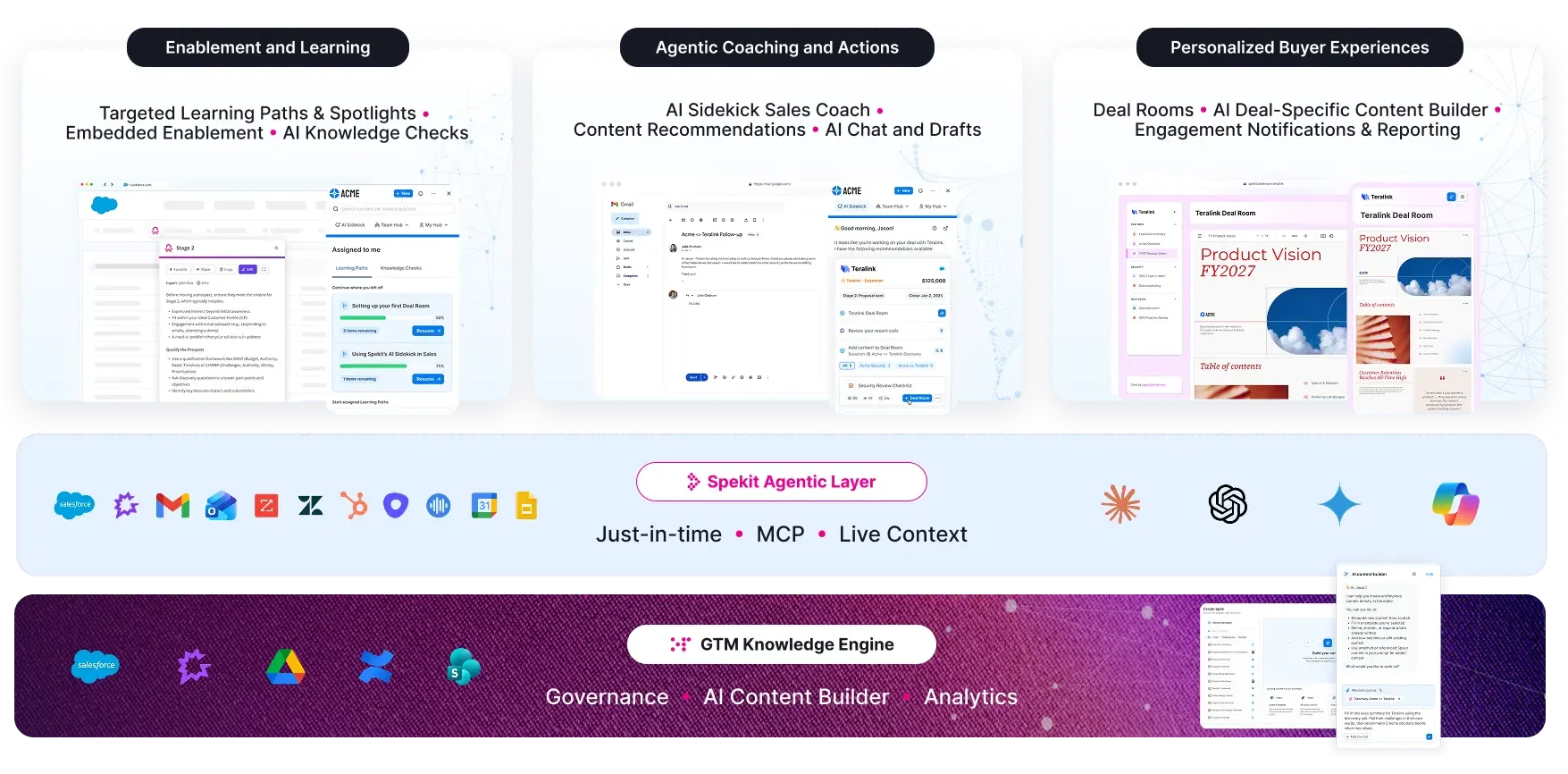
Spekit is a complete enablement platform. Content management, governance, AI content creation, coaching, training, deal rooms, and analytics all run on the GTM Knowledge Engine, a single governed source of truth, so every rep and every agent works from the same approved content.


One system unifies your content library, knowledge base, training, and in-app guidance. Update a Spek once and the change reaches every playbook, learning path, deal room, and AI answer that uses it, the moment it happens. When a product, competitor, or process changes, the knowledge tied to it moves with it.
Spekit Content Hub centralizes decks, one-pagers, playbooks, and battlecards in a governed library with version history, similarity detection at creation, and bulk archive and update tools. Real-time sync from Google Drive, SharePoint, and Confluence means replacing a file once updates it everywhere it is linked.
AI Content Builder creates decks, one-pagers, and follow-ups from your governed knowledge, not from a blank prompt. Brand Studio enforces your visual identity on every piece, and Templates keep structure consistent, so every rep and every agent creates from the same on-brand foundation.
The Governance Dashboard scores content freshness, catches potential duplicates with Similarity Detection as content is created, and recommends what to update, merge, or archive. Every Spek carries an owner, permissions, and review metadata. No manual audit cycles, no expiration to-do lists that get ignored. Nested Speks maximize content re-use, minimizing duplication and maintenance.
AI Sidekick answers from your governed knowledge with source transparency, never from the open internet. Full bi-directional MCP connectivity grounds the LLMs and agents you already use in the same source of truth. Models are interchangeable. The governed knowledge underneath them is not.
Deal Rooms automatically create a personalized space for every deal, assembled from the same governed content library, so buyers never see a stale deck. Spekit Analytics ties that buyer engagement to Salesforce opportunity data, showing which shared content actually moves deals to closed-won.
Learning Paths turn governed content into structured onboarding and ongoing training, delivered inside the tools reps already use instead of a separate LMS to log into. Learning performance ties back to revenue outcomes and improved ramp times.
Spekit connects content engagement to Salesforce opportunity data, so you see which assets influence pipeline and closed-won deals, and where knowledge gaps are hurting deals before they show up in the forecast.
SOC 2 Type II, SSO, and role-based permissions make Spekit ready for any size deployment. AI Sidekick, AI Content Creation, MCP, digital sales rooms and analytics ship in standard licensing.
Spekit and Seismic are both revenue enablement platforms. The difference is architecture: Seismic is a legacy portal, while Spekit is an AI-powered governed knowledge system delivered inside the tools reps already use. Here is how the platforms compare, capability by capability.
| Capability | Spekit | Seismic | Amount | Seismic |
|---|---|---|---|---|
| Content library and CMS | Governed library with version history, Similarity Detection, and Drive, SharePoint and Confluence sync | Enterprise document repository with tagging taxonomy | ||
| Content creation | On-brand content created instantly from governed knowledge with AI Content Builder and Brand Studio, both included, plus live sync from Drive, SharePoint and Confluence | Template-based document automation; authoring happens in external tools | ||
| Content governance | Freshness scoring and built-in conflict and decay detection flag stale content before it reaches the field | Admin-managed tagging, expiration, and review workflows | ||
| Rep experience | AI answers, coaching, and recommendations inside Salesforce, Gmail, Gong, and every tool reps already use | Portal destination, plus integrations | ||
| Digital sales rooms | AI Deal Rooms auto-assembled from governed content; engagement and revenue analytics | Digital sales rooms available | ||
| AI availability | 100% of customers get the full AI platform from day one: in-workflow answers, coaching, and content creation | Aura AI in use at 248 of 2,000+ customers as of June, 2026 | ||
| AI for LLMs and agents | Bi-directional MCP connectivity grounds LLMs and agents in your governed knowledge and brand and lets reps and admins create in their preferred tool | Aura agents operate within the Seismic platform | ||
| Analytics | Content and deal room engagement tied to Salesforce pipeline and revenue in Spekit Analytics | Content views and engagement scoring | ||
| Training and onboarding | Learning Paths and Enablement in the Flow of Work® included | Available via Lessonly (acquired in 2021), separate module |
The biggest reason teams stay on a platform they've outgrown isn't love. It's the fear of the migration lift. But with Spekit's dedicated team of experienced migration specialists, it takes only a few weeks to go from an old-fashioned portal to AI-native power.
Still under contract? Spekit works with switching teams to make the economics work before renewal.
G2's AI-generated summary of Seismic reviews surfaces these recurring themes from verified buyers. Each count reflects the number of individual reviews mentioning the issue.
Choose Seismic if high-volume document automation is your priority. Its reviewers praise its document management and data centralization, and it is a genuinely powerful system for organizing content at enterprise scale. The challenge those same G2 reviewers report is that reps can't find what they need in the moment they need it.
Choose Spekit if that moment is what you're buying for. Knowledge, content, and coaching delivered inside Salesforce, Gmail, Gong, and the browser, on-brand content created from governed knowledge, and ROI a lean team can show inside a year.
.webp)
100% of Spekit customers have AI active from day one
AI Sidekick, contextual recommendations, auto-indexing, and in-workflow answers aren't a separate SKU or an upgrade tier. Every Spekit customer gets them from day one — no add-on to unlock, no adoption gap to explain.
.webp)
What percentage of your customers actively use your AI, and what does it cost at our seat count?
When a rep needs an answer mid-call inside Salesforce or their inbox, what happens without opening your platform?
How many tags per asset will our admins maintain, and how many hours a month does content upkeep take at our volume?
Can we speak to two reference customers who reached full payback within 12 months?
What exactly does implementation include, who does the work, and what does support look like after go-live?
How do reps know which version of a document is current when three similar ones exist?
Yes, Spekit is an excellent replacement for Seismic that provides the full revenue enablement solution across content management, knowledge management, AI content creation, learning and training, digital sales rooms, revenue analytics, and AI agentic assistance, all directly in the flow of work. Spekit's GTM Knowledge Engine 2.0 provides a trusted, governed foundation for accelerating reps, enablement, and new AI and agentic workflows.
Early in 2026, Seismic and Highspot signed a definitive agreement to merge; the combined company will operate under the Seismic brand once the transaction closes, and both companies have stated that both platforms will continue to be supported. If you're evaluating or renewing, it's reasonable to ask which platform's roadmap your deployment will live on and to get continuity commitments in writing. Spekit is able to help organizations at any point in their contract find paths to migration.
Yes. Spekit Content Hub is a full content management system with a governed library for decks, playbooks, talk tracks, and battlecards. Teams switching from Seismic typically migrate their library in weeks: connect Google Drive, SharePoint, or Confluence and content syncs in, with AI handling indexing and organization instead of a manual tagging taxonomy. Version history tracks every change, and similarity detection catches redundant content as it is created rather than after it piles up.
The GTM Knowledge Engine is the foundation of the Spekit platform: a governed source of truth for all go-to-market knowledge and content. Instead of storing static files, it structures knowledge as modular Speks tied to your products, sales stages, and personas. Update a Spek once and the change reaches every playbook, learning path, deal room, and AI answer that uses it. Governance, permissions, and freshness monitoring are built into the engine, so reps and AI agents always work from the same current, trusted answer.
Yes. Every Spek carries an owner, role-based permissions, and review metadata, and the Governance Dashboard scores content freshness with recommended actions to update, merge, or archive. Knowledge updates itself instead of decaying: change the source once and it updates everywhere, every tool and every connected agent. Built-in conflict and decay detection flags stale content before it reaches the field, so governance happens the moment knowledge changes, not at the quarterly review. Spekit is SOC 2 Type II certified with SSO.
Yes. Deal Rooms are Spekit's digital sales rooms. Each one is a personalized space for a specific deal, automatically assembled from your governed content library so buyers never receive a stale or off-brand asset. Buyer engagement is tracked in Spekit Analytics against Salesforce opportunity data, so revenue teams can see which shared content moves deals toward closed-won.
Yes. Learning Paths turn governed content into structured onboarding and ongoing training, completed inside the tools reps already use rather than a separate LMS. Because training draws from the same knowledge reps see in their daily workflow, there is no gap between what gets taught and what gets used, and learning performance ties back to revenue outcomes.
Yes. Spekit is trusted by leading enterprise revenue teams including organizations like Southwest and Morningstar, and was named a Visionary in the 2025 Gartner Magic Quadrant for Revenue Enablement Platforms. It supports SSO, role-based permissions, and SOC 2 Type II compliance, with deployments in financial services and healthcare.
Spekit is an AI-powered revenue enablement platform that includes digital adoption as one of its use cases. In-app guidance and contextual help inside Salesforce is where Spekit started, and many teams still use it that way as one part of their enablement process. Today that capability is one layer of a complete platform that also includes content management, governance, learning paths, digital sales rooms, revenue analytics, and agentic AI assistance.