












Marketing Content Management
AI Made Everyone a Content Creator. Now What?
Reps can now build a buyer-ready deck in minutes with AI. Here's how Marketing and Enablement keep the story buyers hear accurate and consistent.


Reps can now build a buyer-ready deck in minutes with AI. Here's how Marketing and Enablement keep the story buyers hear accurate and consistent.
A sales rep finishes a discovery call, opens Claude, drops in the Gong transcript, and asks for a presentation tailored to the buyer. A few minutes later, they have a polished deck. It addresses the buyer's priorities, speaks to their use case, and looks ready for the next meeting.
Two years ago, that same deck might have taken days of back-and-forth with Marketing or Enablement. Today, the rep can build it before their next call.
This is happening across revenue teams, whether Marketing and Enablement are ready for it or not. And it raises a question every revenue leader should be asking: If everyone can create customer-facing content, how do you know what story your buyers are actually hearing?
For years, Marketing and Enablement operated as the primary producers of sales content. They created the pitch decks, wrote the messaging, approved the claims, and distributed the materials reps needed to sell. That model also came with its own set of frustrations: Reps waited for personalized materials. Marketing spent hours customizing presentations for individual opportunities. Enablement worked to keep everyone aligned as products, positioning, and competitive dynamics changed.
Generative AI has removed much of that friction. A rep can now create a deck for a specific industry, rewrite a pitch for a new stakeholder, or turn a customer conversation into a tailored presentation in minutes. That's an enormous opportunity for sales productivity. Reps can respond faster, prepare more thoroughly, and deliver content that speaks directly to their buyers.
But it also changes how companies need to think about content governance.
Consider what happens when 50 reps use AI to create their own presentations. One generates a competitive comparison using outdated information. Another makes a product claim that hasn't been approved. A third introduces an entirely new way of describing the company's value proposition.
Every deck looks professional and every rep believes they're delivering a compelling, on-brand story. Meanwhile, Marketing has spent months refining a positioning strategy that may never make it into those presentations, and Enablement has no reliable way to know whether reps are applying the messaging they've been taught.
The problem becomes more difficult as those decks circulate. They get saved locally, shared with colleagues, reused in other deals, and sent to buyers long after the original content has changed. AI accelerates content creation. It also accelerates the spread of inconsistent information.
The consequences extend beyond brand consistency. An inaccurate capability claim can undermine buyer trust. Outdated positioning can weaken differentiation in a competitive deal. Generic or inconsistent messaging can make it harder for buyers to understand why they should choose you.
Marketing and Enablement need to be able to define the approved story once and make it available wherever content gets created. That means giving AI access to trusted company knowledge, approved messaging, and the context of each deal. It also means distinguishing between the content that should remain consistent and the parts of a presentation that should be personalized.
Your product capabilities, competitive claims, and core positioning should reflect what the company has approved. Your buyer's challenges, priorities, and use cases should reflect what they've actually shared. Both belong in the same presentation.
This is the thinking behind Spekit Slides.
Spekit Slides brings native presentation creation into Spekit, where your approved GTM knowledge already lives, with the same capabilities accessible through LLMs like Claude and ChatGPT using Spekit MCP. At the foundation is a centralized library of approved slides, each managed as a reusable Spek.
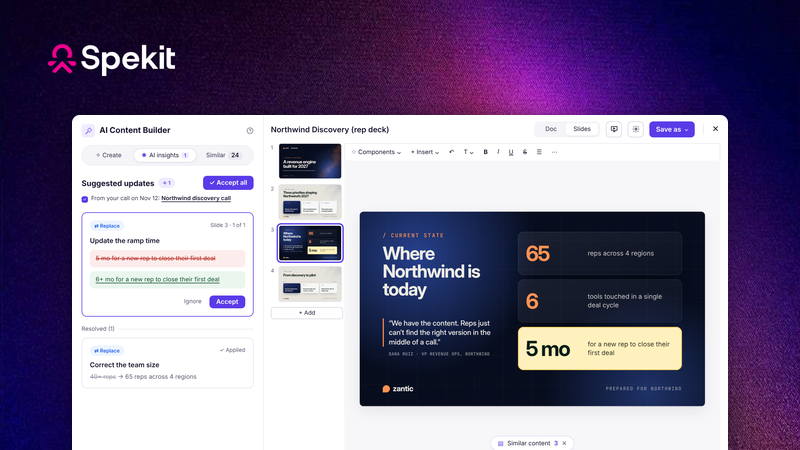
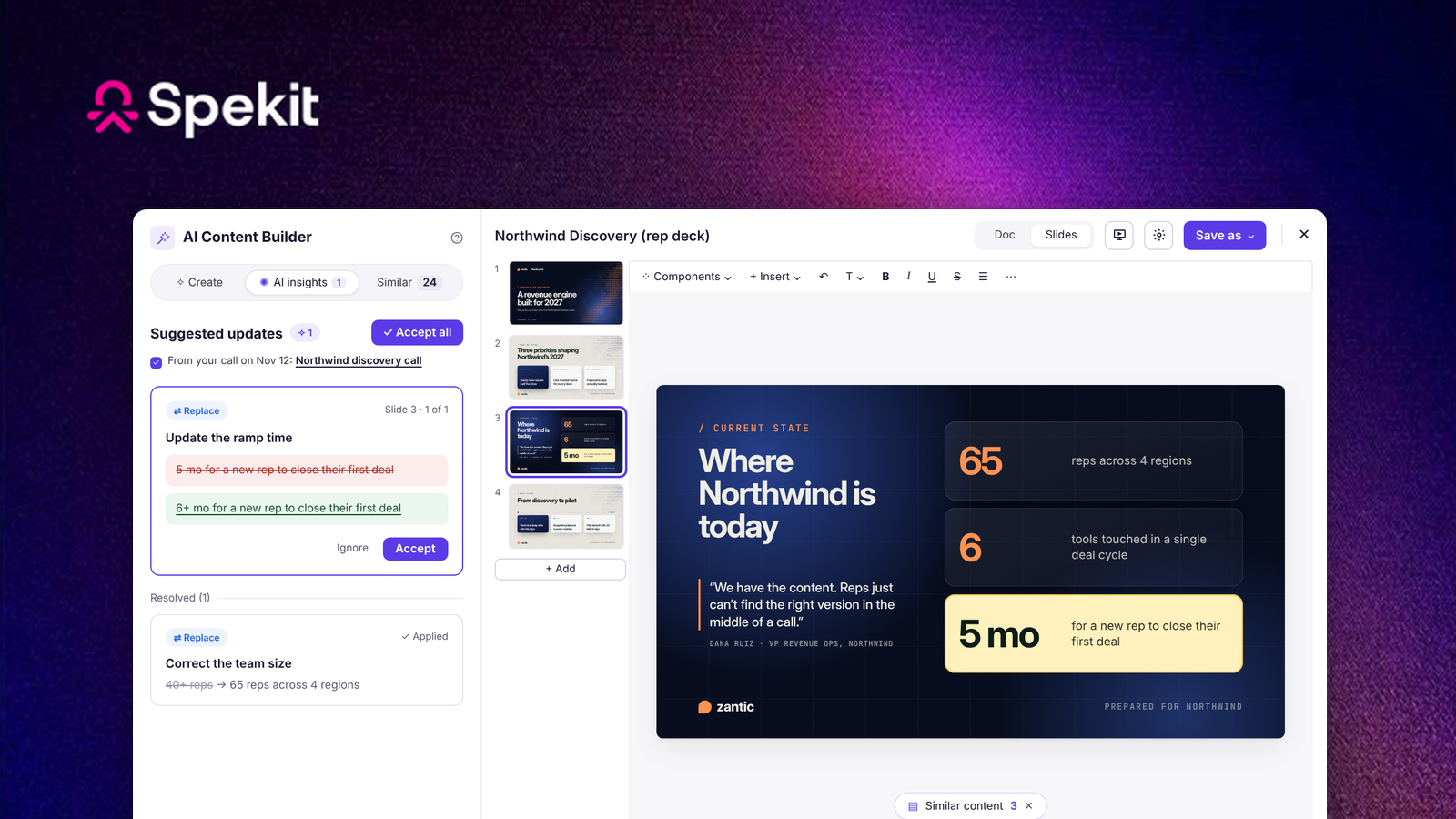
Marketing and Enablement can create and govern those slides, organize them into templates, apply brand standards, and lock critical content that reps shouldn't change. Spekit's agents then use that approved foundation alongside Gong conversations, Salesforce data, and deal context to create presentations tailored to individual buyers.
A rep preparing for a meeting can start directly in Spekit or ask their preferred LLM to build the deck in Spekit for them. In either case, slide content draws from the same governed knowledge.
And the experience continues after the deck is created. When Marketing updates an approved source slide, that change reaches connected decks automatically. As new buyer conversations happen, Spekit's agents can recommend relevant slides and suggest revisions for the rep to approve.
The buyer gets a presentation that reflects their current priorities. The rep spends less time searching, assembling, and updating content. Marketing and Enablement maintain control over the messaging that matters most.
AI has fundamentally changed the economics of content creation. A personalized presentation that once required hours of coordination can now be produced in minutes. Revenue teams should be able to use that speed without sacrificing the accuracy of what reaches their buyers.
For Marketing and Enablement, that creates an opportunity to scale their impact. Approved knowledge can reach more deals, messaging changes can propagate instantly, and teams can see how content is being used throughout the sales process. For reps, it means faster access to presentations built around the actual opportunity, with less manual preparation between meetings. And for buyers, it means receiving relevant, current information that helps them make a decision.
Everyone can be a content creator now. The companies that get the most value from that shift will be the ones that give every creator access to the right knowledge.