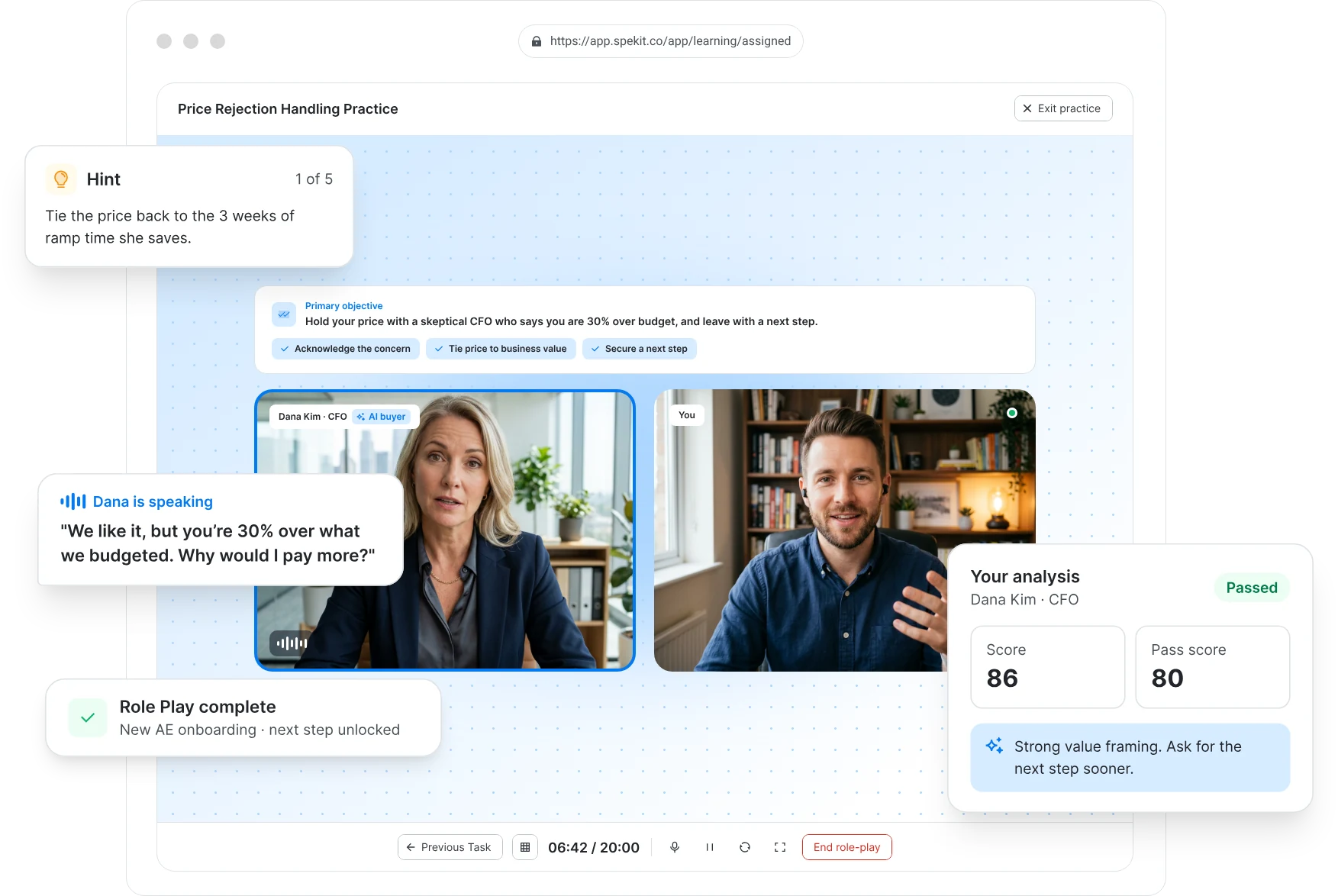
Today, we’re launching AI Role Play in Spekit Learning Paths, giving reps a way to practice the prospect and customer conversations that matter before they have them live.
Role play has a specific job. It belongs in the moments where the outcome you care about is whether a rep can have the conversation effectively. That might be a first discovery call after onboarding, a pricing discussion, a competitive objection, or a new talk track the field needs to use consistently. If the goal is recall or process knowledge, there are better ways to assess it. Our own best practices are explicit about that: if a scenario amounts to asking a rep to list information back, it belongs in a quiz. Role play is for the things they need to do live, with another person responding in real time.
That distinction is particularly important because completion can only tell you so much. A rep may have already worked through the material, passed the knowledge check, and finished the Learning Path. For some training, that is exactly the signal you need. For customer-facing conversations, the more important question is whether they can apply what they learned when the conversation starts moving in a direction they did not script. AI Role Play gives teams a way to see that before the prospect is involved.
Give new reps a place to practice before the first call
New hires have a lot to absorb before they start taking meetings. They need to learn the product, understand the pitch, know the discovery questions, and get comfortable with the objections they are likely to hear. The challenge is turning that knowledge into something they can use naturally in a live conversation.
Traditionally, that practice happens through manager role plays, shadowing, or a few mock calls during onboarding. Those sessions are valuable, but the amount of practice a rep gets often comes down to how much time a manager or enablement team has available.
With AI Role Play, enablement teams can add a conversation-based practice step to the Learning Paths where it makes sense. Reps work through the material first, then enter a scenario built around a specific buyer or buying committee and moment in the sales cycle. They can practice privately, get a score after each attempt, and repeat the conversation until they meet the threshold the team has set.
That gives the rep room to work through the awkward first attempt without a customer listening, and it gives the team a much clearer signal than completion alone.
Turn new messaging into something reps can rehearse
The same issue shows up long after onboarding. Changes happen frequently, whether that’s a pricing change, an important competitive update, or Product releasing a major new capability that reps need to include in their demos. The positioning shifts, and enablement has to get the field comfortable with a different story quickly.
Most teams already have a process for getting the new message out. They create the content, update the Learning Path, run the training, and track completion. The harder part is knowing how that message will sound once a buyer starts asking questions.
AI Role Play gives teams a way to turn that launch material into a scenario the field can practice before the message reaches a customer.
A rep can work through the new pricing conversation with a skeptical buyer, practice responding to a competitive objection, or rehearse a new pitch while the material is still fresh. Enablement can then see how the team is performing while there is still time to address any gaps.
This is especially useful when accuracy matters as much as delivery. A rep can sound confident and still say something that is outdated or incorrect. That is why we recommend including at least one scoring criterion tied directly to accuracy, such as whether the rep described the pricing model correctly or made a product claim the company cannot support.
Give managers a better place to focus their coaching
Managers rarely have enough time to sit through every rep practicing every conversation.
That means coaching tends to happen where the need is already obvious. A rep asks for help, a deal goes sideways, or a manager sees a recurring issue and steps in. Valuable coaching still happens, but it is difficult to give every rep the same amount of practice and attention.
AI Role Play gives reps a consistent place to practice on their own, then gives managers something more useful to work from.
Each attempt is scored against criteria set by the team. Managers can review the results, see where reps are struggling, and spend their time on the people and skills that need more attention. They do not have to be present for every rehearsal to understand where coaching will have the most impact.
For the rep, that creates a lower-pressure place to improve. They can repeat the scenario as many times as they need, learn from the feedback, and come into a manager coaching session with a much clearer sense of what they are working on.
Add practice where the conversation is the thing you need to prove
AI Role Play gives teams another way to use Learning Paths when the learning objective is tied to a real customer conversation. Reps still learn the material first. Then, when the situation calls for it, they get a place to practice applying that material with a buyer who responds, questions, and pushes back. Enablement gets a clearer view of readiness, and managers get a stronger signal for where their coaching is needed.
For the conversations that matter most, the first real test no longer has to happen with a customer.









 Sales Enablement