


a World of AI



a World of AI
a World of AI


Spekit delivers ROI 53% faster than Highspot
Stop paying for a portal your reps don't use. Spekit is a full replacement for Highspot. One AI-powered platform for content management, governance, training, digital sales rooms and revenue analytics, delivered where your reps already work instead of in a portal they have to remember to open.
Updated August, 2026






faster ROI with Spekit vs. Highspot according to G2 reviews across both companies
of Spekit customers on G2 say the product is headed in the right direction. And no unresolved merger to worry about.
of Spekit customers on G2 reported not seeing ROI compared with 6% of Highspot customers
Why revenue teams switch from Highspot to Spekit
Lack of portal adoption
Highspot's customers who leave rarely cite the product itself. Instead, they cite adoption, that reps have to go to the platform, that searching takes longer than it should, and that eventually they just stop going. Spekit inverts that dependency, delivering governed answers proactively inside Salesforce, Gmail, Gong, and the rest of the apps they already use.
Maintenance and admin effort
Highspot's content model runs on Spots, tagging, and permissioning, and its reviewers describe keeping that structure current as significant ongoing work. Spekit's AI indexes, de-duplicates, and organizes content automatically, so a small enablement team can run the whole knowledge library without a full-time admin behind it.
Paying for more than you need
On G2, Highspot buyers report reaching ROI in 15 months on average versus 7 for Spekit, and 11% report payback at three years or never versus zero Spekit reviewers. Spekit is one platform with AI included for every user.






.svg)
What G2 customers report
Fastest ROI in the category, used daily by reps
%201.svg)




What does Spekit include?
Spekit is a complete enablement platform. Content management, governance, learning, digital sales rooms, analytics and AI all run on the GTM Knowledge Engine, one governed source of truth for every rep, Deal Room, and agent.
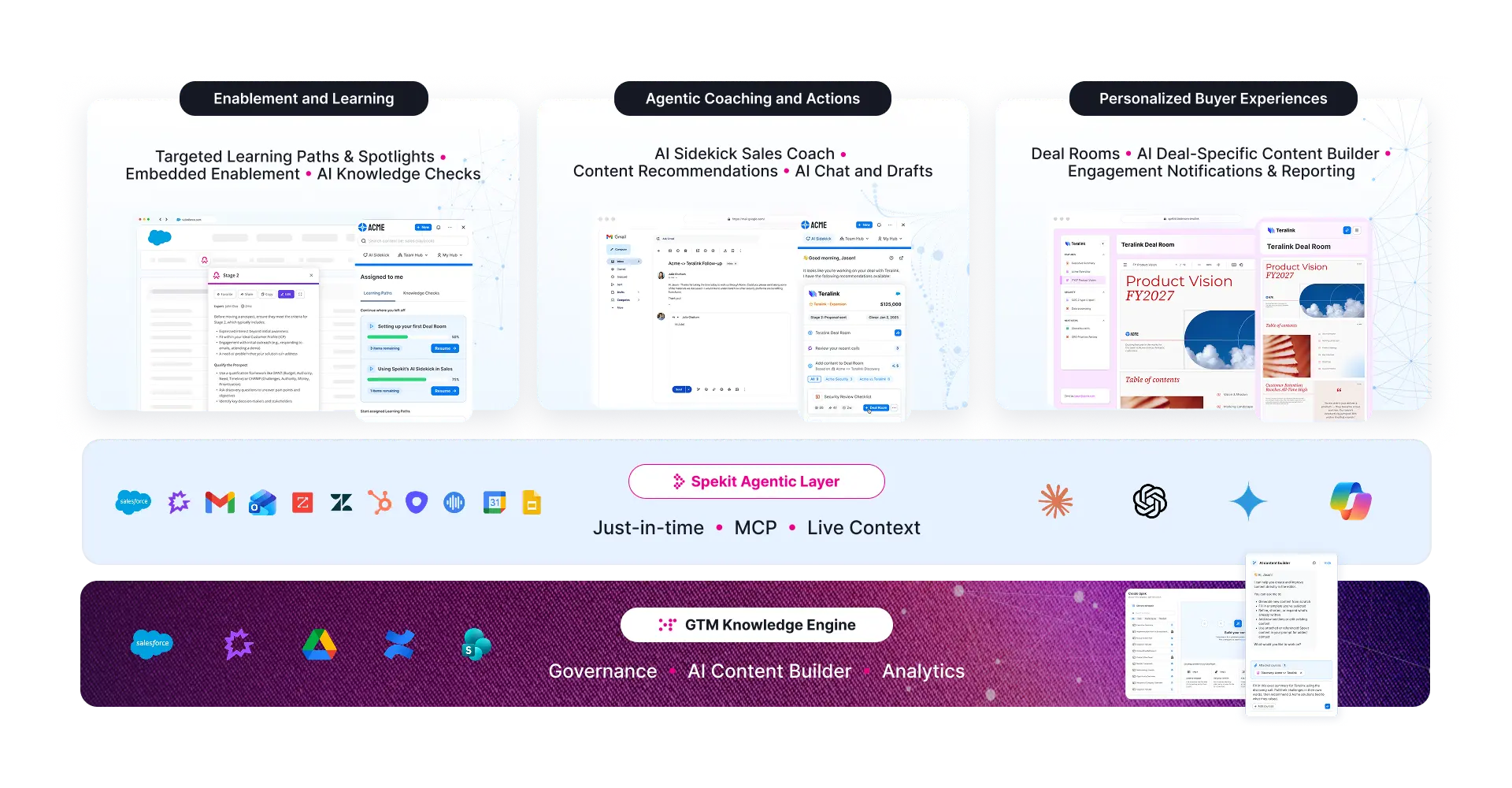






How do Spekit and Highspot compare?
Spekit and Highspot are both revenue enablement platforms, and Highspot is a capable one. The difference is where the platform lives and how much hand work it takes to keep running. Highspot concentrates value in a destination reps visit and a structure admins maintain asset by asset, while Spekit organizes content automatically as it is synced, created or modified, and delivers it inside the tools reps already have open.
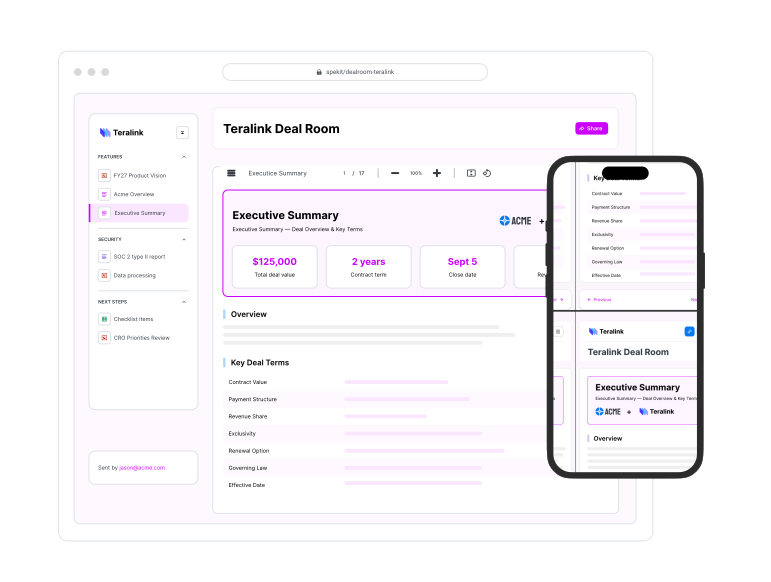
Deal rooms your reps will actually build
One governed source for your reps
and AI tools
Every agent is only as accurate as the content behind it
Your reps are already putting product, pricing and process questions to Claude, ChatGPT, Copilot, Gemini and Glean. Ungrounded, those tools answer from whatever they reach: a current price sheet, a deck from two quarters ago, a draft nobody archived. Connect them to Spekit over MCP and every one of them, plus any agent your team builds, answers from the same governed knowledge in your GTM Knowledge Engine.
Switching is less complicated than staying
The biggest reason teams stay on a platform they've outgrown isn't love. It's the fear of the migration lift. But with Spekit's dedicated team of experienced migration specialists, it takes only a few weeks to go from an old-fashioned portal to AI-native power.
Still under contract? Spekit works with switching teams to make the economics work before renewal.

Audit + Connect
Migrate + Create
Curate + Review
Implement

What does the Highspot and Seismic merger mean for buyers?
Seismic and Highspot signed a definitive agreement to merge on February 12, 2026. The combined company will operate under the Seismic brand, led by Seismic's CEO, with Highspot's founder joining the board. The deal has not closed, and both companies say both platforms will continue to be supported in the meantime. Gartner advises against long-term commitments until the integration and roadmap picture is clear.
Overlapping modules get consolidated
Both platforms sell a content management system, a training and readiness module, digital sales rooms, and AI content recommendations. When two products overlap that heavily, the combined company usually keeps one of each and winds the other down. Ask which one your renewal is buying.
One platform becomes the legacy path
The announced terms already point one direction: the combined company takes the Seismic name and Seismic's CEO. That does not settle which product survives, but it makes the question worth asking in writing before you sign. Customers on the other side of that decision face a migration they did not plan for.
Roadmaps slow while it gets sorted
Roadmap commitments commonly slow for 12 to 24 months after a merger of this size, and engineering investment splits across two codebases during that period rather than compounding on one. That is the window in which AI capability gaps between platforms tend to widen.
Don’t take our word for it. Take theirs.
G2's AI-generated summary of Highspot reviews surfaces these recurring themes from verified buyers.


Recognized by Gartner® for transforming enablement into an adaptive intelligence layer that connects knowledge, context, and action.
Evaluating platforms?
Ask these questions.
How does your platform drive adoption and utilization in reps' workflows?
What do common administrative tasks look like? Duplicate a learning path. Update expiry on 50 assets.
How does buyer engagement turn into analytics that are tied to live pipeline and revenue?
How long does it take to build a new digital sales room from scratch?
What capabilities are in the tier package, and what are add-ons that are separately negotiated?
What does content and data egress look like? Will we be able to get our assets, metadata, and engagement data back out?
Book your 30-minute personalized demo
Book a 30-minute demo to see how Spekit delivers just-in-time enablement with AI built for speed, adoption, and revenue impact.
What you'll see:
- Spekit working inside Salesforce, Gong, Gmail and your existing revenue stack
- AI coaching, recommendations and actions grounded in GTM knowledge and live deal context
- How implementation, administration, and rep experience actually work
- Recommended next steps based on your current Highspot environment and priorities


Frequently Asked Questions
Yes. Spekit replaces Highspot in full for content management, knowledge management, AI content creation, onboarding and ongoing training, deal rooms, revenue analytics and AI agent connectivity, all on one platform and all in standard licensing. With GTM Knowledge Engine 2.0, Spekit delivers a trusted, governed foundation for reps, enablement and agentic AI workflows.
Highspot and Seismic signed a definitive agreement to merge on February 12, 2026. Under the announced terms, the combined company operates under the Seismic brand, led by Seismic's CEO, with Highspot's founder joining the board. The deal has not closed, and both companies have said both platforms will continue to be supported in the meantime. If you are evaluating or renewing, ask which platform's roadmap your deployment lives on after close, and get continuity and pricing commitments in writing. According to Gartner, you should avoid long term contracts.
According to Gartner, organizations should avoid long term commitments during this period before clarity on corporate integration and roadmap is possible. Many teams have migrated quickly and efficiently to Spekit, mitigating vendor risk while increasing usability and ROI in their enablement platform.
Five weeks, through a guided program that opens with a joint audit of your current library and usage data to settle what moves across, what gets retired, and what needs rebuilding. Google Drive, SharePoint and Confluence sync content directly into Spekit, with no taxonomy to design first and no tagging pass to work through. Migration support is included, and Spekit works aggressively with organizations on the economics to make early migration work well before contracts expire.
Almost never. AI Sidekick is a browser extension that brings answers, recommendations, content, coaching, and digital sales rooms into the apps and web tools reps already use, including Salesforce, Gmail, Outlook, and more. Spekit does have Content Hub, a web app, that admins and reps can use if they choose to.
No. Every user gets AI Sidekick, contextual recommendations, AI content creation and MCP under standard licensing. Because there is a single tier, nothing on the platform is gated behind a module you have to purchase before you can reach it.
Yes, over bi-directional MCP. Claude, ChatGPT, Copilot, Gemini, Glean and agents your team builds all read the governed knowledge your reps read, so an agent's answer and a rep's answer say the same thing to a buyer. Users can also create content and digital sales rooms through MCP which automatically follows an organizations brand guidelines through Brand Studio.
Yes. Deal Rooms are assembled from your governed content library with AI recommending what belongs in each one, so a rep starts from a draft rather than an empty page. AI Content Builder and Brand Studio allow fast creation and update of on-brand content in the personalized buyer experience. Buyer engagement shows who engaged, on which content, and for how long. And analytics are tied back to pipeline and revenue so reps and managers understand how Deal Rooms impact opportunities.