











Marketing Content Management
AI-Enabled Go-to-Market Insights from Product Marketers
Four product marketing leaders reveal how AI, continuous launches, and revenue-tied enablement are reshaping go-to-market and what executives must do next.

Four product marketing leaders reveal how AI, continuous launches, and revenue-tied enablement are reshaping go-to-market and what executives must do next.
Wall Street still jitters at every interest-rate whisper. Boards keep tightening spend. Yet the velocity of artificial intelligence keeps rising, compressing product cycles and amplifying buyer expectations. If you own revenue or brand, you feel the paradox: slash the budget in Q2 while also funding tools the CFO has never touched.
Moments like this reward executives who play long games—think Amazon’s early “losses on purpose” era or Priceline’s quiet pivot to hotel inventory. Betting on durable advantage, not quarterly optics, turned short-term skeptics into long-term believers.
To separate fad from foundational, I listened to an AMA-style roundtable featuring four practitioners who sit where strategy meets quota every day:
Moderated by Larkin Dahal, their conversation ranged from release fatigue to the ethics of ChatGPT-drafted RFPs. Below are nine lessons, tempered by fresh research, framed in business cases, and written for CMOs, founders, and revenue leaders steering through uncertainty.
Shipping twice a year is nostalgia. Most SaaS teams now push code weekly. The panel’s playbook:
Every panelist leans on GenAI for call summaries, data cleansing, first-draft copy, and locating legacy assets. Yet each stressed a constant: human judgment.
“AI can surface data and even scare reps with performance metrics, but it can’t drive the human connection that changes behavior,” Middleton noted.
Allen framed the gap succinctly: “AI may spit out a plan; someone still has to build the relationship and see it through.”
Their guardrails:
Trust concerns echo the data: about half of employees worry about AI inaccuracy or security risk, says McKinsey’s March 2025 workplace survey.
Course-completion metrics feel quaint. Q4’s enablement and PMM teams share three targets:
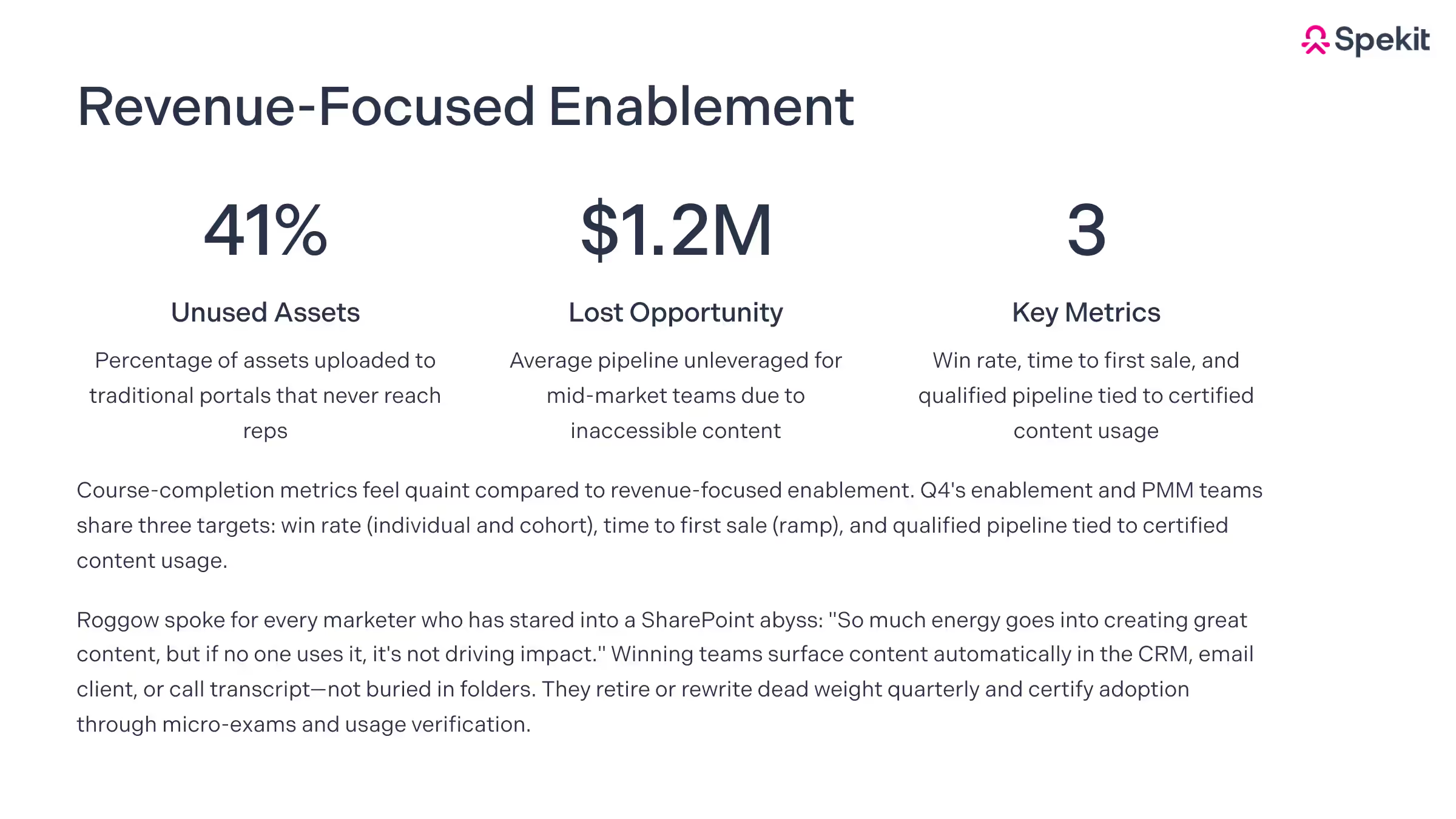
Roggow spoke for every marketer who has stared into a SharePoint abyss: “So much energy goes into creating great content, but if no one uses it, it’s not driving impact.”
A Sales Enablement Collective study with Spekit shows 41 % of assets uploaded to traditional portals never reach reps, leaving an average of $1.2 million in pipeline unleveraged for mid-market teams .
Winning teams:
Allen feeds customer-by-product matrices into a GPT agent, lets it flag white space, then sizes the total addressable upsell market, before lunch. The analysis directs reps to cross-sell plays most likely to close.
McKinsey finds B2B units deploying GenAI for upsell scenarios see revenue gains comparable to launching new segments, yet without acquisition cost .
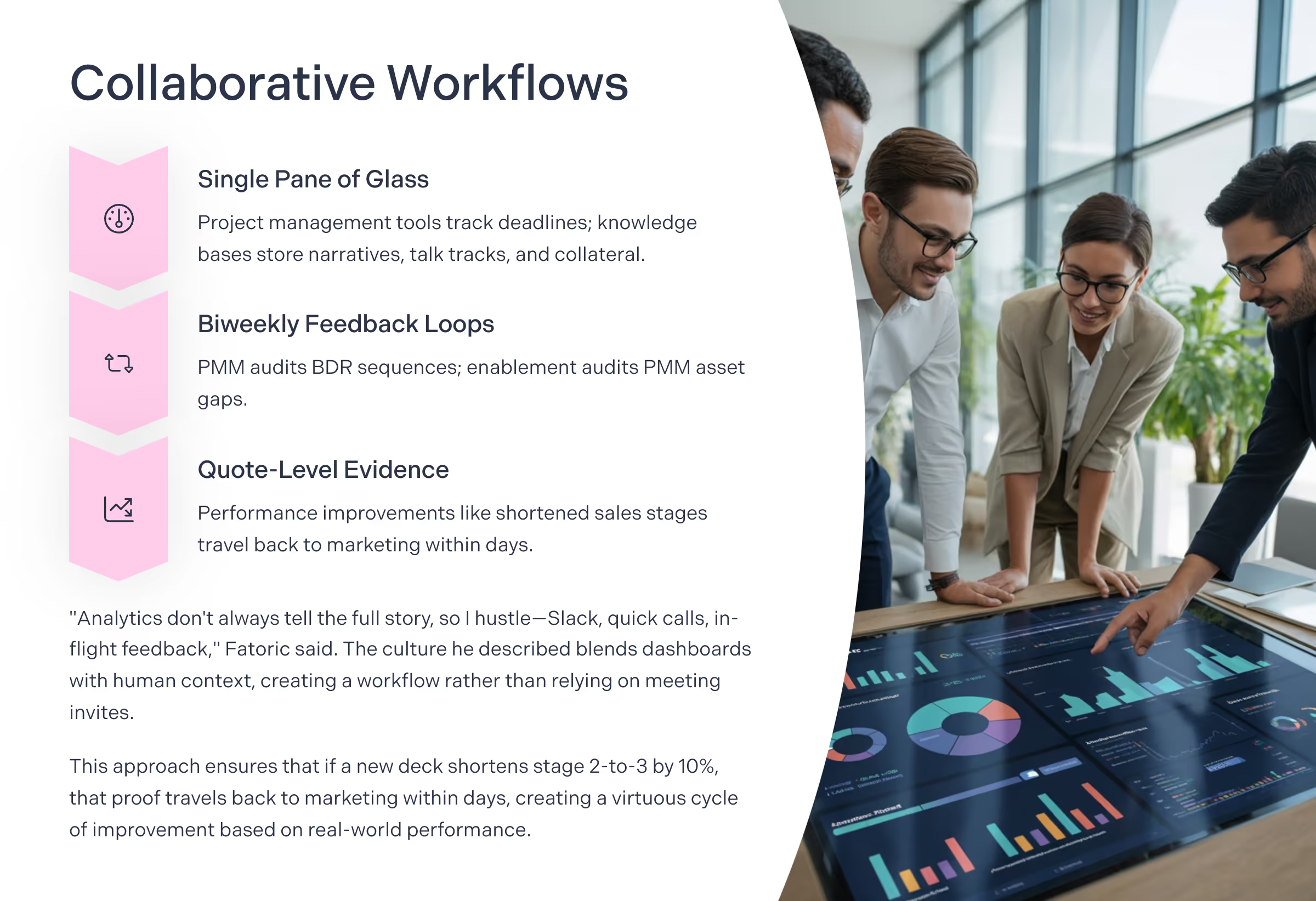
“Analytics don’t always tell the full story, so I hustle—Slack, quick calls, in-flight feedback,” Fatoric said. The culture he described blends dashboards with human context:
Middleton’s rule of three for copy:
Speed matters because AI summaries are eating clicks. Bain & Co. reports 80 % of users now resolve 40 % of searches without leaving the results page . Brands that linger at “AI-powered” fade from generative answer boxes; brands that translate capability into micro-stories get front-row placement.
Despite dashboards and algorithms, every speaker returned to a belief that relationships close deals.
Allen sees senior finance contacts relying on Bloomberg’s AI summaries yet avoiding standalone GPT tools, while younger managers use ChatGPT daily for competitive teardowns. Segmentation by buyer fluency, not just firmographics, is becoming mandatory.
Brand equity is built over years, not quarters. It compounds only when every launch, every enablement touch, and every AI workflow ladders up to a clearer promise for the buyer. The companies thriving today:
When the next downturn hits, as it inevitably will, these habits form a moat. Amazon’s “loss years” funded Prime. Priceline’s pivot funded Booking Holdings. Today’s disciplined AI-enabled go-to-market motions will fund tomorrow’s compounding advantage.
As Allen put it, turning certification into closed-won is “a force multiplier,” and that force is human-led.
Above all, people buy from brands they trust. Make every AI-assisted interaction, pitch deck, chatbot answer, follow-up email, an extension of that trust, and you won’t just weather uncertainty; you’ll convert it into equity that pays dividends long after this hype cycle cools.