



Key takeaway: Revenue enablement widens sales enablement to the teams that onboard, support, renew, and expand customers, because renewals and expansion now make up a large share of B2B software revenue and track closely with company valuations. Solutions like Spekit®, an AI-first revenue enablement platform, keep the whole revenue organization and its AI agents on one governed source of truth and deliver answers, coaching, and buyer experiences in the flow of work.
Sales enablement is the strategy and practice of giving sellers the knowledge, content, skills, and guidance they need to engage buyers and move deals forward. Revenue enablement extends sales enablement to every customer-facing team, including sales, customer success, marketing, and partners, giving each the knowledge, content, coaching, and guidance it needs to win and grow revenue across the customer journey. The methods are largely the same, which is why many companies use the terms interchangeably. The difference is scope. Sales enablement serves sellers through the close, and revenue enablement serves every team that works with customers, through onboarding, renewal, and expansion.
How do sales enablement and revenue enablement differ?
Scope drives the other differences, including the content the enablement team builds, how it is measured, and who it reports to.
| Dimension | Sales enablement | Revenue enablement |
|---|---|---|
| Primary goal | Sales enablementWin more deals, faster | Revenue enablementWin and grow revenue across the customer lifecycle |
| Who it serves | Sales enablementAccount executives, SDRs, and sales managers | Revenue enablementSales, customer success, support, implementation, marketing, and partners |
| Lifecycle covered | Sales enablementProspecting to closed deal | Revenue enablementProspecting through onboarding, renewal, and expansion |
| Typical content | Sales enablementPitch decks, battle cards, playbooks, pricing, and objection handling | Revenue enablementSales content plus customer onboarding plans, support playbooks, and renewal plays |
| Common measures | Sales enablementRamp time, win rate, deal velocity, quota attainment, and content use in deals | Revenue enablementThe sales measures plus customer onboarding time, retention, net revenue retention, and expansion |
| Typical owner | Sales enablementSales leadership, often a VP of Sales or chief sales officer | Revenue enablementOften the CRO or another revenue leader, working with RevOps and product marketing |
| Typical tooling | Sales enablementA sales enablement platform, a training tool, and a content library for sellers | Revenue enablementThe same tools shared across customer-facing teams, or one revenue enablement platform that serves them together |
In practice the line is blurry. Plenty of teams called sales enablement already support customer success, and plenty called revenue enablement still spend most of their time on sellers. Job titles mix the two as well, so a Director of Sales Enablement and a Director of Revenue Enablement can have the same responsibilities.
A skeptical sales leader could fairly say that revenue enablement is sales enablement with a customer success training track and a new name. For onboarding and training, that is close to true, since the programs look much the same for each team. The difference is in the upkeep. Once several teams rely on the same product knowledge, keeping it current for all of them becomes a large part of the job.
Why did sales enablement grow into revenue enablement?
Sales enablement grew into revenue enablement as B2B software moved from perpetual licenses to subscriptions. That transition started in the mid-2010s, when companies like Adobe and Autodesk stopped selling perpetual licenses for their main products. With a perpetual license, most of the revenue came from the initial sale, so enablement focused on the people who closed it. With a subscription, customers decide again at every renewal, and they buy more only if the product keeps delivering value. More of the revenue now comes after the first sale.
Today, the split between revenue from new customers and revenue from existing customers is approaching fifty-fifty. Benchmarkit's 2026 benchmark found that at the median B2B SaaS company, 40% of new recurring revenue came from existing customers buying more. Investors reward that revenue. In McKinsey's 2025 analysis, the most highly valued B2B SaaS companies had net revenue retention of 113%, which means revenue from their existing customers grew 13% a year without any new business. Those companies traded at nearly five times the revenue multiple of the lowest-valued companies, whose net revenue retention was 98%.
That means implementation, customer success, and support now affect company valuation the way new-customer sales always has. Everyone who sells the product and everyone who delivers it needs to work from the same facts about what it does. Promises made during pre-sales have to be delivered post-sales. Gartner wrote in 2022 that "disjointed messaging and operations across sales, marketing, service and other customer-facing roles create barriers instead of growth."
Analysts have tracked the move from sales enablement to revenue enablement for years. As early as 2020, Forrester's SiriusDecisions research described revenue enablement as "a discipline that seeks to bring the skills, knowledge, assets, and process expertise to all customer-facing roles." In June 2023, Forrester moved its research coverage of sales enablement to "revenue enablement." Peter Ostrow, who announced the change, wrote that "siloed empowerment of different customer-facing staffers is a detriment to B2B success." In November 2025, Gartner published its Magic Quadrant for Revenue Enablement Platforms, which says the market "pivots to AI-driven, consolidated platforms."
What changes when enablement serves every customer-facing team?
Serving every customer-facing team means more content and more complexity for the enablement team. The administrative work of keeping that content current grows with each team it supports.
Sales needs pitch decks and battle cards. Customer success needs onboarding plans and renewal plays. Support needs help articles, and partners need their own guides. A single product launch has to update all of it. The AI assistants these teams use to answer questions and draft emails draw on the same material, so they need the same updates.
In many companies, each team's material is built separately, stored in that team's own system, and owned by someone on that team. Sales content sits in the enablement platform, customer success playbooks sit in shared drives or the customer success platform, and help articles sit in the help desk. All of these repeat the same facts about the product. When a release changes how a feature works, someone has to find and update the demo script, the battle card, the rep training, the onboarding plan, and every affected help article. Those updates happen across several systems and several owners.
When the priority is updating sales material for new deals, the other teams' material often falls behind. Customer success may then be working from out-of-date product information, which makes it harder for them to help customers get value and renew. AI assistants answering from the same documents can repeat the outdated version.
The answer to this complexity and risk is a single system for the knowledge every team shares. Product capabilities, positioning, packaging, and pricing each live in one place, with an owner, a review schedule, and permissions that control which teams see them. Playbooks, training, and help articles can all draw on that one source instead of separate repositories that fall out of sync. One update then reaches every asset that uses it.
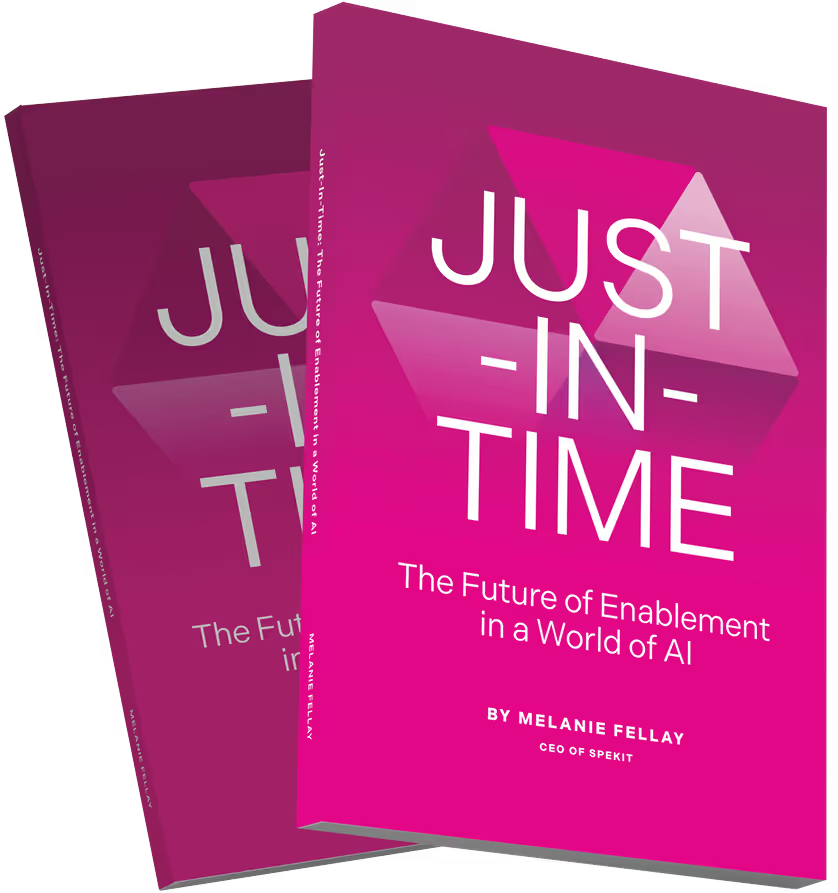
The system should also deliver that material inside the tools each team already works in. It should give AI agents the same approved knowledge that people use. A single source cuts the administrative work, so the enablement team can spend its time on programs instead of edits. In her book Just-in-Time: The Future of Enablement in a World of AI, Spekit CEO and cofounder Melanie Fellay describes how a product launch playbook built from reusable pieces "can be used to onboard new hires, train existing reps on new features, and even support customer success teams."
Which one does your team need?
Nearly every B2B company that sells subscriptions needs revenue enablement, since its customers decide at each renewal based on everything they have heard from the company, from the sales pitch to the last support ticket. Many companies begin with one role, usually sales, because that is where the enablement team, its content, and its budget already are. Starting with one role works if the leaders of the other teams agree from the start on shared product and messaging knowledge, kept on a platform all of those teams can use. Customer success, support, and partners can then be added without creating a separate copy of that knowledge for each team.
How does Spekit support revenue enablement?
Spekit® is a governed content library powered by an AI-first knowledge engine that automates versioning, conflict detection, and decay detection, and it delivers that content as Enablement in the Flow of Work® to the people on each team and the AI agents working for them. Legacy content repositories make people leave their work to search a portal. For customer success and support, that portal was usually built for sellers.
Spekit stores knowledge as Speks, its units of governed content. When a feature changes, product marketing updates the Spek that describes it once, in the GTM Knowledge Engine. The Spek already has an owner, role-based permissions, and version history, and decay detection flags it if it goes stale. Wherever that Spek is nested in other content, used in a Learning Path, or shared in an active Deal Room, the update appears automatically, so buyers see the current description as well. Files someone downloaded or exported earlier still need to be found and revised.
AI Sidekick, your AI Sales Coach, brings the current answer into Salesforce, Gmail, Outlook, Gong, Slack, and other browser-based tools, so a customer success manager preparing a renewal gets the same current description of the feature as the rep who sold the deal. Spekit MCP gives AI assistants and agents the same governed knowledge, subject to each user's permissions. Analytics show who has used the updated content and in which deals.
Scholastic's sales and customer success teams had relied on documentation stored in Google Drive, a Guru knowledge base, and PDFs. Scholastic reports that after the move to Spekit, onboarding and early ramp dropped from nearly six weeks to two weeks.
See how Spekit supports revenue enablement for people and their agents.