



.svg)
.svg)


Sales Enablement
What the Seismic + Highspot Merger Means for Enablement Buyers
What the Seismic-Highspot merger means for enablement teams: contract risk, roadmap uncertainty, and what to do over the next 18 months

What the Seismic-Highspot merger means for enablement teams: contract risk, roadmap uncertainty, and what to do over the next 18 months
Update · September 2026
Seismic completed the merger with Highspot on August 18, 2026. Seismic CEO Rob Tarkoff will be CEO of the combined company, which will operate under the Seismic name. On August 19 the US Department of Justice closed its antitrust review noting that “AI-native firms are growing quickly to win sales enablement software platform customers and are increasing competitive pressure on legacy providers.” Seismic says contracts, products, and support are unchanged for now and that it will show its first roadmap at its upcoming Seismic Shift event.
Spekit’s perspective
As the DOJ found, the pressure on Seismic and Highspot now comes from AI-first platforms like Spekit, which have fully integrated AI solutions to accelerate enablement functions and directly impact rep effectiveness and efficiency. Spekit is built on a governed content library and GTM Knowledge Engine and delivers that knowledge inside Salesforce, Gmail, Gong, Slack, and Claude, and everywhere reps and their agents work.
If you are a Seismic or Highspot customer approaching renewal, this is the time to ask which platform becomes the foundation for your enablement plans and to compare alternatives. Teams typically migrate to Spekit in about five weeks through a guided program with dedicated migration specialists, and if you are still under contract, Spekit works with switching teams to make the economics work before renewal. Read the merger explainer, or see how Spekit compares with Seismic and Highspot.
Seismic and Highspot recently announced their intent to merge. The combined entity will operate as Seismic, retaining Seismic's name, CEO, and PE ownership under Permira.
Before I share my perspective on what this means, I want to start with respect. Building two category-defining companies is incredibly hard. Seismic and Highspot played a massive role in shaping enablement as both a function and an industry. Thousands of professionals now carry "enablement" in their titles, and many careers I admire were forged because of this category. That kind of market creation takes conviction and investment that few outside the founder seat can truly appreciate.
To both teams: thank you.
This merger follows a clear pattern in GTM technology. Clari acquired Salesloft. Totango merged with Catalyst. Bigtincan combined with Showpad. Revenue technology companies built in the early 2010s are consolidating as growth slows and meaningful innovation gets harder inside their original architectures.
Seismic and Highspot were both founded in 2011. They built portal-first content management platforms that served revenue teams well for over a decade. Since the generative AI revolution, they have layered AI capabilities on top of those architectures, but the foundational model remains the same: a centralized destination where reps go to find content, complete training, and access resources outside their day-to-day workflow.
The competitive advantage of this combination is financial consolidation and defense of the customer base. Two companies with near-complete product overlap are combining balance sheets and reducing competitive churn between them. The energy and investment required to integrate two mature platforms at this scale are substantial, and history suggests they divert focus from the R&D that drives innovation.
If you're a Highspot or Seismic customer, or you're currently evaluating either platform, there are practical questions worth asking.
The first: what happens to the deprioritized platform? When two platforms with overlapping capabilities merge under one brand, one technology stack eventually becomes the foundation. If the architecture you built on is the one that gets deprioritized, that has real implications for your implementation, integrations, admin workflows, and reporting.
There is precedent here. When Seismic acquired Lessonly in 2021 to enter the LMS space, they promised a seamless seller experience. More than two years later, the platforms still required separate logins. True architectural unification of two mature platforms is exponentially harder than an integration layer.
The second question: Can your team afford to wait? Large SaaS consolidations like this often take 18 to 24 months to work out, as organizations need to bring together sales, engineering, marketing, product, and every other function. During this time, energy and investment that could have gone to customer-facing innovation are sidetracked. Roadmaps serve the merger before they serve the customer.
That timeline matters more today than it would have five years ago. AI is reshaping sales workflows in weeks. Your competitors are deploying new agent and copilot capabilities in real time. Your leadership team still expects faster growth and greater efficiency. Committing to a multi-year renewal during a period of structural transition locks you into roadmap uncertainty that is ultimately outside your control.
Large SaaS consolidations typically take 18 to 24 months to work through, while your competitors deploy new AI capabilities every week.
These practical risks for individual buyers point to a broader shift that the merger underscores. The portal-first model, where reps leave their workflow to find content, complete training, and then return later to apply it, was built for a world where products launched quarterly, and buyer journeys followed a predictable path.
That model doesn't match how revenue teams operate today. Products evolve weekly, buyer journeys are nonlinear, and reps are managing more information and tools than any training session can prepare them for. The revenue teams that win are the ones whose reps get coaching, content, context, and actions delivered directly in their workflow, in every deal, in every tool they use.
Built for a world where products launched quarterly and reps had time to train.
Coaching, content, and context delivered in every tool your reps already use.
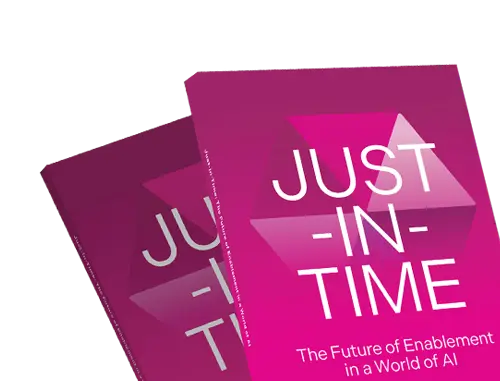
Gartner recognized this shift in their 2025 Magic Quadrant for Revenue Enablement Platforms, where Spekit was named a Visionary. I wrote about it extensively in my book, Just-in-Time: The Future of Enablement in a World of AI, including the prediction that platform consolidation among incumbents was coming. The market is now validating that thesis.
Spekit was designed as a unified platform from the start. Every capability, from our GTM Knowledge Engine to our AI Sidekick to Deal Rooms, shares a single architecture and a consistent experience. That design choice took longer to build, and it was harder to explain in our early days. But now it means that every new feature makes every other feature more useful and valuable, and that 100% of our R&D goes toward building for where the market is going: AI-powered enablement delivered in the rep's workflow.
In 2026, that investment is going toward the problems legacy platforms can't prioritize during integration cycles, and customers are already seeing the results: 75% faster ramp times and 90% reductions in the time reps spend hunting for content. We're building the content and knowledge infrastructure that ensures both your team and your AI tools work from the same accurate, up-to-date foundation. Our AI coach understands the deal a rep is working on and delivers relevant guidance in the moment, inside the tools they already use. And we're investing in deep interoperability so that Spekit makes your entire revenue stack more valuable.
Whether you're a current Seismic or Highspot customer working through this transition, a prospect midway through evaluation, or a revenue leader investing in enablement for the first time, this is a good moment to take stock. The category matters more than ever. The question is whether to invest in the architectural approach from 2011 or the one built for where revenue teams are headed.
We'd welcome the conversation.
For current customers, the biggest near-term impact is uncertainty around product roadmap, support continuity, integrations, and long-term platform direction. While both platforms may continue to be supported in the short term, customers should expect questions around which architecture will become the long-term foundation and how that could affect daily workflows, reporting, and future migrations.
Enablement buyers should ask which technology stack will become the long-term platform, how AI capabilities will evolve, what happens to existing integrations and reporting, whether customer success ownership will change, and what contract protections are available. They should also ask for clear timelines, data egress rights, pricing protections, and specifics on how the merger will affect reps in their day-to-day workflow.
Large SaaS platform mergers often take 18 to 24 months or longer to fully integrate. That timeline can affect product innovation, customer support, feature delivery, and the overall user experience. For enablement teams, that means the next 18 months may involve slower roadmap progress and less clarity on the future state of the platform.