



Key takeaway: Sales messaging becomes inconsistent when an organization cannot agree on one consistent message, or when the people who deliver it cannot access it consistently. For example, the message changes faster than teams update the assets reps use. Reps repeat messaging from memory rather than the current approved version. Teams work from copies of assets and content that drift apart. AI assistants draft from a different source than the reps. The best way to keep sales messaging consistent is a unified, governed system for go-to-market knowledge that holds the approved message once and delivers it to reps and AI agents in their flow of work. Solutions like Spekit®, an AI-first revenue enablement platform, store approved messaging as reusable Speks and deliver it in the flow of work, to reps and their AI assistants.
Sales messaging is the language go-to-market teams use to communicate about the company and its products to customers and prospects. It may include positioning, value propositions, proof points, competitive claims, pricing language, and product names and definitions. Reps use it in calls, emails, decks and digital sales rooms, including drafts written with AI. Marketing, customer success and partners use the same message, so inconsistency reaches beyond the sales team.
What does consistent sales messaging mean?
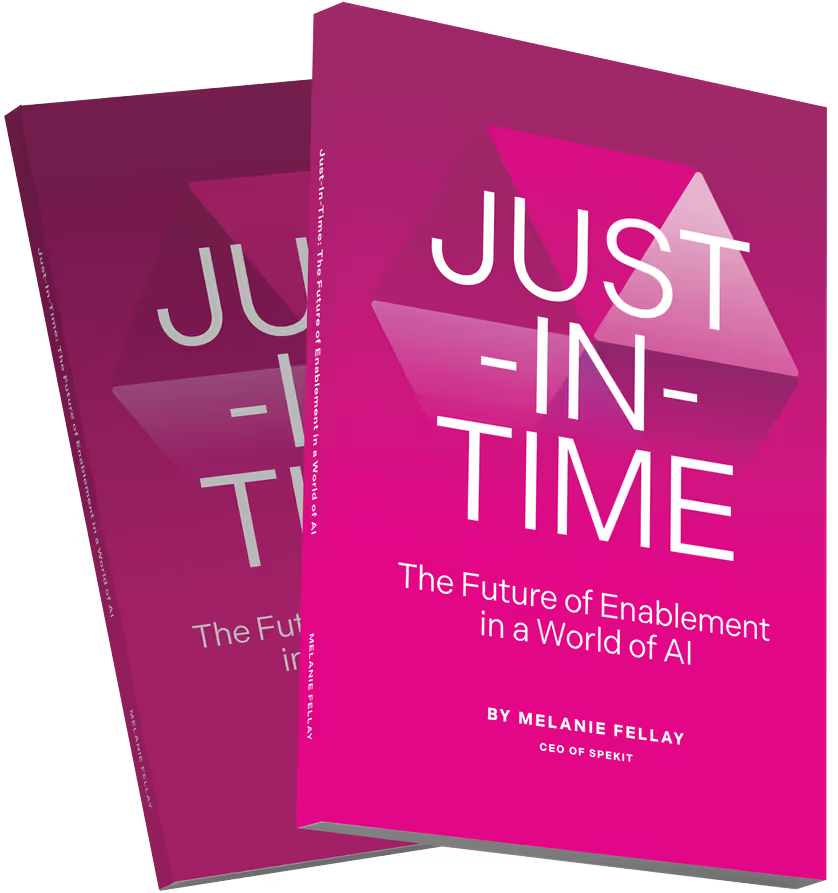
Sales messaging is consistent when every rep, team and channel makes the same approved claims about the product, its value and its price. It does not mean every rep sends the same generic asset to every buyer. The claims stay fixed while the rep adapts the problem they lead with, the proof point and the words. In Just-in-Time: The Future of Enablement in a World of AI, Spekit CEO Melanie Fellay writes that one case study for every prospect, regardless of industry or size, "may even send the wrong message".
What causes inconsistent sales messaging?
Inconsistent sales messaging comes from the lack of a centralized, governed source of approved go-to-market knowledge, including the messaging itself. It also comes from the lack of a way to make sure customer-facing teams access and use that source consistently.
- Misalignment between teams. Marketing, product marketing and product each write their own version of the message. Misalignment between sales and marketing leaves sales with little input. Reps and leaders then rewrite the message in words they believe work better. Unclear positioning makes those rewrites more likely.
- Copies that fall out of sync across many places. The message lives in decks, drives, chat channels and battle cards, with no single approved source. Each copy is updated on its own schedule, or never. Growth multiplies the copies as new regions, products and acquired teams adapt the story. AI assistants add more versions when they draft from whatever content they can reach.
- Constant change and churn in the message from many sources. Product, pricing, competitors and positioning change all year. A new product gets a launch, but a revised competitive claim or a new price often gets an email or nothing. Those changes stack up until the content reps use is out of date.
- Messaging taught in one place and used in another. Launch sessions and kickoffs set the message well, but reps use it for months afterward, when the details have faded. Melanie writes in Just-in-Time that reps who can't find the approved content in a time crunch "resort to outdated resources" or "rely on their fuzzy memory". Managers often keep coaching the version they learned at launch, even after the message changes.
How do you fix inconsistent sales messaging?
To fix inconsistent sales messaging, unify and centralize the message and deliver it to reps in their flow of work. Make the message easy to keep updated, and make every change to the source propagate everywhere the message is used.
- Identify the most critical messaging gaps, so you can focus on those first. Pricing, competitive claims and the core value proposition usually carry the most risk. Compare recent calls, emails and decks with the approved version of each, using call-recording reports or a hand-read sample. A message with no approved version at all is the first gap to close.
- Agree on one core message, built with sales input. Use win-loss evidence and rep feedback, so reps do not rewrite a message that never fit their conversations. Write down which claims stay fixed and where reps adapt the story to the buyer. A small company can do this in a few sessions, and a large one phases it by business unit.
- Unify all messaging on one governed platform. Such a platform holds each claim once and reuses it inside battle cards, playbooks and training. A change to the source then updates every place the claim is reused. Each claim has an owner who keeps it current. AI tools that draft from the approved claims, for review, help keep each new asset and each update on the current message. A team without such a platform can keep the message in one shared, owned document linked from everywhere. Copies made from that document still have to be found and fixed by hand.
- Deliver the message where reps work. Reps are most likely to use the approved claim when it sits inside the CRM, the inbox and the call tool. Announce each pricing or competitor change in those same places, as a small rollout rather than another email.
- Size formal training, kickoffs and messaging documents to the change. These remain an important part of the mix, but they are not sufficient on their own. A new positioning may deserve a launch session and a written messaging guide. A new price or a revised competitive claim reaches reps as an update at the moment of use.
- Coach and reinforce the current version. Managers review real calls against the current claims and coach the errors that recur. Short knowledge checks show which claims reps still get wrong. Melanie writes that leaders should repeat key messages often after kickoffs.
- Connect AI assistants to the same source as the reps. Every assistant that drafts emails, summaries or deck text needs live access to the approved claims.
- Measure and refresh. After each change, compare calls and emails with the approved version to see which teams still use the old claims. Review the full message on a regular cadence as well.
How do you keep AI-written sales emails on message?
AI-written sales emails stay on message when the AI assistant or agent is connected live to the same governed source of approved messaging that the reps use. Emails are one example. The same rule applies to every piece of sales copy an AI drafts, such as call summaries, proposals, deck text and digital sales room content. An assistant without that connection cannot tell a current claim from a retired one, so it repeats retired claims at scale.
Pasting approved claims into prompts, project files or templates does not solve the problem, because each one is a copy. A copy goes out of date the moment a price or a competitive claim changes, while the assistant keeps using it with confidence. Humans and agents have to work from the same context. The agent has to read that context live, at the moment it writes the draft.
That takes a system that provides the approved source and delivers it in a form AI can consume. Spekit MCP connects AI assistants to the same Speks the reps use, so an assistant reads the current approved claim rather than a saved copy. An assistant that a team builds on a folder of exported documents has the same problem, because exported documents are copies.
What is the best way to keep sales messaging consistent?
The best way to keep sales messaging consistent is a unified, governed system for your go-to-market knowledge that delivers answers to reps and agents in their flow of work.
Keeping the message in one place makes it easier to control than a message spread across decks, drives and inboxes. Centralization alone still produces a collection of assets, and a collection drifts out of sync. Governance gives each claim an owner, a version history and permissions, so there is one clear source of truth. AI creation lets new content start from the approved message. With AI, the message is also easier to update when a price or a claim changes. Analytics show the owners which content is used, which reps have seen a change and where the gaps are.
Delivery is the most important advantage, because a system that only stores the message leaves reps and AI assistants to find their own answers. A system that delivers the current answer inside the CRM, the inbox, the call tool and the LLM gives reps and agents the approved claim at the moment they need it. Spekit is a great example of a platform like this.
How does Spekit keep sales messaging consistent?
Spekit® is an AI-first revenue enablement platform built on a governed content library. It delivers that content as Enablement in the Flow of Work®. Content in Spekit is stored as Speks, units of governed content that define the information in the system. A Spek can be a battle card, a pricing statement or a competitive claim. It can be reused inside other Speks, Learning Paths and Deal Rooms, Spekit's digital sales rooms. Because content is reused instead of copied, updating a Spek updates it wherever it is nested or reused. Sent emails and exported decks do not update and need their own review.
New content can start from the current Speks instead of an old deck. AI Content Builder drafts battle cards, launch kits and training from existing Speks, Gong transcripts, PRDs and Drive files, for review. Owners can use the builder to update existing content when a source changes. Authors who write by hand start from their team's templates. When an author starts writing, Similarity Detection suggests existing content to update instead of adding a copy.
AI Sidekick brings knowledge directly into reps' flow of work. Reps ask questions, draft messages and find content from those Speks inside Gmail, Salesforce, Gong, LinkedIn and Slack. Embedded Enablement attaches positioning to Salesforce fields and stages. Spotlights announce changes to prices and competitive claims as in-app alerts.
Spekit MCP delivers all of that knowledge, its answers and brand guidance to any LLM a team wants to use. Assistants such as Claude, ChatGPT, Copilot and Glean work from the same Speks as the reps.
Analytics show which reps have reviewed updated messaging and which content is used. Owners then see where a change has not landed. They also choose which messaging to promote from the content that correlates with closed-won deals in Salesforce.
See how marketing teams use Spekit to put the approved message into every deal on the marketing solutions page.