












Marketing Content Management
Product Marketing Trends for 2025 and Beyond
PMMs are now strategic, but overwhelmed. Discover how AI-powered enablement helps marketers scale impact, reduce burnout, and drive real revenue.



PMMs are now strategic, but overwhelmed. Discover how AI-powered enablement helps marketers scale impact, reduce burnout, and drive real revenue.
If you’re a product marketer in 2025, odds are you’re stretched thin, strategically vital, and quietly burning out.
The 2025 State of Product Marketing Report from Product Marketing Alliance confirms what most of us already knew: product marketing is no longer a support function, it’s a strategic growth engine. And while that shift should feel like a win, most PMMs are left managing more responsibilities than ever, without the team or tools to keep up.
Let’s break down what’s really happening behind the slides and strategy decks and how modern product marketers are adapting.
A few years ago, product marketing lived in limbo. You weren’t quite product, not quite marketing. You launched things, updated messaging, enabled sales, and quietly kept the business running.
That’s changed.
In 2025, 41% of companies now identify as product-led, up from just 31% in 2024. With that shift, PMMs have become critical to translating product value into revenue. You’re now expected to:
And finally, leadership is paying attention. According to the report, 69% of PMMs are now part of leadership conversations, up from 66% last year. Tom Crist at Fluvio puts it this way:
“What follows a multi-year focus on revenue retention and monetization during a downturn? A return to product as the center of value delivery.”
PMMs are no longer the forgotten middle. You’re the linchpin of growth.
But there’s a catch.
While PMMs are being elevated, teams aren’t growing at the same pace. In fact, 44% of product marketing teams still consist of just one or two people. Yet your responsibilities have exploded:
Aliona Margulis, Senior PMM at Satisfi Labs, summed it up:
“The role is expanding beyond just launches and messaging to cover more strategic areas that impact growth and customer success.”
You’re no longer just launching features, you’re maintaining the systems that support them across the full customer lifecycle. That includes:
The moment a feature changes or a competitor updates their pricing, half your content is suddenly out of date. This is the hidden tax of being strategic and tactical at the same time.

Modern PMMs don't need another bloated enablement platform, they need systems that scale their knowledge without adding to their workload.
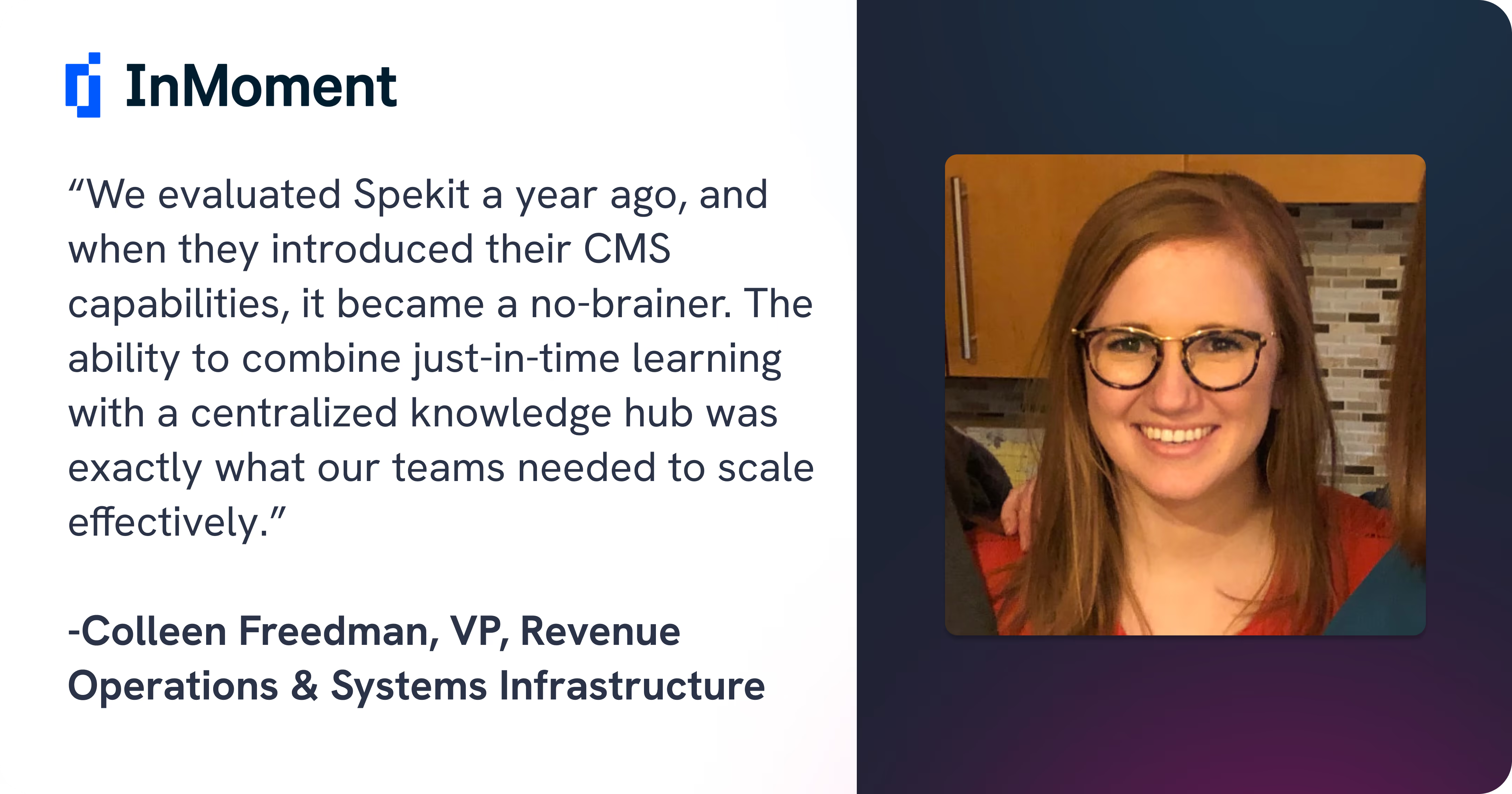
InMoment faced a fragmented knowledge ecosystem post-acquisition, with a failing CMS and siloed information. Jenna Siegel, Senior Director of Revenue Enablement, sought a solution that integrated knowledge, content, and messaging into daily workflows. Spekit provided just that, combining just-in-time enablement with a powerful CMS.
"We were deploying training, but we weren’t reinforcing it. Our reps weren’t going back to the LMS, and our CMS was too messy to be useful. We needed a system that made knowledge part of everyday workflows."
— Jenna Siegel, Senior Director of Revenue Enablement at InMoment
The results were transformative:
At Q4, Richard Thibault, Head of Revenue Enablement and Training, experienced similar challenges with clunky knowledge management systems. After implementing Spekit, Q4 saw a 3× ROI from usage and productivity improvements, a 30% drop in ad-hoc questions to managers, and more than 4,000 hours reclaimed per quarter.
"We tripled our self-serve engagement, which was the goal. But what I didn’t expect was how much it freed up my team to focus on strategic work." - Richard Thibault, Head of Revenue Enablement at Q4
These stories highlight the shift PMMs need: from being reactive content managers to strategic enablers driving impact across the organization.
The problem isn’t just that PMMs create content. It’s that they own living content, which means every change triggers a ripple effect:
Without the right product marketing tool to manage this at scale, PMMs become the single point of failure. You’re stuck in reactive mode, not strategic mode.
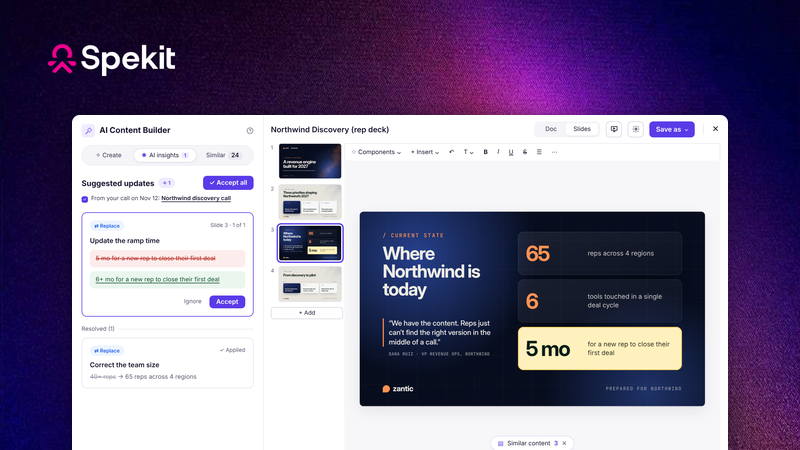
This is where AI-powered enablement platforms make the difference. They don’t just store content, they sync, surface, and adapt it in real time.
And they don't rely on reps finding the right doc. They deliver the right answers or recommend the right content exactly when and where reps need it.
PMMs are often called the glue between teams. But let’s be real: glue isn’t scalable.
According to the 2025 PMM report:
As Charlotte Davies, Product Marketing Leader at Meta, noted:
“Product expects us to be market experts, and sales expects us to have the detailed technical product knowledge of entire teams of PMs.”
You’re the bridge. The interpreter. The single source of truth.
And when you’re operating from disjointed tools, slides, Slack threads, outdated wikis, that makes you the bottleneck too.
Forget the hype about AI writing your messaging. The real value for PMMs is automation and orchestration.
In the 2025 BOND AI Trends Report, enterprise AI adoption is focused less on cost-cutting and more on driving growth and accelerating revenue. Companies aren’t asking: “Can AI replace marketing?” They’re asking: “Can AI unblock sales?”
That’s where Spekit’s approach to just-in-time enablement comes in:
This is AI that enables your go-to-market strategy - not another copilot that generates fluff.
PMMs are under pressure to prove ROI, but 13% of orgs don’t even track PMM-specific KPIs. And 33% of PMMs have no dedicated budget.
That’s why top PMMs are adopting tools with built-in analytics to prove impact:
Spekit, for example, helped teams measure how fast new reps found answers, how often enablement content was used, and where deals were getting stuck. Those insights drive smarter content, not just more content.
They’re not trying to do more with less. They’re refusing to do everything manually and ensuring that what they do create is measurable, accessible, and impactful.
According to the 2025 PMA report, investments are shifting to:
These aren’t just software purchases. They’re scaling strategies.
They allow lean PMM teams to:
You know your product. You know your customer. You've created awesome content. But the value of all that disappears if it’s disconnected from the seller's workflow or buried in content repositories nobody has time to sift through.
Spekit helps PMMs turn product knowledge into repeatable, scalable revenue impact.
"We’re not replacing PMMs, we’re giving them their time back and multiplying their impact," said Melanie Fellay, Spekit CEO and author of Just-in-Time: The Future of Enablement in a World of AI.
In a world where content decays overnight and GTM strategies shift weekly, PMMs need more than collaboration. They need enablement infrastructure that scales with them.
So, here’s the question:
You’ve become the most strategic function in the org. Are your systems keeping up?
Let’s talk about how Spekit helps PMMs like you scale your impact, without scaling your burnout.