



.avif)
Two of the largest names in sales enablement are becoming one. In February, Seismic announced a definitive agreement to merge with Highspot. If you work in enablement, you probably had the same reaction as Lisa Tricarico, the Manager of GTM Readiness at Justworks: wait, why?
Spekit CMO, Ian Lowe, and Lisa were recently on the main stage at the Sales Enablement Summit in NYC, talking about the gap between what companies spend on enablement and what reps actually get out of it. That conversation hit a nerve.
So they picked it back up, this time in a live webinar exploring what the merger signals, what the broader pattern of consolidation tells us about the future of enablement, and what happens when two legacy platforms combine under PE ownership.
Lisa brings a perspective most panelists can only theorize about. She spent three years running Highspot at Justworks before migrating her entire team to Spekit in under two months. She knows what the portal model looks like from the inside and what it looks like to leave it behind.
Read on for what came out of the conversation or catch the full webinar on-demand here.
The merger didn't happen in a vacuum
The Seismic-Highspot merger is the latest, and most high-profile, in a string of consolidations across enablement. Over the past two years, MediaFly acquired Appinium. Clari and SalesLoft joined forces. A private equity firm brought BigTinCan and Showpad together under one roof. And now, two companies that, between them, have raised over a billion dollars in venture capital are combining operations. That pattern matters.
These are two of the most well-capitalized companies that enablement has ever produced. Seismic, founded in 2010, has raised over $440 million. Highspot, founded a year later, has raised north of $650 million. Both built massive customer bases. Both helped define what the category even means.
"They were such leaders in the game. Why do they have to now merge? Why can't they thrive on their own? Those are the questions I started having," said Lisa.

What's actually driving this?
There's a temptation to read every merger as a sign of weakness. That's too simple. Both companies built real products and delivered real value to thousands of customers over more than a decade. The more honest read is that the economics of competing head-to-head (at their scale, at their valuations, in a market that's shifting underneath them) started working against both.
Seismic brought in a new CEO from Oracle, Rob Tarkov, just before the announcement. Seismic's name, CEO, and private equity firm are carrying forward. And Highspot's roughly 1,000-customer base is now folding into that structure. That sends certain signals about where the go-forward technology platform will land, though the official line remains that both platforms will continue to be supported.
But when you have two companies with overlapping CMS capabilities, overlapping LMS capabilities, overlapping analytics capabilities, how long does dual support last before someone has to make hard choices?
Ian walked through what the first 12 to 24 months after a merger like this typically look like: the first phase is organizational restructuring (who owns what accounts, how do support teams reorganize, how do you communicate continuity to customers). Months six through twelve shift toward integration priorities, where engineering bandwidth splits between building the existing roadmap and building the integration. That competition for resources is real. And in the year after that, structural decisions start to land: migration paths, feature rationalization, and pricing dynamics that shift because the head-to-head competitor that used to push both companies on price and service is gone.
There's a precedent here, too. Seismic acquired Lessonly a few years ago, and it took meaningful time to fully integrate that into the stack. That was one acquisition. This is two platforms of comparable scale trying to merge everything.
Forrester flagged the risk of bifurcation when analyzing similar deals. Gartner published a publicly available note warning customers to expect slower innovation and to be cautious about long-term commitments during the transition. Both analyses are measured, pragmatic reads of what happens when large technology stacks with significant overlap try to become one.
“Both platforms in the press release were talking about both being supported moving forward. But what does that really mean when there's so much overlap in the technology stacks?," said Ian.

The real story: the foundations are shifting
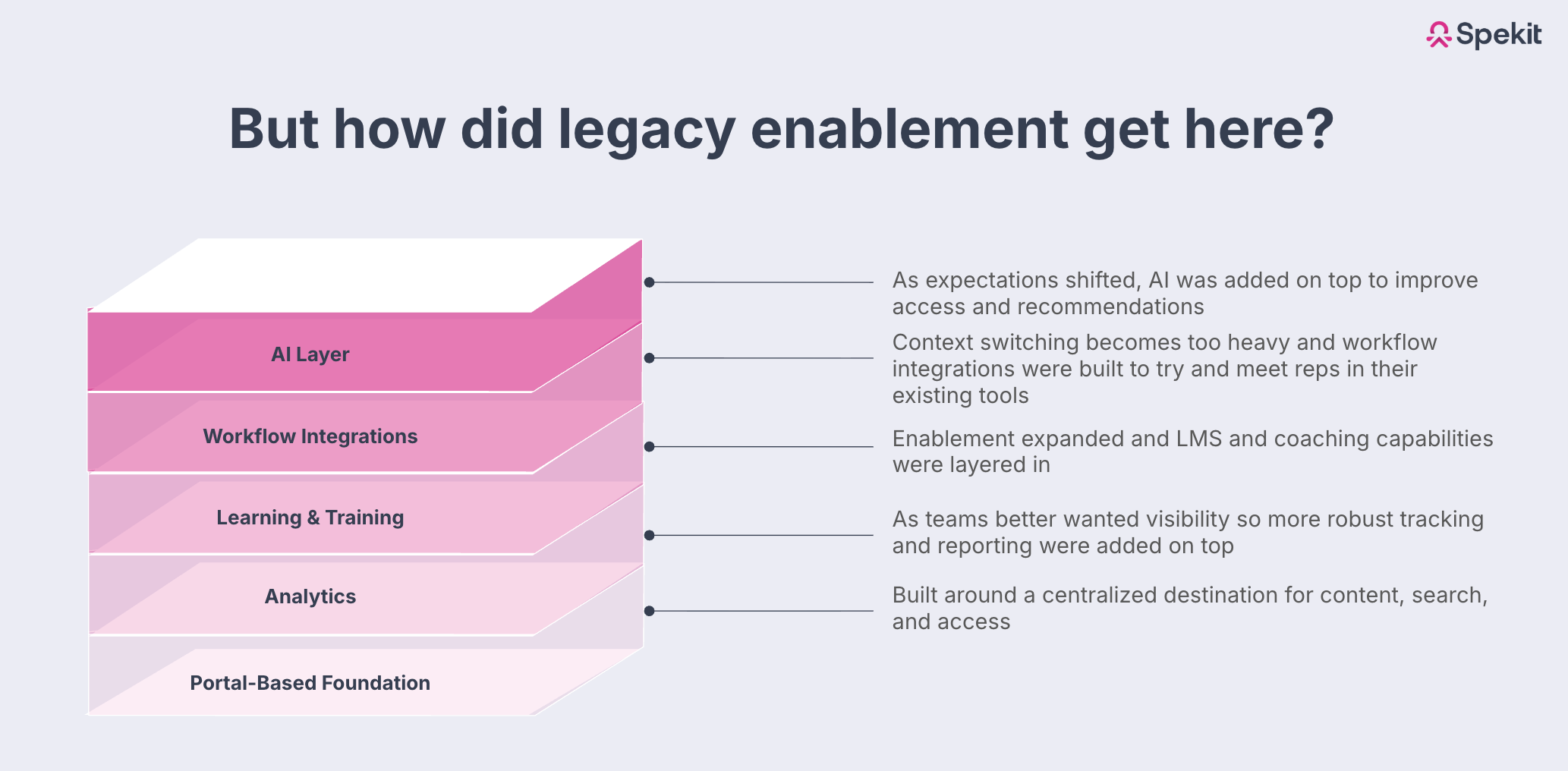
Mergers are symptoms. The deeper issue is that the way reps consume information has changed at a structural level, and the platforms built a decade ago haven't kept pace.
Five shifts came up repeatedly during our conversation:
1) Product velocity is outrunning enablement: Engineering teams using AI are shipping features in weeks, not quarters. Lisa described a product launch at Justworks that happened in three weeks, unheard of for their team. That speed means enablement has to move just as fast. Lisa was honest about her own evolution here: her initial approach was always "take this e-learning course, then join this workshop, then do a certification." She'd pull reps off the floor for two to three hours a month. With the current pace of launches, that model broke. There's simply no time.
2) Everything lives in the browser now: Chrome won. Every tool your reps use (CRM, email, call intelligence, outreach) runs in a browser tab. That means enablement no longer needs to exist in its own silo. It can meet reps exactly where they work. The platforms that figured this out early built for a completely different architecture than those that started with portals.
3) 65% of sales content consistently goes unused: This stat has persisted for years, and the reason hasn't changed: if finding the right content requires reps to leave what they're doing, navigate to a separate platform, search through a taxonomy someone else built, and hope the result is still current, most of them will just ping Slack instead. Lisa laughed at this one. "We are still moving our teams off of trying to lean into Slack," she said. "It becomes the easy way. The path of least resistance. But it shouldn't be the solution."
4) AI is enabling entirely new modalities: The ability to proactively surface the right information at the right moment (what we call just-in-time enablement) only became possible recently. And it requires AI built into the architecture from the ground up, which looks very different from AI layered on top of a legacy content repository.
5) Content requirements are exploding: More products, more competitors, more messaging changes, more process updates. The volume of content that enablement teams need to create, govern, and distribute has skyrocketed. Without infrastructure that helps manage freshness and accuracy at speed, content decay becomes a trust problem.
As Lisa put it, “they were super innovative at the time when they founded. But they kind of grew, and then other people came into the game and started to think differently about how to approach enablement. And they didn't make that shift as quickly as maybe they should have."

What the "search and find" model misses
Lisa's story about her time on Highspot is worth examining closely. Highspot is a real product with real capabilities. What Lisa ran into was a structural limitation, the kind that no amount of feature additions can fully resolve.
When she inherited Highspot at Justworks, usage was low. She attended a QBR where the vendor itself surfaced the adoption numbers, and the picture wasn't good. Reps weren't using the platform the way it was designed to be used. The content was there. The tagging was there. But the fundamental problem remained: reps had to leave what they were doing and go somewhere else to find what they needed.
She described it this way: the platform was functioning as a document-sharing tool for externally facing content. Not a knowledge base, coaching engine, or integrated part of the daily workflow. A file repository that happened to have analytics.
When Lisa started evaluating alternatives, she went back to Highspot first and asked a fair question: do you have anything that works more like in-workflow guidance? Their answer was that they could add a tile in Salesforce.
"I was like, okay. We don't need anything else in Salesforce. This still isn't going to resolve the problems that we have,” she said.
That response captures the architectural constraint. When your platform is built as a portal, even the best integrations still route you back to the portal. A Salesforce tab that opens the same content library in a different frame doesn't change the fundamental motion. The rep is still being asked to stop, go find, and come back.

The "suffocating in change" problem
There's a feedback loop that nobody's talking about enough.
AI is making product and engineering teams two, five, ten times faster. That means go-to-market teams need to absorb more changes more frequently. But those same reps are already at capacity managing their pipelines, following sales methodology, learning new talk tracks, and adapting to new tools.
The old enablement motion runs into what amounts to a brick wall: broadcast a Slack message, send an email, hold office hours, run a workshop. Reps hear the bullhorn. They just can't process what it's saying because they're in the middle of the work.
Despite all the investment in technology and AI, the core metrics haven't moved much. Win rates have crept from 28% to 30% over the past three years. Reps hit quota only 46% of the time. Average annual growth rates sit around 16%. The industry is pouring resources into rep enablement and watching the needle barely twitch.
Why? Because we keep approaching new problems with old architectures.
"We had to make the switch of how can people get the information they need. That means the right audience, right time, and right message because of the velocity of change," she said.
What changed when enablement moved into the workflow
Lisa's migration story addresses the question every enablement leader asks: Will reps actually use this?
Justworks signed with Spekit in October. Lisa was literally on her way to a Sabrina Carpenter concert when the deal closed. The team had roughly six weeks to build out the platform and go live before the December 15th target. Not months of planning or a phased rollout but six weeks, start to finish, including the holidays.
Was there a behavior change required? Yes. Lisa was candid about that. Even though the Spekit Sidekick sits directly alongside the tools reps already use, some team members, particularly tenured reps, needed reminders and refreshers. That's normal adoption curve territory.
But here's what shifted operationally: the team stopped relying on Slack as the default channel for knowledge sharing. Within three months, Lisa's team had logged over 4,000 Sidekick conversations and more than 7,000 content views. She started seeing reps redirect each other. Someone would ask a question in the sales Slack channel, and a colleague would respond with a Sidekick screenshot showing the answer was already there.
The behavior change spread beyond reps. It changed the entire organization. Instead of saying "go to Confluence to find the update," department leaders started saying "go ask Sidekick." The platform became the default reflex, not the workaround.
Lisa also pointed to a capability that scaled value across her org: team-level content personalization. Justworks has over 20 customer-facing personas. Account executives see different content than customer success managers, who see different content than sales specialists. The foundational knowledge is shared, but the context-specific material (like Salesforce selling stages) only shows up for the people who need it.
Spekit's integration with Confluence and Google Drive means that content updates sync automatically. Lisa no longer has to worry about reps working off a stale one-sheeter that was uploaded six months ago. When the source document changes, the version reps see changes with it. For a team moving as fast as Justworks, that kind of governance happening automatically is critical their ability to scale.
"It takes out the guesswork for them. It gives them the answers they need when and where they need them," she explained.
One attendee, Denny, dropped a note in the Q&A that captured the adoption dynamic well: "I'm not new to Spekit. Love it. And the more people who use Sidekick, the faster they adopt using it." That flywheel effect, where usage drives more usage, is exactly what Lisa was describing.
"I've seen people ask questions in sales Slack and someone else saying, you can find that in Spekit. It's teaching people how to use it. And our data shows fewer Slack questions and more questions in Spekit,” she said.
The four things any enablement solution needs to solve right now
Whether you're buying a platform, building your own, or stitching together Glean and Copilot and hoping for the best, the conversation kept returning to four non-negotiables:
1) Be everywhere the rep is, all the time: If you're not in the deal with the rep, they're going to scramble and try to recall from memory. The content, the coaching, the context needs to be present wherever they're working. Not waiting in a separate tab.
2) Be proactive, not passive: Reactive enablement relies on the rep knowing they should ask a question. Proactive enablement reads the signals: what stage is this deal in, what email are they drafting, what call are they prepping for. And it pushes the right material forward before the rep even thinks to look.
3) Build semantic understanding of your go-to-market: This goes beyond content management. It means the system understands what a competitor is, what your products do, what objections come up at each stage, and organizes information around those concepts.
4) Generate and govern content dynamically: Static content decays. In a world where products launch in three weeks and competitive landscapes shift monthly, you need infrastructure that enables you to create, update, and retire content at the speed your business demands.

What to do if you're navigating this right now
Whether you're a Seismic customer, a Highspot customer, or someone evaluating both, the conversation surfaced some practical guidance:
If you're approaching a renewal, you have more negotiating power than usual. Any vendor going through a merger wants to minimize customer churn, which means there will be pressure and incentives to lock you into multiyear commitments.
If you're mid-contract, use the time to start parallel evaluations, understand what your data portability looks like, and get a sense of what's available in the market today, even if you're not ready to move. The enablement landscape has shifted meaningfully, and the answer to "what does state of the art look like?" is different now than it was even two years ago.
If you're evaluating fresh, recognize that market conditions have changed. The innovations that made Seismic and Highspot category-defining in 2010 and 2011 served a specific moment in how businesses operated. The tools, the architectures, and the expectations are different now.
Lisa closed with advice that applies whether you end up staying or moving:
“Go in there with your list of questions. Compare the different vendors on the same questions. Make sure you're finding the solution that really meets your needs. At the end of the day, it's about making the right decision for you, your company, and the employees you're supporting,” she said.
The bigger picture
This story is about a category that's outgrown its original architecture.
Seismic and Highspot both built platforms that defined what enablement could be in 2010 and 2011. That contribution is real, and it matters. Those platforms served their era well. The question is whether combining two portal-based systems produces something different enough to serve the next era or whether it produces a larger version of the same thing.
In Just-In-Time: The Future of Enablement in a World of AI, Spekit CEO and founder Melanie Fellay predicted this wave of consolidation, writing that enablement solutions built through bolt-on acquisitions and feature wars produce different outcomes than platforms designed around a unified content experience from the start. That argument has only gotten sharper since the book came out last year.
The last question from the live audience asked how realistic it is that the merging companies will be transparent about what's changing. The honest answer? You'll have to ask them and judge for yourself. But you don't need to wait for their answers to start asking better questions about what your reps actually need right now.