












Sales Enablement
How to Improve Sales Rep Performance in 2025
Sales performance isn’t a knowledge problem, it’s a recall problem. Learn how to improve sales rep performance with timely, contextual reinforcement.
Updated
September 3, 2026


Sales performance isn’t a knowledge problem, it’s a recall problem. Learn how to improve sales rep performance with timely, contextual reinforcement.
Memory under pressure is fickle.
It doesn’t care how solid your onboarding was or how polished your playbook is. In the heat of a live call or a high-stakes email, even top performers sometimes forget the pitch, the next step, or the resource that could’ve moved the deal forward.
…not because they’re careless, but because they’re overloaded.
In her book, Just-In-Time Enablement, Melanie Fellay, Spekit CEO, writes:
“Employees are expected to complete modules in advance, detached from real-world situations where they’ll need to apply their learnings. Such training leads to information overload, low retention, and a disconnect from the immediate challenges that employees face. Why cram for a final exam when the real test is happening right now, in the trenches?”
Sales isn't a knowledge game. It's a recall and execution game. So, you can only improve sales rep performance when reinforcement is timely, contextual, and consistent, as reps juggle competing priorities and fast-moving deals.
To identify what needs reinforcement, consider three core factors:
If any one of these is missing, performance suffers. The good news? Each one can be strengthened with simple, intentional shifts.
Here’s how to improve your sales team’s performance by reinforcing the right things at the right time:
From coaching to closingWhen vague expectations like “hit your quota” are the only directive, reps default to whatever feels familiar, even if it’s inefficient or misaligned. They might chase the wrong deals, rush through discovery, or inflate deal forecasts.
To fix this, give reps precise, visible markers for success:
Instead of telling reps to “build more pipeline,” break it down into trackable sales performance metrics:
These specifics help reps prioritize the right activities and give managers a clearer view of pipeline bottlenecks.
This could be a one-pager or interactive Spekit card that includes:

A visual, step-by-step layout gives reps something to reference quickly in the flow of work.
For example, if you’ve launched a new product or shifted to mid-market, your “healthy pipeline” benchmarks may need to reflect:
Bake these updates into team meetings, refresher training, or inline tools so the entire sales team stays aligned.
💡Pro tip: Use Spekit to embed these definitions directly inside Salesforce (or other CRMs), so reps see them right when they’re updating deals or prepping for a call. This in-the-flow visibility makes expectations harder to forget—and a lot easier to follow.
Not every rep struggles in the same way. One may run a brilliant discovery call but freeze during negotiations. Another might shine in demos but consistently drop the ball on follow-up. But diagnosing them doesn’t have to mean sitting through hours of call recordings or performance reviews.
Quick, focused conversations, done regularly, can surface a lot more than you’d expect.
During the debriefs, ask three questions:
As you collect answers, watch for recurring issues across the team. For example:
Tracking these themes helps you tailor your coaching to the team's actual needs, not just what’s in the enablement calendar.
Use top-performing reps as models for the rest of the sales team. For example:
Giving reps concrete examples of what “great” looks like can be more impactful than another workshop or slide deck.
In Just-In-Time Enablement, Melanie Fellay explored the forgetting curve, a diagram developed by psychologist Hermann Ebbinghaus:

This curve describes the natural tendency for people to forget what they learned over time when there’s no active effort to retain it. It shows that a significant amount of information is forgotten shortly after it is learned, with the greatest loss occurring in the first few hours or days.
“Traditional training methods like LMS courses—or even expensive events like your annual sales kickoff—often fall victim to this. They dump a large amount of information on learners only to have it vanish soon after because it’s never reinforced or revisited,” Melanie wrote.
The key to fixing this isn’t more training—it’s smarter placement. Reps need reminders that show up in context, right when they’re doing the work.
Here’s how Spekit makes that possible:
Instead of repeating the same advice, like how to write a compelling follow-up email or handle pricing objections, turn it into a Spek that appears as a quick tip right where the rep is working.

For instance, if a rep is logging a call with a new prospect, a tooltip can appear with bullet-point reminders on how to write a crisp, value-led follow-up. In Slack, drop those same Speks into team channels when themes come up in conversation, turning coaching into a shared, searchable resource.
Spekit triggers real-time prompts the moment a rep takes a key action. For example, if a rep moves a deal from “Discovery” to “Proposal” in Salesforce, Spekit will trigger a checklist with reminders like:
These timely nudges reinforce process consistency and reduce errors that often slow deals down or require manager follow-up.
Spekit scans your entire content library—battlecards, one-pagers, case studies—and suggests the best asset to send based on where the rep is in the deal cycle. For instance:
These content suggestions appear in a sidebar inside tools like Salesforce, Gmail, or Slack, so reps can find and send the right asset in seconds, without switching tabs or digging through folders.

💡 Pro tip: Reinforce one key skill per week using in-workflow nudges instead of full sessions. For example, highlight objection-handling tips during negotiation stages, or share one discovery question daily directly in Slack. Small, well-timed nudges are easier to absorb and more likely to stick.
Reps aren’t wired the same way. While compensation matters, assuming money is the only motivator can cause you to miss what truly drives someone—or worse, disengage them entirely.
Some reps want recognition. Others crave autonomy, growth opportunities, or simply a sense of progress. If you don’t ask, you’ll likely miss the mark.
In the survey, ask three open-ended questions:
According to QuotaPath’s 2024 report, 31% of sales leaders said unrealistic quotas were the main reason their reps missed quota.
When quotas don’t reflect the reality of a rep’s territory, lead volume, or current buyer behavior, it creates pressure to compensate in the wrong ways. Reps may start chasing poor-fit deals, inflating their pipeline, or padding forecasts just to keep up.
Here’s how to assess and fix quota issues:
Start by comparing core metrics, like win rate, average deal size, and sales cycle length, across reps with similar experience levels. For example:
Look for patterns in who consistently underperforms and whether this ties back to the territory, vertical, or type of leads they’re working with.
Markets shift. Products evolve. If your sales cycle gets longer or lead sources change, quota models need to adjust. Build a recurring checkpoint into your quarterly business review to ask:
If your average sales cycle has stretched from 45 to 60 days due to economic headwinds, your current sales targets might no longer reflect what’s achievable. A quarterly check-in helps you stay aligned with real-time market conditions and lead volume.
Sales managers who directly oversee reps often have the clearest view into what’s realistic day-to-day. Include them early in quota planning to flag issues like:
Sales coaching doesn’t scale if you're repeating the same advice to every rep, every week. Instead, turn coaching insights into self-serve resources reps can access anytime. This frees up time for managers and empowers reps to get answers when they need them, without waiting for the next 1:1.
Here’s how to do this:
If you’re explaining the same things in every meeting, like how to qualify a deal or follow up after a stalled proposal, turn that advice into a Spek or a shared doc. Then, group them by topic. For example:
This reduces repeat conversations and gives reps a resource to look at when they need a quick refresh.
Review your recent Slack threads, call reviews, or 1:1 notes to spot common questions or challenges, like:
Compile those into an FAQ that lives where reps already work:
Reps at different levels and deal stages need different kinds of guidance. Break up your sales coaching content into role- or stage-specific guidance so it’s relevant and easy to apply. For example:
By segmenting content this way, you make it faster for reps to find what’s relevant, and easier for them to take action right away.
💡 Pro tip: If your team prefers video (or if written docs aren’t landing), record short 2-minute walkthroughs of common coaching tips. Tag them by theme or sales stage so reps can watch a quick reminder before a call or task.
NAMI’s 2024 Workplace Mental Health Poll revealed that 52% of employees felt burned out at work in the past year, and 37% said they were so overwhelmed that it made it hard to do their job. Since burnout doesn’t always show up as someone saying, “I’m burned out,” you should actively watch for the early signs.
According to the ICD-11 (International Classification of Diseases), burnout is characterized by:
In sales reps, this looks like missed follow-ups, low energy on calls, more mistakes in CRM entries, last-minute meeting cancellations, or simply a lack of enthusiasm.
Here’s what you can do when you spot burnout signals:
Burnout doesn’t look the same for everyone, and neither does recovery. A simple question like “What’s the most helpful way I can support you right now?” opens the door for honest, useful dialogue.
These conversations show you're not guessing or prescribing—you’re listening. And that alone can help a rep feel seen, understood, and less isolated in what they’re experiencing.
Letting reps make small decisions gives them a sense of control and ownership, especially when motivation is low.
Not every win shows up on a dashboard. Recognizing meaningful actions helps rebuild momentum without adding pressure.
These moments help rebuild confidence and show reps that you appreciate their efforts.
Team connection doesn't always need an agenda. Small moments of levity and personal sharing go a long way.
These moments create psychological safety, build trust, and remind reps they’re more than a number on a dashboard.
Reps shouldn’t feel pressured to power through exhaustion and illness, or skip personal needs just to prove their dedication. Encourage them to take time off so recovery feels like part of the process, not something to apologize for.
When reps recharge, they return sharper and more focused.
If you’re guessing who’s engaging with training (and who isn’t), you risk wasting time on the wrong reps or missing those who are ready for more. Instead, use data to guide where and how you coach.
Start by tracking how reps engage with sales training within the tool you use. For example, Spekit’s analytics show which reps view key processes, content, and guidance—and how often. This helps you spot who’s actively using the resources available and who may be skimming past or skipping them entirely.
With Spekit, you can also conduct knowledge retention assessments (or Knowledge Checks) to measure how well employees understand and remember key concepts. Knowledge Check analytics show you how your reps perform with these assessments, so you know what’s resonating and where reps need additional training.

Once you have the engagement data, customize your approach based on what the data reveals about each rep’s habits and needs.
If a rep rarely opens Spekit content or skips over key training materials, ask:
Then act on what you learn. For example:
If someone’s consistently viewing sales process content or objection-handling guides, use that as a signal to challenge them:
Read: Sales Content Analytics: How to Improve Your Sales Content Processes
Instead of giving feedback only during pipeline reviews or quarterly check-ins, try sharing quick, targeted insights in the flow of work.
Create a “Win of the Day” Slack channel where managers or peers can recognize small wins that matter, like
These quick shoutouts take less than a minute to post, but they reinforce what “good” looks like and keep morale high.
Give same-day coaching that sticks.
The closer the feedback is to the moment, the more likely it is to land and shape behavior.
Timely insights reinforce what reps should keep doing and what to pay attention to as they deal with prospects.
Read: Sales Enablement Strategy Examples: Build a Strategy That Drives Revenue
For teams improving sales rep performance in the moment of the deal, Spekit® is an AI-first revenue enablement platform that puts content, coaching, and learning where the rep is selling, unifying AI-powered content creation, content management, learning, governance, coaching, digital sales rooms, and analytics. AI Sidekick, the rep’s AI sales coach, delivers Enablement in the Flow of Work® through approved content, contextual coaching, deal intelligence, and next-best actions inside tools reps already use, including Salesforce, Gong, Slack, Gmail, Claude and every other web app.
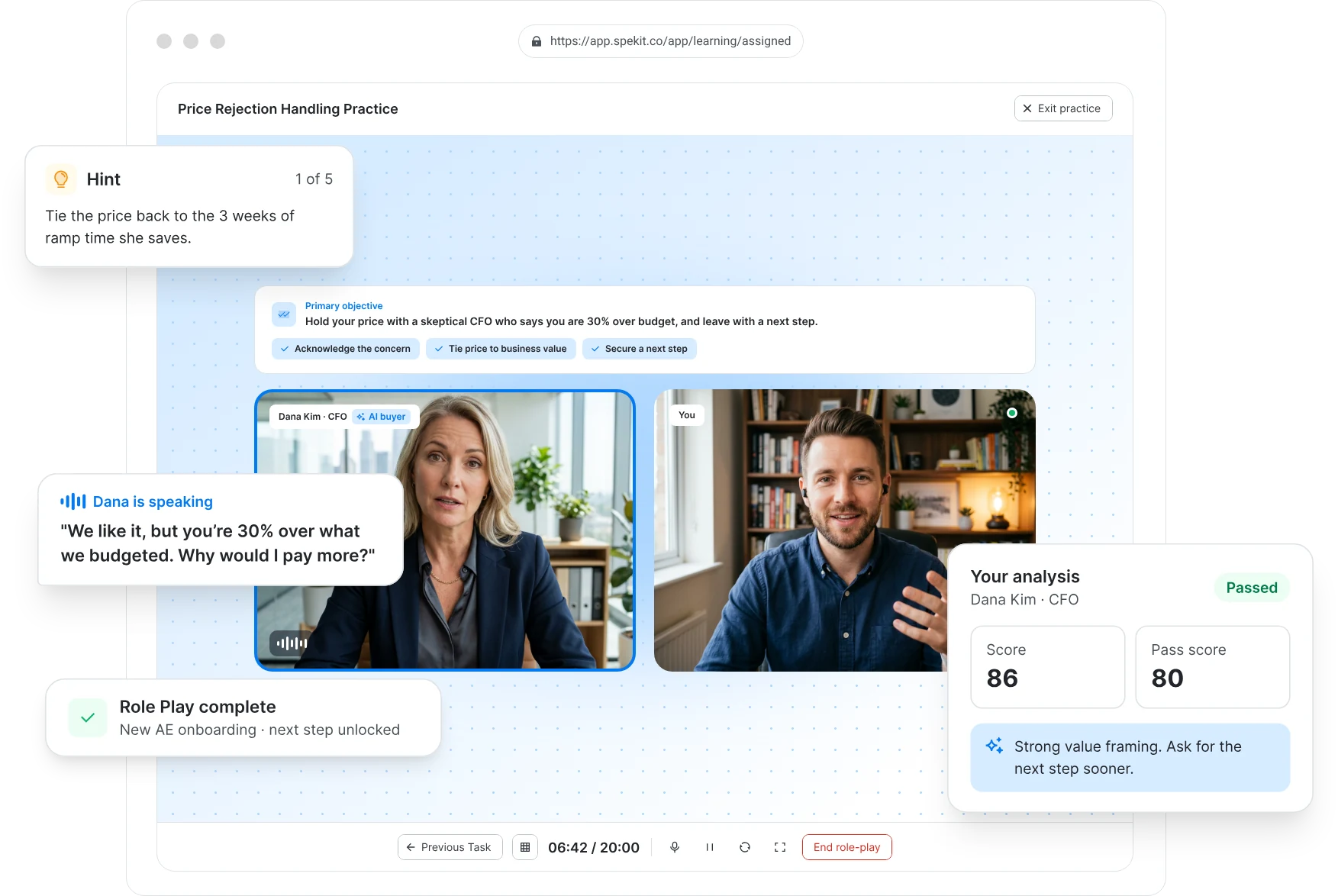
Unified Deal Context brings together signals from CRM, call intelligence, and email, so every recommendation is specific to the deal in front of the rep. AI Roleplays and AI-generated Knowledge Checks verify comprehension, and Sidekick reinforces learning contextually in the moments reps need it.
Spekit delivers granular content-to-revenue analytics, tracking which reps use which content, in what part of their workflow, in which deals, and tying every asset directly to pipeline and revenue impact. Completion, progress, and readiness roll up to the same dashboard, so a manager can see which reps are ready, which are not, and where in the workflow performance breaks down.
Best for: High-growth, mid-market, and enterprise B2B revenue teams that want rep coaching, readiness, and content-to-revenue analytics in one system, delivered in the flow of work and grounded in a governed GTM Knowledge Engine.
To give your reps the support they need exactly when they need it, book a Spekit demo today.