What the Seismic-Highspot merger tells us about where revenue enablement is going
The Seismic–Highspot merger signals consolidation, not innovation. Here's what it means for enablement teams and why the execution era is just beginning.
Seismic completed the merger with Highspot on August 18, 2026. Seismic CEO Rob Tarkoff will be CEO of the combined company, which will operate under the Seismic name. On August 19 the US Department of Justice closed its antitrust review noting that “AI-native firms are growing quickly to win sales enablement software platform customers and are increasing competitive pressure on legacy providers.” Seismic says contracts, products, and support are unchanged for now and that it will show its first roadmap at its upcoming Seismic Shift event.
Spekit’s perspective
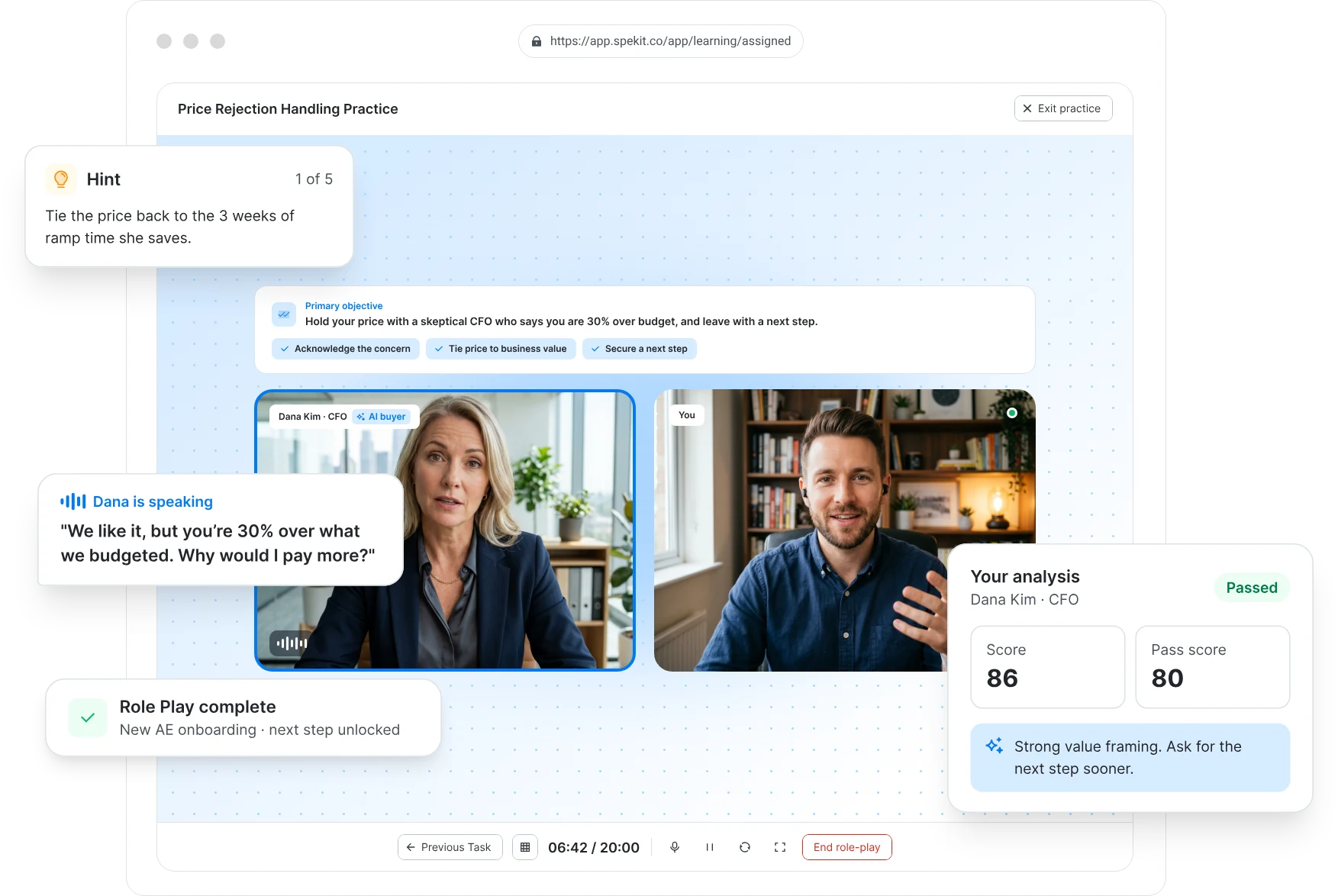
As the DOJ found, the pressure on Seismic and Highspot now comes from AI-first platforms like Spekit, which have fully integrated AI solutions to accelerate enablement functions and directly impact rep effectiveness and efficiency. Spekit is built on a governed content library and GTM Knowledge Engine and delivers that knowledge inside Salesforce, Gmail, Gong, Slack, and Claude, and everywhere reps and their agents work.
If you are a Seismic or Highspot customer approaching renewal, this is the time to ask which platform becomes the foundation for your enablement plans and to compare alternatives. Teams typically migrate to Spekit in about five weeks through a guided program with dedicated migration specialists, and if you are still under contract, Spekit works with switching teams to make the economics work before renewal. Read the merger explainer, or see how Spekit compares with Seismic and Highspot.
A wave of M&A in revenue enablement over the last half-year signals a major shift for the industry. First Clari and Salesloft in August, then Bigtincan and Showpad in October, and now, Seismic and Highspot just last month. This is a pattern in which legacy vendors are forced to consolidate amid rapidly advancing technology and radical shifts in customer demands.
In tech, we typically see two types of acquisition strategy: adding capabilities or financial consolidation. Sometimes they can be both, but most observers see the current trend, and in particular the Seismic acquisition of Highspot, as the latter.
Gartner's first take characterized the deal as a defensive consolidation against pricing, product overlap, and AI threats, and advised enablement leaders to keep renewals to one year and diversify with AI-native vendors. And many industry observers are saying similarthings. Seismic and Highspot have nearly complete product overlap and have been fierce rivals and direct competitors up until now. The only reasonable expectation is that they select one platform as the go-forward solution. Since the joint company will be called Seismic, and have Seismic's CEO and PE company, my bet is on Highspot losing that fight.
M&A Wave · 2024–2026
Four mergers. One clear signal.
2024
Totango + Catalyst
Customer success platforms combine as category growth slows
Customer Success
2025
Clari + Salesloft
Revenue operations and sales engagement platforms combined under one roof
Revenue Ops
2025
Bigtincan + Showpad
Two content enablement platforms merge to defend market share
Content Enablement
2026
Seismic + Highspot
Direct rivals combine — Gartner calls it defensive consolidation
Revenue Enablement
Gartner advised enablement leaders to keep renewals to one year and diversify with AI-native vendors
So does that mean the revenue enablement market is mature and innovation is winding down? Not even close. While legacy platforms struggle, the industry is evolving faster than it has in a decade. And for revenue enablement specifically, the AI revolution means something more fundamental than new features or faster iteration cycles. Now, the technology finally exists to deliver on enablement's original promise: driving higher levels of execution by every rep, in every deal, across every tool.
Why the portal model hit a ceiling
The enablement platforms merging today were all designed between 2010 and 2012. The assumptions baked into their architecture were reasonable for the time. New products and change management had a more regular, quarterly, or annual pace, and the technology stacks of the era demanded portal-like solutions. Reps had enough breathing room between change cycles to learn, and the lower volume of new information meant they could support the search-and-spam model of discovery. The portal model reflected those assumptions well. Organize content in a central destination, structure training into courses and sequences, and give reps a searchable place to go when they need something. For over a decade, that approach has generated real value for revenue teams.
Every one of those underlying assumptions has broken down. The pace of product development across B2B software has accelerated sharply. Continuous deployment is now standard practice, AI-assisted development is mainstream, and the interval between product releases is shrinking across the industry.
For enablement teams, every new release creates a change management event that needs to be absorbed and propagated to reps. Competitive positioning shifts mid-quarter. Messaging that was accurate on Monday can be outdated by Friday. The half-life of what a rep knows accurately is shrinking faster than any structured training program can compensate for. Forrester found that an estimated 65 percent of the content organizations create for sales teams goes unused because reps can't access it when it would actually change an outcome.
On top of that, a critical shift in the technology stack has changed what's possible. All rep tooling has moved to the cloud and the browser, creating one unified HTML interface that support tools can engage with directly. And AI now allows for real-time content analysis, synthesis, and agentic actions. These two shifts together mean that the architectural constraints that made portals the best available option in 2012 no longer apply.
So while legacy vendors have tried to stack more and more capabilities, including AI, onto aging architectures, innovators are leapfrogging them with approaches that drive value directly to the rep's point of execution.
Enablement can finally do what it was always meant to do
Enablement platforms have historically helped reps prepare. The portal model organized knowledge, delivered training, and gave reps a place to learn before they began actual work. Preparation is valuable. It always will be. But the moment that actually determines deal outcomes is execution: the live call, the follow-up email, the discovery meeting where the rep needs context about a feature shipped two weeks ago.
The time of creating and delivering enablement outside the workflow is coming to an end. Reps will break their flow to find answers when they need them, but struggle to engage with content shared with them days, weeks, or months before it becomes useful. In the moment of need, they try to recall what they were taught, or search for it, or spam their colleagues in Slack or email, or, even worse, make something up from half-remembered courses.
The gap is most acute in live selling situations. A rep on a call, last day of the quarter. The prospect asks about a feature shipped three weeks ago. The answer exists in the enablement platform, updated the week it launched. Getting to it means leaving the conversation, opening the portal, and searching. In practice, reps improvise rather than break the flow of a call. The enablement investment goes unused at the exact moment it would have mattered most.
Revenue leaders have always wanted to close that gap. Their teams need support with the deal itself, in real time, with the right context and content at the exact moment it matters. AI is making it possible. Coaching, context, content, and actions can now be delivered to reps in real time, inside the tools they already use, informed by the full context of the deal they're working on. The technology to support reps in the moment of execution, rather than just in the hours of preparation, finally exists. That's what makes this moment so significant for the category.
VS
Prepare
Portal Model
Information Access
Reps search a destination
Where It Lives
Separate platform
Discovery
Rep must know what to look for
Change Management
Manual project per update
Coaching
Happens outside where selling happens
Execute
In-Workflow Model
Information Access
Information meets the rep in context
Where It Lives
Inside every tool reps use
Discovery
System reads the moment, surfaces what's relevant
Change Management
Updates propagate automatically
Coaching
Delivered at the moment of need
The difference shows up in adoption. Portal-based enablement platforms typically struggle with rep engagement because they require reps to change their behavior and go somewhere separate. Spekit customers see 85%+ adoption within 90 days because the platform meets reps where they already work rather than asking them to go elsewhere.
The cost of standing still
The pace of every market is increasing. Driven by AI and agentic development practices, R&D teams are delivering features at aggressively accelerating rates. Revenue teams were already struggling to keep up, and the challenge will only intensify. That acceleration compounds across every dimension of the revenue operation: competition, technology adoption, process changes, sales plays, messaging, and pricing all shift faster than quarterly training cycles can keep up with.
That context makes the timing of these mergers especially consequential. Even if Seismic selects a go-forward platform quickly, the corporate integration is a massive undertaking in its own right. Merging two organizations of this size means combining sales teams, engineering organizations, marketing, support, customer success, finance, and every other function. Layoffs, reorgs, and internal prioritization battles over budgets and roadmaps are inevitable. Leadership attention that should be focused on product innovation and customer outcomes is consumed by absorbing a 1,100-person company. That process typically takes 18 to 24 months, and during that window, even the go-forward platform suffers because engineering and product leadership are distracted by the integration work rather than focused on competing in a market that's accelerating around them.
The Hidden Cost
18–24 months of organizational distraction
While Seismic integrates a 1,100-person company, the market won't wait. Engineering and product leadership will be consumed by absorption, not innovation.
Integration Window
18–24 monthsof organizational distraction
Risk 1
Engineering Distraction
Product teams focused on merger integration, not shipping features for you
Risk 2
Platform Uncertainty
Highspot vs. Seismic: one platform will be sunset. Which is your bet?
Risk 3
Talent Attrition
Layoffs and reorgs erode the teams that know your account
Risk 4
Competitive Gap
AI-native competitors ship weekly while consolidating vendors look inward
"Keep renewals to one year and diversify with AI-native vendors."
Gartner first take on the Seismic–Highspot merger
Eighteen months of organizational distraction would be manageable in a slow-moving market. In a market where AI is reshaping workflows in weeks and competitors are shipping at accelerating rates, that distraction has real costs. The enablement team whose vendor is focused inward is the one falling further behind on every product update, every competitive shift, and every new tool their reps need support in. The organizations that adopt solutions designed for this pace of change will pull ahead during exactly the window when consolidating vendors are looking inward.
What this means for enablement teams
The shift to execution-era enablement changes the role of enablement leaders, and it changes it for the better.
Today, too many enablement teams spend their time on content creation and course-building that may never reach a rep at the right moment. The operational overhead of maintaining portal taxonomies, publishing schedules, and training calendars consumes capacity that could be devoted to strategic work. When 65 percent of your content goes unused, the problem is structural, and no amount of harder work within the existing model changes the math.
In the execution era, enablement becomes more active, more focused on outcomes, and more measurable. The tools and systems enablement leaders need help to move faster: creating more content more accurately with AI assistance; ensuring that the GTM knowledge reps rely on is curated, governed, and up-to-date; and using AI and agents to deliver this content to the rep when they need it. This is a critical distinction from horizontal AI solutions that try to synthesize answers from whatever documents they can find across your organization. You can't afford to have reps trusting a general-purpose AI to figure out the right competitive positioning or the current pricing model. Enablement teams need to govern that knowledge, and execution-era platforms give them the tools to do it at the speed the market now demands.
The metrics shift, too. Instead of measuring content created and courses completed, enablement leaders can measure what actually matters: ramp time, rep capacity, change adoption speed, and the direct connection between enablement activity and revenue outcomes, such as win rates and deal velocity. Spekit customers have reported 67%+ reductions in ramp time because reps receive what they need in the flow of work rather than studying in advance and hoping they remember. That's a more strategic, more valuable position for the enablement function, and it becomes only possible when the platform is embedded in the rep's actual workflow.
Delivering the future
Spekit has been building this model since our founding, designing the platform to deliver enablement inside the rep's workflow from the start. In Gartner's inaugural 2025 Magic Quadrant for Revenue Enablement Platforms, Spekit was named the sole Visionary, a designation applied to companies positioned to define where the category is headed.
Successful execution-era platforms put reps and their activity at the center of the model. That means trusted GTM knowledge that stays accurate without creating content burdens, unified deal context so reps walk into every conversation informed, personalized buyer experiences tailored to every stakeholder and deal stage, embedded enablement across every tool in the GTM stack, and revenue analytics that connect enablement activity directly to business outcomes.
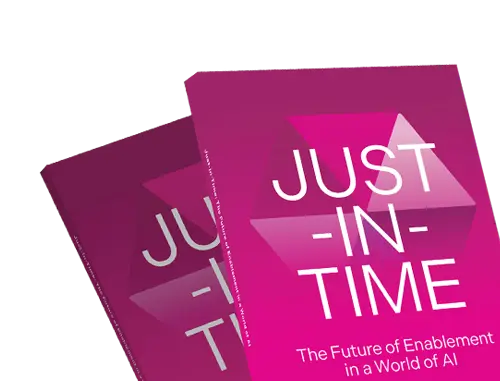
Melanie Fellay, our Founder and CEO, wrote the book on this transformation. Her Just-in-Time: The Future of Enablement in a World of AItraced the structural gap between portal-based enablement and what revenue teams actually need, and chapter seven forecasts the wave of consolidation we're now seeing play out. We could clearly see the need: enablement simply didn't work outside the tools reps were using. That insight has shaped every product decision we've made, and the AI revolution is powering us to move beyond embedded enablement into powerful tools that accelerate reps across every tool and every system.
Proof It Works
When enablement meets reps where they work, they use it.
67%
reduction in ramp time reported by Spekit customers
85%+
platform adoption within the first 90 days
90%
reduction in content discovery time — InMoment, switching from Highspot
InMoment saw this firsthand, reducing content discovery time by 90 percent after switching from Highspot to Spekit, because reps stopped searching portals and started receiving what they needed in the flow of work.
If you're evaluating your enablement platform or approaching a renewal with one of these merging vendors, the questions you ask now will determine your team's trajectory for the next two years. Our guide covers the 21 questions you should be asking before you commit.
Free Guide
Your enablement platform is merging. 21 questions to ask before you commit.
A practical questionnaire for enablement leaders navigating the Seismic + Highspot merger — before renewal, migration, or a new platform decision.
Which platform survives — and how to get it in writing
Pricing and contract protections before leverage shifts
By subscribing, you agree to receive Spekit updates. Unsubscribe anytime. See our Privacy Policy
About the Author
Ian Lowe
Chief Marketing Officer
Ian has more than 25 years of experience driving growth for leading SaaS companies at the intersection of revenue and technology.
Stay in the flow
Subscribe to our newsletter
FAQ
The Seismic-Highspot merger signals that legacy revenue enablement platforms are consolidating at a time when the market is moving toward AI-native, in-workflow execution. For enablement leaders, that raises important questions about product overlap, roadmap focus, and innovation speed. It also creates an opportunity to evaluate modern alternatives like Spekit, which is built to deliver enablement directly inside the tools reps already use.
Portal-based enablement requires reps to leave their workflow, search for answers, and find the right content on their own. In-workflow enablement delivers the right knowledge, coaching, and content in real time, inside the tools reps use every day. Spekit is designed for this execution-era model, helping reps stay in flow instead of breaking focus to search a separate platform.
Traditional enablement platforms were built for a slower pace of change, when quarterly training cycles and centralized content portals were enough. Today, messaging, product updates, pricing, and competitive dynamics change too quickly for static portals to keep up. Spekit helps enablement teams adapt faster by surfacing trusted, governed knowledge at the moment of need rather than relying on reps to remember training or search for answers later.
Enablement leaders should look for platforms that support real-time execution, not just content storage and training delivery. Key criteria include in-workflow delivery, AI-assisted knowledge governance, fast change management, strong adoption, and measurable impact on ramp time, rep productivity, and revenue outcomes. Spekit stands out because it is built around how reps actually work today, not around the portal model of the past.







.svg)
.svg)




 Sales Enablement