




The Seismic + Highspot merger: what it really means for your revenue team
Two of the largest sales enablement platforms just merged, and the combined company still hasn't shared a roadmap. If your renewal is coming up, you're being asked to commit prematurely. Here's what the integration economics tell you and what to ask before you sign anything.

What happened: the Seismic and Highspot merger explained
Seismic and Highspot, the two largest independent sales enablement platforms, are now one company. The merger was announced in February, cleared by the U.S. Department of Justice after a Second Request review, and closed in August 2026. The combined company operates under the Seismic brand, led by Seismic CEO Rob Tarkoff, with Seismic's PE firm the majority stakeholder. The combined roadmap hasn't been shown yet.
For customers of either platform, the practical effect is 18 to 24 months of integration work, a roadmap you haven't seen, and a private equity owner whose next move is margin expansion, all while AI reshapes the category in weeks rather than quarters.
A timeline of the news and what comes next
Seismic was founded in 2010, Highspot in 2012. Between them, they raised over $1.1 billion in venture capital and defined what sales enablement meant for more than a decade. Their combination is the largest consolidation the category has ever seen.
February 12, 2026
Definitive agreement announced. Both companies say both platforms will continue to be supported
Spring 2026
The DOJ Antitrust Division issues Second Requests for information to both companies
August 18, 2026
The merger closes. The combined company takes the Seismic name, CEO and controlling shareholder
August 19, 2026
The DOJ closes its investigation saying "AI-native firms are growing quickly to win sales enablement software platform customers and are increasing competitive pressure on legacy providers."
What comes next is less certain: sales team alignment, account reassignment, and support model consolidation typically consume the first year, while roadmap items serving customers compete with integration deliverables for engineering resources. History suggests one technology stack eventually becomes the foundation and the other becomes a migration project but which platform wins that decision, and when it gets made, is set by the acquirer, not the customer.
What this potentially means for buyers


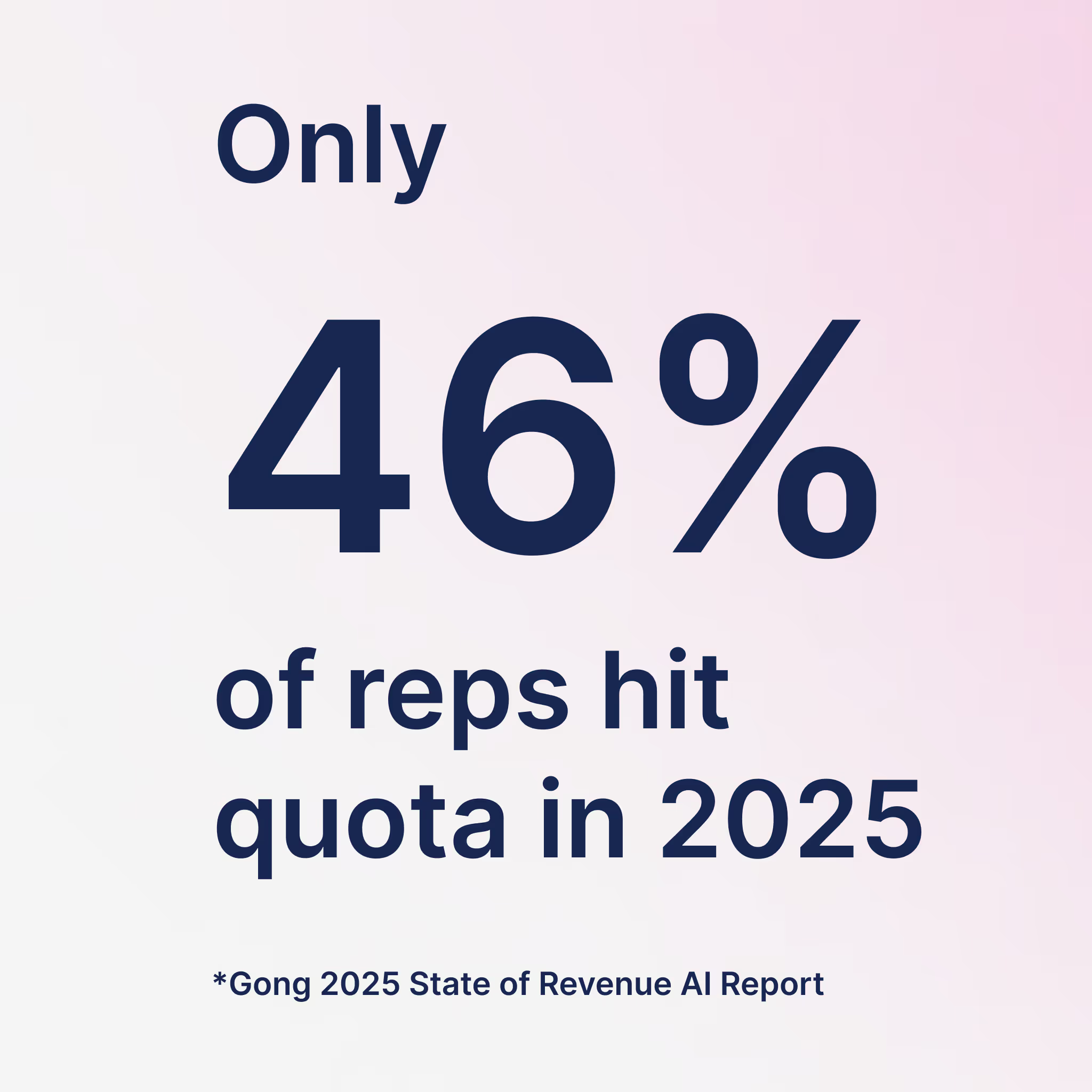
Is the category itself solving the right problem?
You don't have to take our word for it. The DOJ cleared this merger on the grounds that AI-native platforms are already taking sales enablement customers from the legacy providers fast enough to keep the combined company honest. That is a federal regulator saying the market has moved, in a document the merging parties had every incentive to argue against.
AI-first revenue enablement for humans and agents, delivered in the flow of work
Spekit® was built for the market the DOJ described. It is an AI-first revenue enablement platform built on a governed content library and GTM Knowledge Engine, the same content management, learning, and governance a Seismic or Highspot customer relies on today, with ownership, version history, permissions, and decay detection built in. The difference is where that knowledge shows up. AI Sidekick delivers approved content, coaching, and answers inside Salesforce, Gmail, Gong, Slack, Claude, and any browser tool, so reps don't leave the deal to go find things. Through Spekit MCP, the same governed source grounds your AI agents. That is Enablement in the Flow of Work®, and it is why Spekit customers on G2 report reaching ROI in 53% faster than Highspot or Seismic.
How Spekit shifts GTM enablement

"Seeing Spekit and the way it was just-in-time, how it lived instantly in the tools our reps use really stood out to me. We needed something that would reduce any possible friction in the sales process."

What to ask if you're approaching renewal
1. Which platform is the foundation? Not "both are supported." Which codebase receives net-new investment, and when will the other be end-of-lifed?
2. Who pays for the migration? If your product is the one being retired, who does the work, on what timeline, and at what cost to you?
3. What is the price protection? Cap increases through the integratino period, and get packaging changes excluded from your team.
What buyers are asking about the Seismic Highspot merger
Seismic has completed its merger with Highspot after the U.S. Department of Justice closed its antitrust review without conditions. The combined company operates under the Seismic brand, led by Seismic CEO Rob Tarkoff, with Highspot founder Robert Wahbe on the board and Permira as controlling shareholder. Seismic says contracts, pricing, and support are unchanged for now and both products remain supported. The combined roadmap has not been shown; Seismic has promised it for its Shift conference. Customers should expect 18 to 24 months of integration and should get roadmap, migration, and pricing commitments in writing before renewing.
Seismic has not announced any end of life for Highspot, and says both platforms will continue to be supported. But the combined company took Seismic's name and Seismic's CEO, and private equity owners rarely fund two competing platforms indefinitely. Highspot customers should ask which platform receives long-term investment and what the migration path and cost would be if it isn't theirs.
The DOJ Antitrust Division issued Second Requests to both companies and then closed its investigation, taking no action. Its statement said that "AI-native firms are growing quickly to win sales enablement software platform customers and are increasing competitive pressure on legacy providers." In other words, the regulator cleared the deal because newer AI-first platforms are already constraining Seismic and Highspot.
Large SaaS platform mergers often take 18 to 24 months or longer to fully integrate. That timeline affects product innovation, customer support, feature delivery, and the overall user experience. For enablement teams, the next 18 to 24 months will likely involve slower roadmap progress and less clarity on the future state of the platform.
The main alternatives are Spekit, Showpad, Mindtickle, and Allego. Spekit is the one built as an AI-first platform rather than a portal: a governed content library and GTM Knowledge Engine that delivers content, coaching, and learning inside Salesforce, Gmail, Gong, Slack, and Claude, and grounds AI agents through Spekit MCP. Spekit was named a Visionary in the 2025 Gartner® Magic Quadrant™ for Revenue Enablement Platforms. For detailed comparisons, see Spekit vs Highspot, Spekit vs Seismic, the best Highspot alternatives, and our Seismic review.
A former Highspot admin shares her thoughts on the Seismic merger and what comes next
Your enablement platform is merging. Questions to ask.
A practical questionnaire for enablement leaders navigating the Seismic + Highspot merger before renewal, migration, or a new platform decision.


"Spekit had more of a robust tool compared to Seismic. We knew we were going to be getting the same functionality, plus additional stuff. Now, we can surface documentation with ease, deliver and summarize information without having to dig around multiple tools, and give access to essential documentation in the platforms that our reps need."