













Sales Enablement
Why Copilot Is Not Enough for Sales Enablement AI
A comparison of horizontal copilots like Microsoft Copilot and Glean with Spekit AI Sidekick for sales enablement in the workflow.
Updated
September 3, 2026


A comparison of horizontal copilots like Microsoft Copilot and Glean with Spekit AI Sidekick for sales enablement in the workflow.
This post originally appeared on www.justintimeenablement.com. Visit the site for more guides and to get a copy of Melanie Fellay's book Just-in-Time: Enablement in a World of AI.
| Takeaway | Summary |
|---|---|
| Search ≠ Enablement |
|
| Proactive > Reactive |
|
| DIY agents = hidden cost |
|
| No observability |
|
| Governance gaps |
|
| Why vertical AI |
|
In this Change Economy, speed is everything. The pace of innovation is accelerating faster than most organizations can absorb. Competitors launch new features every week. Buyer expectations shift daily. Reps are under immense pressure to keep up. Every minute a rep spends digging through portals, rewriting prompts, or copy-pasting files is a minute stolen from selling — or worse, a lost deal.
The companies that win will be the ones that embrace a more modern approach to enablement that empowers their reps to learn, adapt, and execute at lightning speed.
That’s why many IT leaders, under board-level pressure to figure out their company's AI strategy, are turning to horizontal AI copilots like Microsoft Copilot or Glean.
And it’s tempting to think that if your company invests in a horizontal AI solution, you’ve “checked the box” on enablement.
On paper, the value proposition is compelling:

It’s a seductive vision: a single, all-knowing AI that replaces knowledge portals, surfaces answers instantly, and even executes tasks across the enterprise. For CIOs and CTOs tasked with “getting an AI strategy in place,” copilots feel like a quick win.
But the reality is far messier. In a recent survey of 650 IT leaders, even among the 82% of IT leaders piloting or deploying Copilot, over half flagged foundational issues like data quality and governance - challenges that usually stem from the DIY burden of building usable, reliable agents and “query everything and anything” nature of these copilots.
When IT and Enablement leaders try to stretch a general-purpose AI to cover sales enablement, they quickly run into spiraling costs, governance nightmares, and adoption failures - but most importantly, revenue leak.
In this blog, we’ll explore:
Enablement isn’t just about giving reps another way to find answers. It’s about helping them sell faster by predicting their needs, embedding structured workflows directly into the flow of work, and automating the actions that move deals forward.
The choice isn’t whether to adopt AI in enablement, it’s what kind of AI you adopt. General-purpose copilots promise breadth, but sales teams need depth: proactive workflows that anticipate rep needs, guardrails that prevent governance risks, and analytics that tie enablement directly to revenue.
And in the Change Economy, the companies that win will be the ones that move faster, with AI purpose-built for sales.
Let’s be clear: an “ASK” chat experience doesn’t solve enablement.
Tools like Glean and Copilot promise to unify knowledge by letting reps “just ask” for what they need. On the surface, it sounds logical: one search box, instant answers, problem solved.
But in practice, search-only approaches fall flat for sales. Why?

This is why enablement can’t just be a better search experience. Sales enablement has never been about finding files — it’s about helping reps sell faster. That requires a different model: predictive guidance, proactive nudges, and built-in workflows embedded directly into the flow of work.
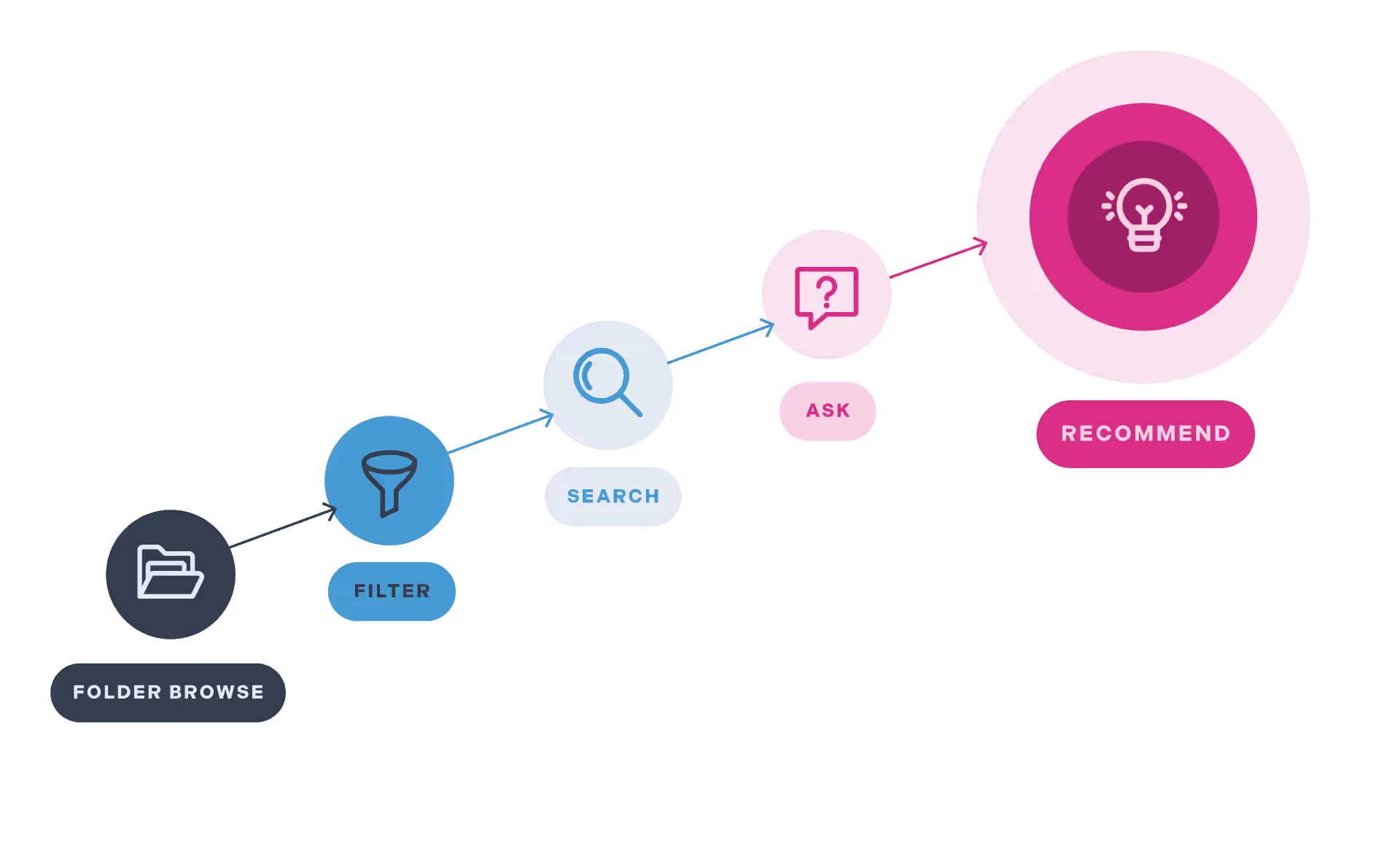
Sales enablement has never been about finding files — it’s about helping reps sell faster.
General purpose AI chatbots like Glean, ChatGPT or Copilot typically answer by pointing back to a file. On paper, that feels helpful. In reality, it forces reps into a clunky, multi-step process: download the file, copy/paste snippets into an email, upload it into a Deal Room, or log into Salesforce to attach it manually. Each step adds friction, slows the deal down, and piles onto their already maxed-out cognitive load (see Chapter 3 of Just-in-Time: The Future of Enablement in a World of AI for the science behind how context-switching kills productivity).
But sales isn’t about finding files, it’s about creating buyer confidence, building trust, and moving deals forward. And that doesn’t happen when a rep is juggling four tabs just to complete one simple workflow.
What reps actually need is automation that pushes answers into their flow of work and bakes the next step right into the experience. Imagine this:
And soon, much of this will be fully automated for you so you can focus entirely on selling while knowing your buyer is experiencing the best, most relevant content at every step.
That’s the difference between “search” and true sales process automation.
Enablement isn’t about search; it’s about action. The most effective AI doesn’t wait for reps to ask; it predicts what they’ll need, pushes guidance into their workflow, and gives them one-click actions to keep deals moving. Below are examples of the kinds of built-in workflows that transform enablement from reactive answers into proactive, revenue-driving automation.
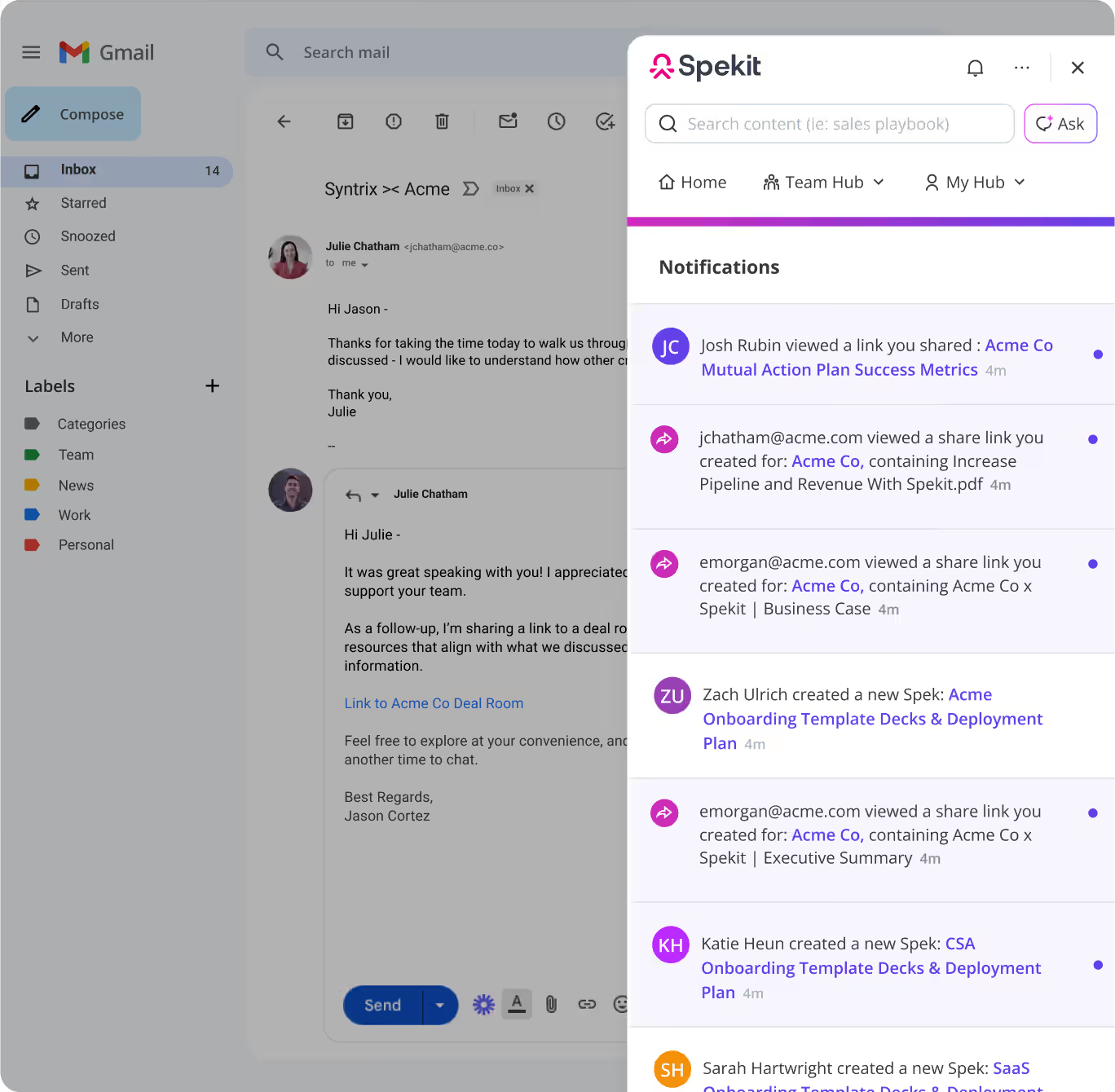
Reps win or lose deals in the moment. Proactive nudges ensure they never miss a buyer signal or the next best move, surfacing guidance before they even think to ask.
| Example Workflow | Value to Reps |
|---|---|
| Buyer Engagement Alerts — Real-time notifications when buyers view shared content, with recommended follow-ups. | Stay on top of buyer activity in real time. |
| Example Workflow | Value to Reps |
|---|---|
| Coaching Prompts — Suggestions for the next best question to ask on a specific topic mid-deal. | Build confidence and credibility by knowing exactly what to say or do next. |
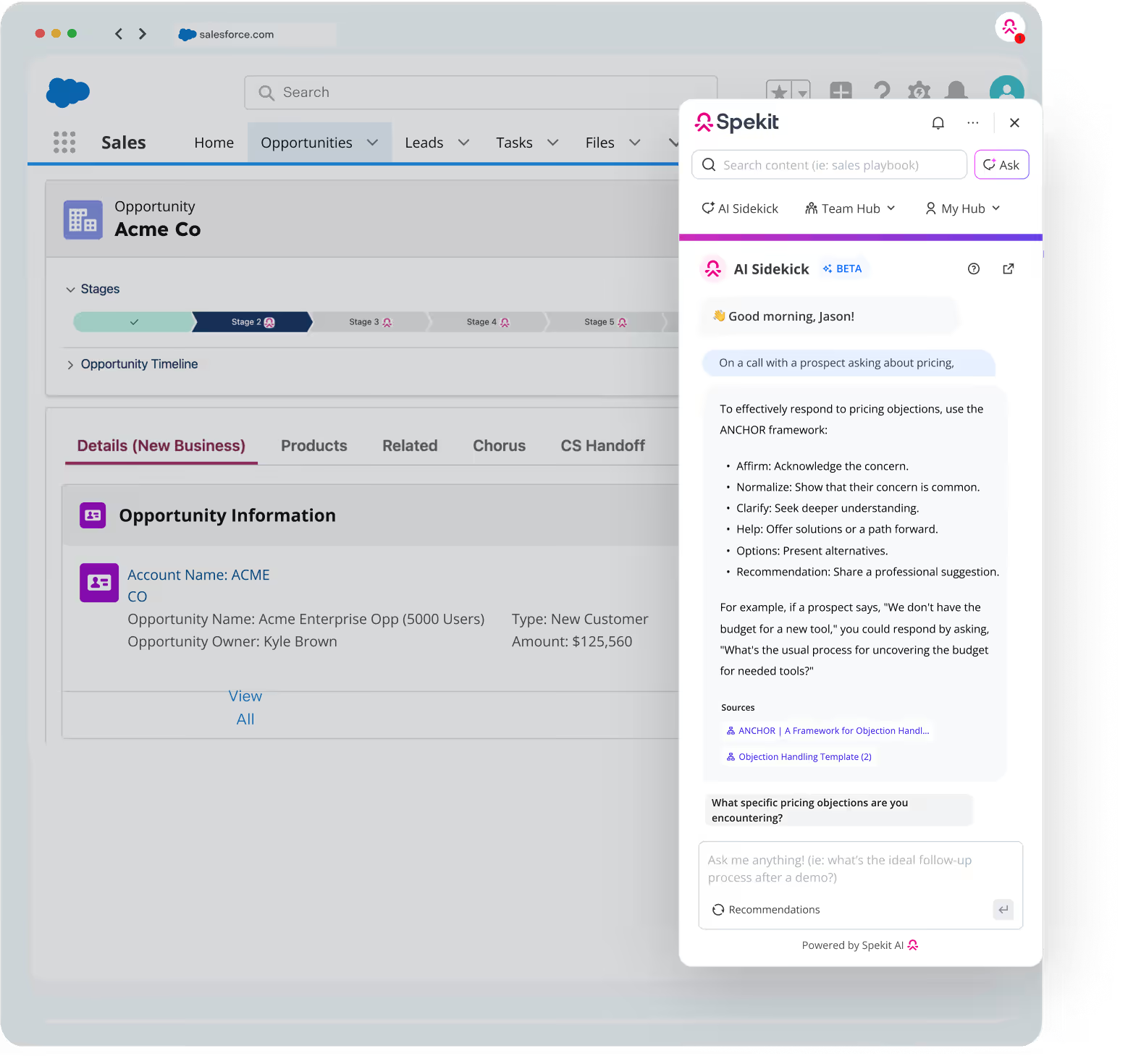
Speed matters. Predictive recommendations anticipate rep needs before, during, and after buyer interactions so they always show up prepared and follow up flawlessly.
| Example Workflow | Value to Reps |
|---|---|
| Meeting Prep Guidance — Auto-suggest relevant case studies, competitive plays, and talking points before a call. | Go into every conversation prepared. |

| Example Workflow | Value to Reps |
|---|---|
| Meeting Follow-Up Guidance – Recommend follow-up content and actions immediately after calls. | Move deals forward faster with tailored next steps surfaced automatically. |

Reps don’t need links; they need action. One-click workflows eliminate friction, embed automation directly where they work, and keep deals moving without switching tabs.
| Example Workflow | Value to Reps |
|---|---|
| Create a Deal Room — Auto-populated with stage-appropriate content. | Eliminate copy/paste busywork and personalize buyer experiences instantly. |

| Example Workflow | Value to Reps |
|---|---|
| Add to Deal Room — Insert collateral or next steps from Salesforce or call notes in one click. | Keep deals moving without switching tabs. |

| Example Workflow | Value to Reps |
|---|---|
| Draft and Insert Messages — Personalized emails or LinkedIn messages drafted and inserted in one click. | Save time while ensuring follow-ups are tailored and professional. |

| Example Workflow | Value to Reps |
|---|---|
| Draft and Insert Messages — Personalized emails or LinkedIn messages drafted and inserted in one click. | Save time while ensuring follow-ups are tailored and professional. |
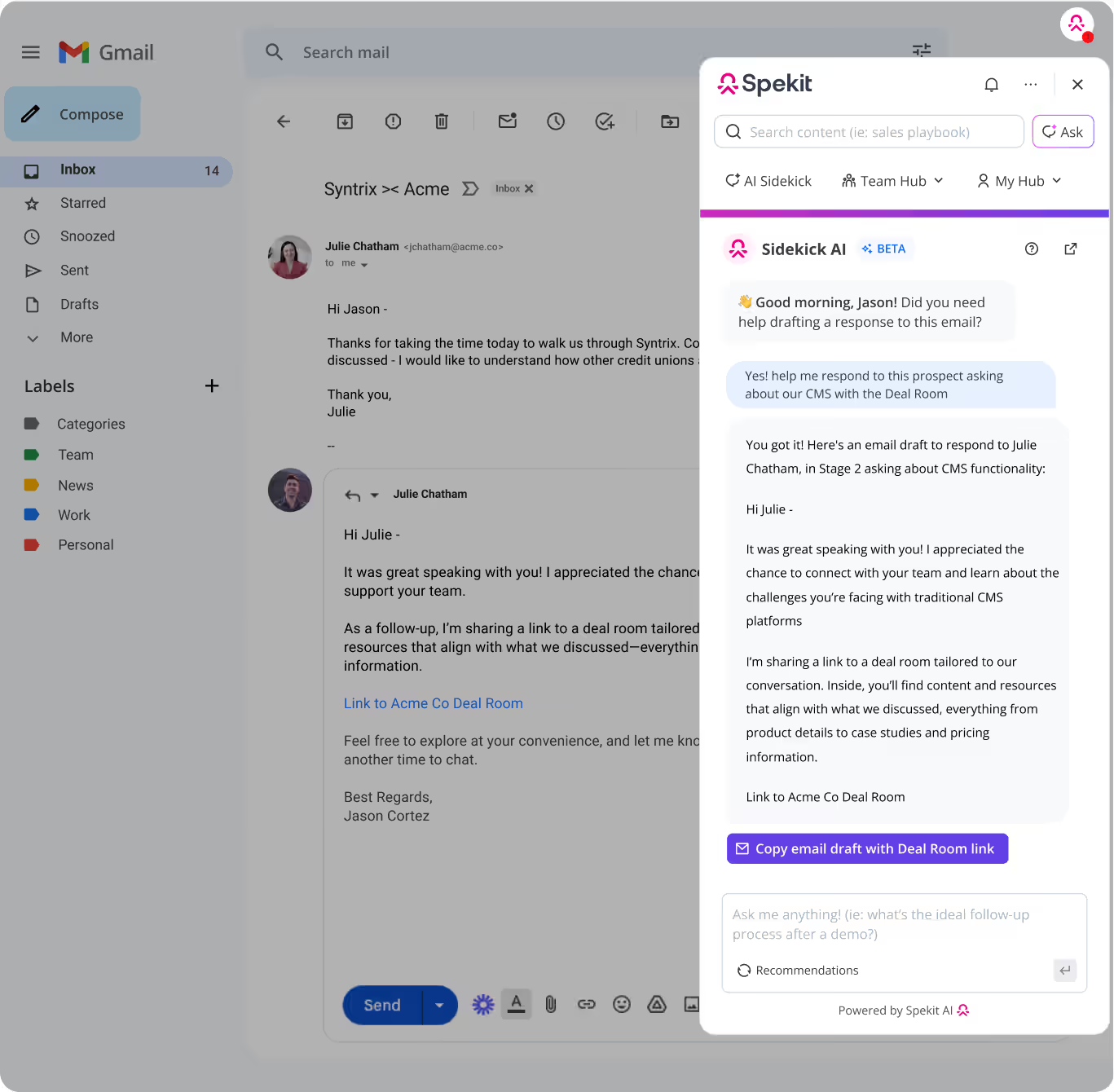
No guessing. No prompting. No friction.
“We can just build that.”
It’s a phrase every IT and enablement leader has heard or said themselves. After seeing the power of predictive, built-in workflows, it’s tempting for internal teams with good intentions to think: “We’ll just build agents on top of Copilot or Glean for that.”
On the surface, it sounds clever. Why not design your own sales workflows with prompts and custom automations? But in practice, this approach almost always turns into a treadmill of cost, complexity, and constant maintenance.
Even the biggest companies in the world struggle with this reality. Take Google: despite billions in resources and world-class engineering talent, they recently retired their Tables product, which was designed to compete with Airtable. Why? Because keeping up with user needs, integrations, and ongoing maintenance was too costly and unsustainable, even for Google. Priorities shift, orgs restructure, leaders change, and suddenly those beautiful custom-built workflows slip down the backlog until they collapse under neglect.
Think about how hard it already is to get what you need out of Salesforce. At least most CRM teams have deep Salesforce expertise, yet projects still take months. With agents, it’s worse. The skills are brand new, the playbooks don’t exist, and teams are learning as they go. What looks easy on day one quickly becomes a quagmire of rewrites, bug fixes, and broken promises.
If a tech giant like Google can’t justify the ongoing cost of maintaining a DIY workflow platform, how can internal IT and enablement teams expect to succeed in maintaining fragile, sales-specific agents on top of general-purpose copilots?
Building effective agents isn’t about clever prompts. It’s about instrumentation, QA, and telemetry, all of which carry enormous hidden costs:
The result? A system that looks cheap on paper but drains resources in practice.
Instead of innovating around real business challenges, your IT and enablement teams end up babysitting brittle, homegrown agents, spending all their time on QA rather than building true outcome-driving innovation.
Manual Workflow Design
Constant QA & Maintenance
Instrumentation Overhead
Telemetry Burden
SME Drain
Resourcing & ROI
Even if you put aside the massive cost of building and maintaining DIY agents (though you shouldn’t), there’s another fundamental flaw with Copilot, Glean, and other general-purpose AI tools: they provide zero visibility into what’s actually working in your GTM.
These tools can surface answers, but they can’t tell you whether those answers were accurate, impactful, or revenue-driving. Why? Because Copilot and Glean don’t actually deliver enablement, they simply redirect you to it. Ask a question, and you’re usually sent to the original source: a SharePoint doc, a Confluence page, or a PDF buried in your CMS.
The second a rep clicks out, tracking stops cold.
With Copilot and Glean, you’ll never know. They act as a front door to scattered systems, but because the experience fractures the moment a rep leaves to view the source, all observability is lost.
The problem is structural: these platforms were built to retrieve, not measure. And without measurement, leaders are flying blind.
In the Change Economy, speed isn’t just about how fast you deliver answers; it’s about how fast you can learn what works and act on it. In Chapter 9 of my book, I argue that speed to insights is the differentiator.
But the problem is that most organizations are operating in the dark. This isn’t just inconvenient—it’s the default state of most sales orgs today. When I ask sales leaders questions like:
Most admit they simply don’t know. Instead of visibility into what drives success, they rely on retroactive analysis after missed quotas or lagging win rates.
Even when fragments of this data exist, they’re scattered across disconnected systems. The result is insight chaos: incomplete, delayed, and irrelevant by the time leadership finally sees it.
This is where purpose-built, vertical AI solutions for sales like Spekit change the game. Unlike Copilot or Glean, which stop tracking the moment a rep clicks into a file, Just-In-Time Enablement is embedded inside the workflow itself.
Because Spekit works everywhere the rep works (Salesforce, Gmail, Slack, Gong, and more), it captures not just what content was accessed, but when and in what context. Did the rep pull up a pricing guide in the middle of a negotiation? Did they open a competitor battlecard right before a CFO call? That context is gold. Without it, you’ll never tie enablement back to real outcomes.
As I argue in Just-in-Time: The Future of Enablement in a World of AI, context is what transforms enablement from a content library into a performance engine. By anchoring knowledge to the moment of need, you unlock insights that were previously invisible.
Instead of fragmented, delayed signals, Just-In-Time Enablement delivers:
This holistic view empowers revenue leaders to answer the questions Copilot and Glean never will. And most importantly, it closes the loop between enablement and revenue.
When your IT team says, “Copilot or Glean can handle enablement,” here are the questions that cut through the hype:
Tracking Usage & Impact
Context & Observability
Program Effectiveness
Single Source of Truth
Products, services, competitors, and buyer expectations are evolving faster than ever. New features launch weekly, pricing shifts constantly, and competitive positioning changes overnight. This creates a massive change management challenge for sales organizations.
Reps need the latest content, messaging, and process guidance at their fingertips—but only if it’s accurate and approved. Without the right mechanisms to manage change, the “garbage in, garbage out” problem is inevitable:

The faster the business changes, the faster this garbage piles up. But here’s the catch: without visibility, you can’t fix content quality. Insights and governance are two sides of the same coin.
Without reporting, there’s no quality control. Without quality control, there’s no improvement.
And this pace of change makes governance non-negotiable.
1. They don’t host or manage content.
Copilots scan across SharePoint, Slack, Confluence, Teams, and more, but they don’t actually manage content quality. They simply point reps back to whatever source file exists in that system, whether it’s accurate or not. The underlying sprawl remains untouched, and the decay continues to multiply.
Horror story: In a small exec forum, a Fortune 500 company shared that an employee asked Copilot about org changes. Because it indiscriminately scanned SharePoint, it surfaced a confidential layoff list directly to the employee on that list. Ouch.
2. They lack integrated change management.
Each repository the Copilot is pulling from still has its own versioning, permissions, and decay. Copilots don’t unify them, nor do they push proactive updates. There’s no way to cascade a pricing change across every asset or notify reps in their workflow when something critical has shifted. At best, copilots help reps find the haystack. They don’t ensure the haystack is golden.
Breaking this cycle requires a platform that enforces governance and delivers reporting tied to revenue outcomes something horizontal copilots simply can’t do.
This is where vertical AI enablement platforms stand apart. A true sales-focused solution isn’t just a smarter search bar; it’s a governance and content engine built for the reality of constant change.
Drawing from Chapter 8 of Just-in-Time: The Future of Enablement in a World of AI, the future of enablement depends on solving content decay — the silent killer of productivity and trust. Outdated, conflicting, or duplicated information undermines deals, frustrates reps, and erodes buyer confidence. In fact, as of January 2025, over half of marketing and enablement teams believe that 40–60% of their content needs a refresh according to this research report where over 300+ teams were surveyed.
A vertical enablement AI platform solves this by unifying governance, analytics, change management, and content creation into a single loop:
In other words, horizontal copilots amplify chaos; vertical enablement AI prevents it. Instead of drowning in content decay, reps get guidance that is always accurate, contextual, and revenue-driving.
Governance & Security
Content Accuracy & Freshness
Horizontal copilots like Copilot or Glean promise breadth, but when it comes to enablement, breadth without depth creates risk. Building DIY agents on top of these platforms drains IT resources, introduces governance gaps, and leaves sales teams stuck with reactive search instead of actionable workflows.
A vertical, purpose-built enablement solution flips that equation. Instead of endless IT firefighting, a platform like Spekit ships with guardrails, governance, and pre-built sales workflows designed to anticipate rep needs and tie every action back to revenue with:
In short, purpose-built enablement platforms don’t compete with IT priorities; they protect them.
That means lower total cost of ownership, higher ROI, and no hidden IT overhead.
For teams comparing Copilot or Glean with vertical sales enablement AI, Spekit® is an AI-first revenue enablement platform that unifies AI-powered content creation, content management, learning, governance, coaching, digital sales rooms, and analytics. AI Sidekick, the rep’s AI sales coach, delivers Enablement in the Flow of Work® through approved content, contextual coaching, deal intelligence, and next-best actions inside tools reps already use, including Salesforce, Gong, Slack, Gmail, Claude and every other web app.
Unlike Copilot or Glean, which rely on reps to ask the right question, Sidekick is predictive and contextual:
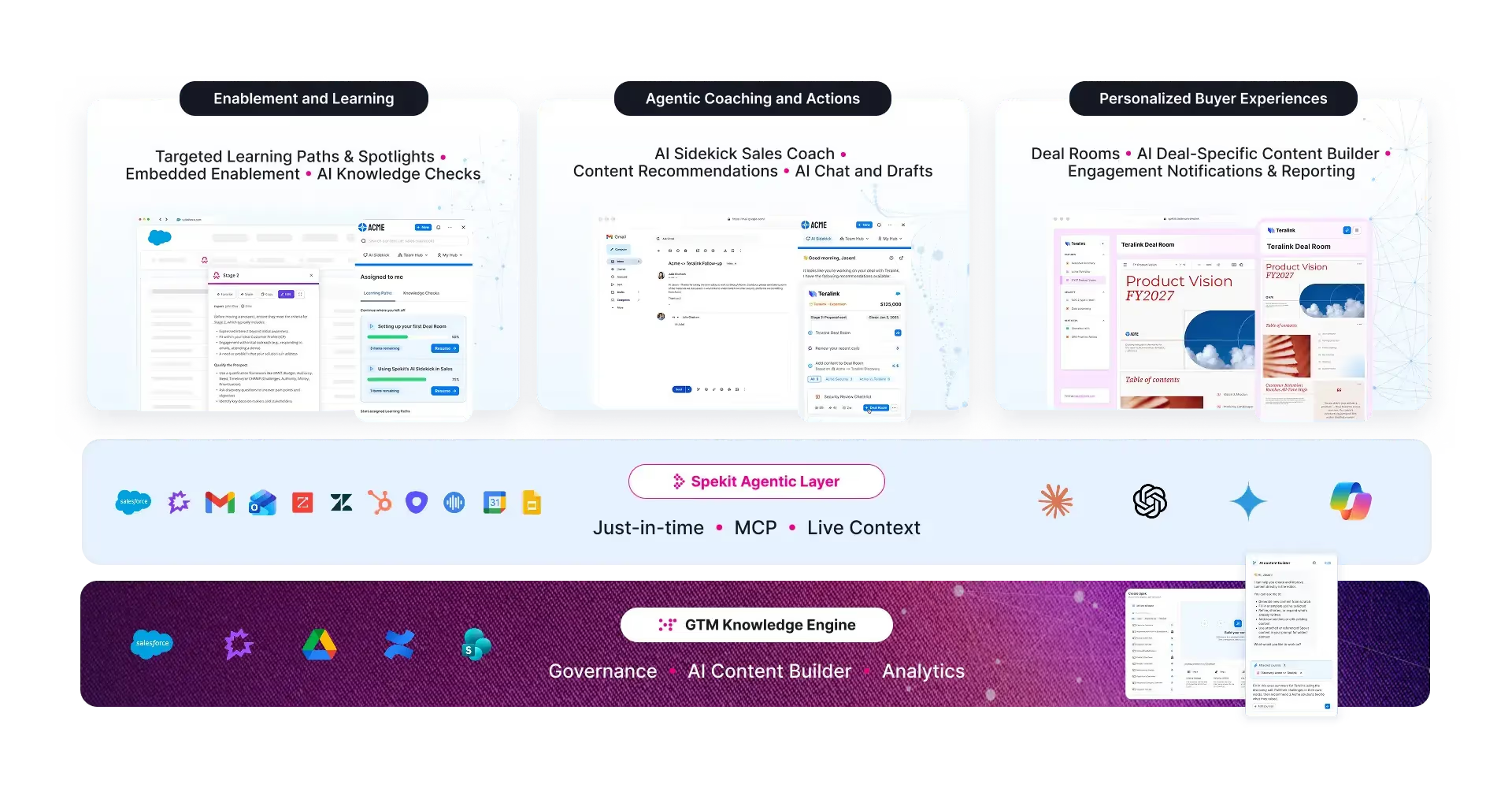
Best for: High-growth, mid-market, and enterprise B2B revenue teams that want predictive enablement AI instead of generic search in the flow of work, grounded in a governed GTM Knowledge Engine.
At the highest level, the difference is simple: this is the leap from “AI that answers” → to “AI that drives revenue.”
But here I’ve included a detailed breakdown for reference.
| Category | Copilot / Glean | Spekit |
|---|---|---|
| Approach | Reactive search: reps must know what to ask. | Predictive, proactive: anticipates rep needs before they search. |
| Workflows | None built in; links back to files. IT must build and maintain agents. | Prebuilt, sales-specific workflows out of the box (Deal Rooms, follow ups, nudges, buyer engagement). |
| Actionability | Copy/paste into email, CRM, or Deal Room. Multiple manual steps. | One-click actions embedded in Salesforce, Gmail, Slack, and more (create/add to Deal Room, share content, draft follow-ups). |
| IT/SME Dependency | High: IT and SMEs must constantly maintain prompts, fix breakage, and QA. | Low: prebuilt, auto-updating workflows maintained without IT lift. |
| Observability | Build-your-own telemetry to track accuracy and hallucinations. | Full analytics: every click, share, and recommendation tracked to ensure accuracy. |
| Content Hosting and Governance | Doesn’t host content; only references files. No enforcement of approved vs outdated. | Centrally manages approved sales content with guardrails; stale or conflicting docs flagged or retired. |
| Measurement and Reporting | No visibility into usage or impact; cannot tie to revenue. | Tracks views, shares, Deal Rooms, and ties engagement to pipeline movement and revenue. |
| Change Management | No integrated updates; relies on each repository’s versioning. | Updates cascade from systems of record; in-app alerts notify reps in their workflow. |
If you’re evaluating Spekit vs Copilot or Spekit vs Glean, the decision comes down to what matters most. Horizontal AI copilots are powerful for broad enterprise search, but they weren’t built for enablement.
Spekit eliminates hidden IT costs, provides revenue-tied observability, and puts guardrails in place to prevent governance nightmares. With AI Sidekick, it goes even further, moving beyond “search and ask” to proactive, contextual, just-in-time assistance that reps can trust and IT can govern.
That’s why even if your IT team invests in Copilot or Glean, you still need Spekit. Because while copilots help you find answers, Spekit Sidekick helps your reps sell smarter, faster, and safer.
It delivers predictive guidance inside Salesforce, Gmail, Outlook, Gong, and Chrome, plus built-in workflows like Deal Rooms, change alerts, and analytics tied to outcomes. Copilots help you find answers, while Spekit helps reps act on them.