





You’re on a call with a high-value prospect. Everything is going well—until they ask for a case study to see how well your product performs in their industry.
You know it exists, but you can’t find it.
You scramble through emails, Slack, and shared drives. Nothing.
You promise to send it later, but by then, the momentum is gone, and the lead stops responding.
This happens all the time. According to Forrester, reps have an average of 1,400 sales assets to choose from. Without proper management, they can become overwhelmed, struggle to find what they need, and lose momentum in active deals.
Sales content management software keeps all your sales assets, case studies, pitch decks, product sheets, organized and instantly accessible — so reps can find what they need in seconds, not days.
In this guide, we’ll explore the top seven sales content management tools to help your team sell smarter and close deals faster.
Let’s get started.
What is a sales content management system?
A sales content management system, or sales CMS, is software that organizes, governs, and distributes sales and marketing content in a central location. It helps reps find, personalize, and share approved assets at the right point in the sales process.
Unlike general cloud storage such as Google Drive or Dropbox, a sales CMS treats content as a managed asset. It adds capabilities such as search, version control, permissions, workflow delivery, buyer engagement tracking, and integrations with tools such as CRM and email.
The best sales content management platforms also use AI to surface the right content automatically, suggest next-best actions, and analyze which assets actually help close deals.
Why you (likely) need a sales content management system
A sales content management system is no longer optional for sales enablement teams.
It’s the infrastructure that turns content from a static library of chaotic, often outdated content into a dynamic sales acceleration tool. Without it, enablement teams operate blind, sales reps lose productivity, and marketing’s content investment can go to waste.
Here are eight key benefits to choosing the right sales content management system:
- Prevent content chaos: A modern sales content management system prevents disorganized, outdated, or hard-to-find content scattered across drives, emails, and Slack channels.
- Increase efficiency and speed: It allows reps to quickly find, personalize, and deliver the right content without wasting time searching or recreating materials.
- Ensure consistency and compliance: Only approved, up-to-date, and compliant content is shared externally, reducing risk and maintaining brand integrity.
- Gain content performance insights: It provides analytics on what content works, who uses it, and how it contributes to deals, helping the enablement team refine strategy and prove ROI.
- Integrate with existing workflows: Seamlessly delivers content within reps' existing tools (CRM, email, Slack), so enablement materials are used in the flow of work, not buried in separate systems.
- Enable personalization at scale: Reps can easily customize decks, case studies, and proposals without needing creative or marketing teams to manually update materials for every prospect.
- Support training and coaching: Many SCMS platforms include or integrate with coaching tools, enabling sales enablement teams to embed training directly into the content experience.
- Drive revenue impact: Directly supports the goal of increasing conversion rates, shortening sales cycles, and improving deal sizes by getting the right content in front of buyers at the right time.
Now let's compare the best sales content management platforms on the market today.
7 best sales content management systems (at a glance)
Now let's look at how each of these sales enablement content management software works.
1. Spekit: AI-first revenue enablement
Spekit is an AI-first revenue enablement platform for high-growth, mid-market, and enterprise B2B revenue teams. It combines governed GTM knowledge, content management, coaching, learning, buyer experiences, and analytics in one platform, then delivers them inside the tools reps already use.
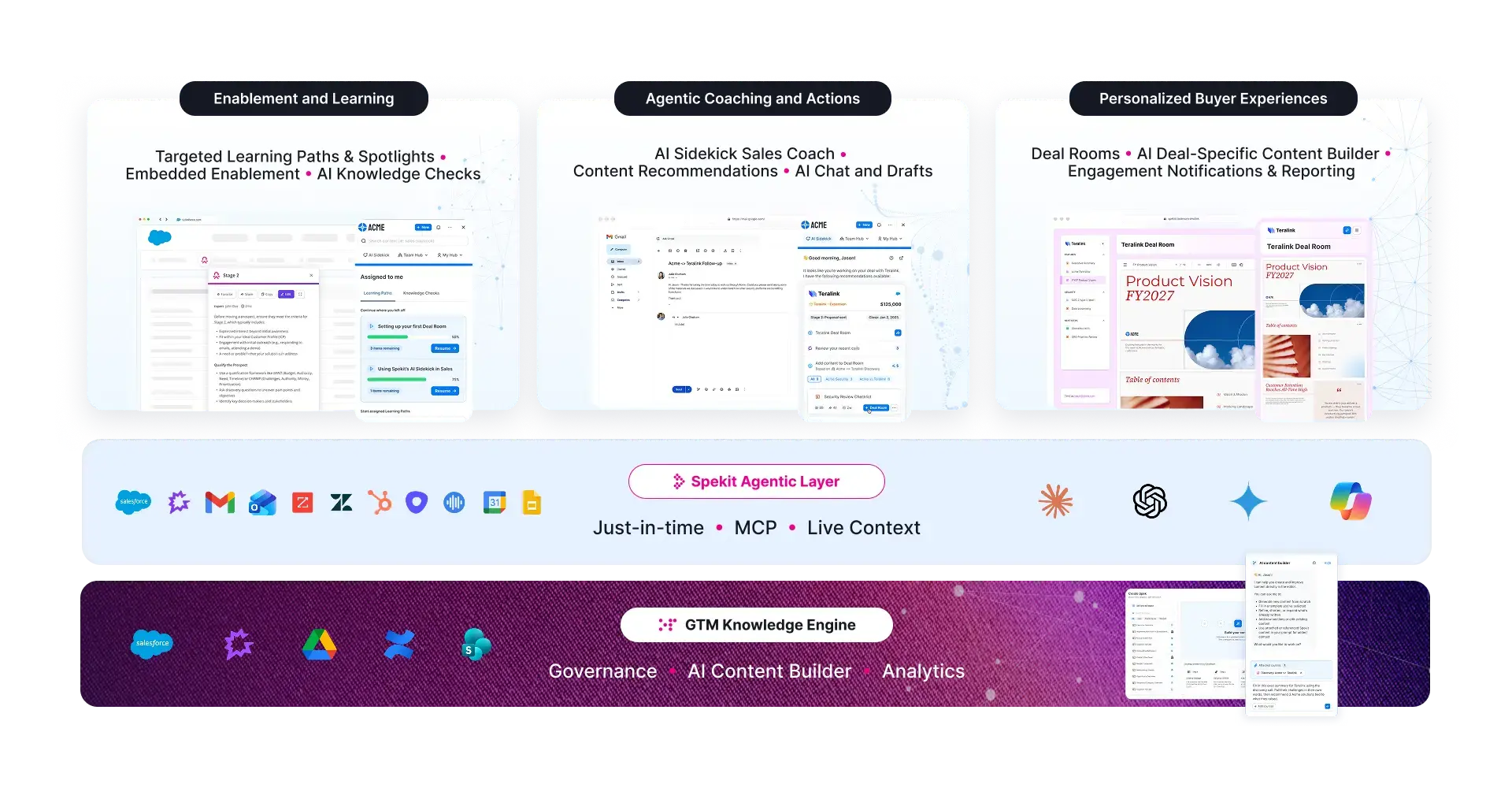
At the center of the platform is Spekit’s GTM Knowledge Engine, a governed source of truth for sales content and knowledge. Enablement and product marketing teams can create modular content in Spekit or sync existing resources from systems such as Google Drive, SharePoint, Notion, and Confluence. Ownership, permissions, version history, content health monitoring, and source syncing help teams keep information current and prevent duplicate or outdated content from reaching reps.
AI Sidekick delivers answers, content, coaching, and next actions inside tools such as Salesforce, Gmail, Gong, Slack, and anywhere else in a Chrome browser. Because guidance appears in the rep’s workflow and can use deal context, reps do not have to stop selling to search a separate portal or open a different tool.
Spekit also supports buyer-facing content through AI Deal Rooms. Reps can create personalized, auto-branded spaces for each deal, share approved resources, and use engagement signals to guide follow-up. When governed source content changes, those updates can flow into the experiences that use it. With AI Content Creation, reps can create hyper-personalized content for their deal and stakeholders that stays consistantly on-brand and is grounded in governed, approved GTM knowledge.
Relevant sales content management capabilities include:
Governed content management: Create or sync content, assign owners, control access, maintain version history, and monitor freshness.
In-workflow delivery: Surface content and guidance inside the applications reps already use.
Contextual AI assistance: Ground answers and recommendations in approved GTM knowledge and live deal context.
Modular knowledge: Create reusable Speks that can appear across playbooks, learning, buyer content, and AI-generated answers.
Buyer experiences: Share content through trackable, personalized Deal Rooms.
Content and revenue analytics: See which content reps use, how buyers engage, and how activity relates to pipeline and closed-won outcomes.
AI-agent access: Use Spekit MCP to connect governed GTM knowledge to supported AI tools and agents.
Best for: High-growth, mid-market, and enterprise B2B revenue teams that need governed content and contextual enablement in the flow of work.
2. DocSend by Dropbox
DocSend's Standard plan starts at $30 per user per month when billed monthly.
Sales professionals need more than just a way to send documents. They need to know who’s engaging, how they’re interacting, and when to follow up.
That’s where DocSend comes in.

It goes beyond simple file sharing by offering digital content management, secure access controls, and engagement insights, all in one platform.
DocSend is a Dropbox product, but it also imports files from Box, Google Drive, and Microsoft OneDrive.
Key features include:
In-Depth Document Analytics
Ever sent a proposal and wondered what happened next? Did they open it? Did they read it? Which pages held their attention?
DocSend gives you those answers with detailed engagement insights.
You can see exactly how prospects interact with your documents—from which pages they spend the most time on to where they lose interest.
Instead of guessing, you’ll know who’s engaged and when to reach out.
If a prospect only skims through your proposal, you might need to refine your pitch. If they spend extra time on a specific section, that’s a cue to focus your follow-up conversation on that area.
This kind of detailed feedback can help you tailor your approach and close deals more effectively.
Secure Access
Sharing sales content is important, yes, but keeping it secure is just as important.
Once a document is sent, it’s out of your hands; unless you’re using DocSend.
With DocSend, you decide who gets access to your sales materials and how they interact with them.
You can set password protection to restrict access, enable or disable downloads to prevent unauthorized file sharing, and revoke access at any time, even after the document has been sent.
Prospects also always see the latest version of your document.
If you make updates, there’s no need to send a new link or worry about outdated information being passed around.
Real-Time Alerts
Timing can make or break a deal. Follow up too soon, and you might come across as pushy. Wait too long, and the prospect may have already moved on.
DocSend notifies you the moment a prospect opens your document.
Instead of sending a follow-up email blindly, you can reach out while they’re still engaged.
When a prospect is actively reviewing your proposal, that’s the perfect moment to check in and answer any questions.
This real-time visibility helps you stay one step ahead, which can improve your response rates and speed up deal cycles.
Downsides
- Too much focus on sales content analytics may not be necessary for teams with simple content-sharing needs.
- Pricing may be relatively high compared to basic document-sharing solutions.
3. Dock
Dock is an AI revenue enablement platform that replaces static content repositories with real-time guidance for sellers and buyers throughout the customer lifecycle.
Unlike traditional sales content management systems, Dock combines an AI-powered content library with collaborative workspaces that guide customers from first call through onboarding and renewal.
Key features include:
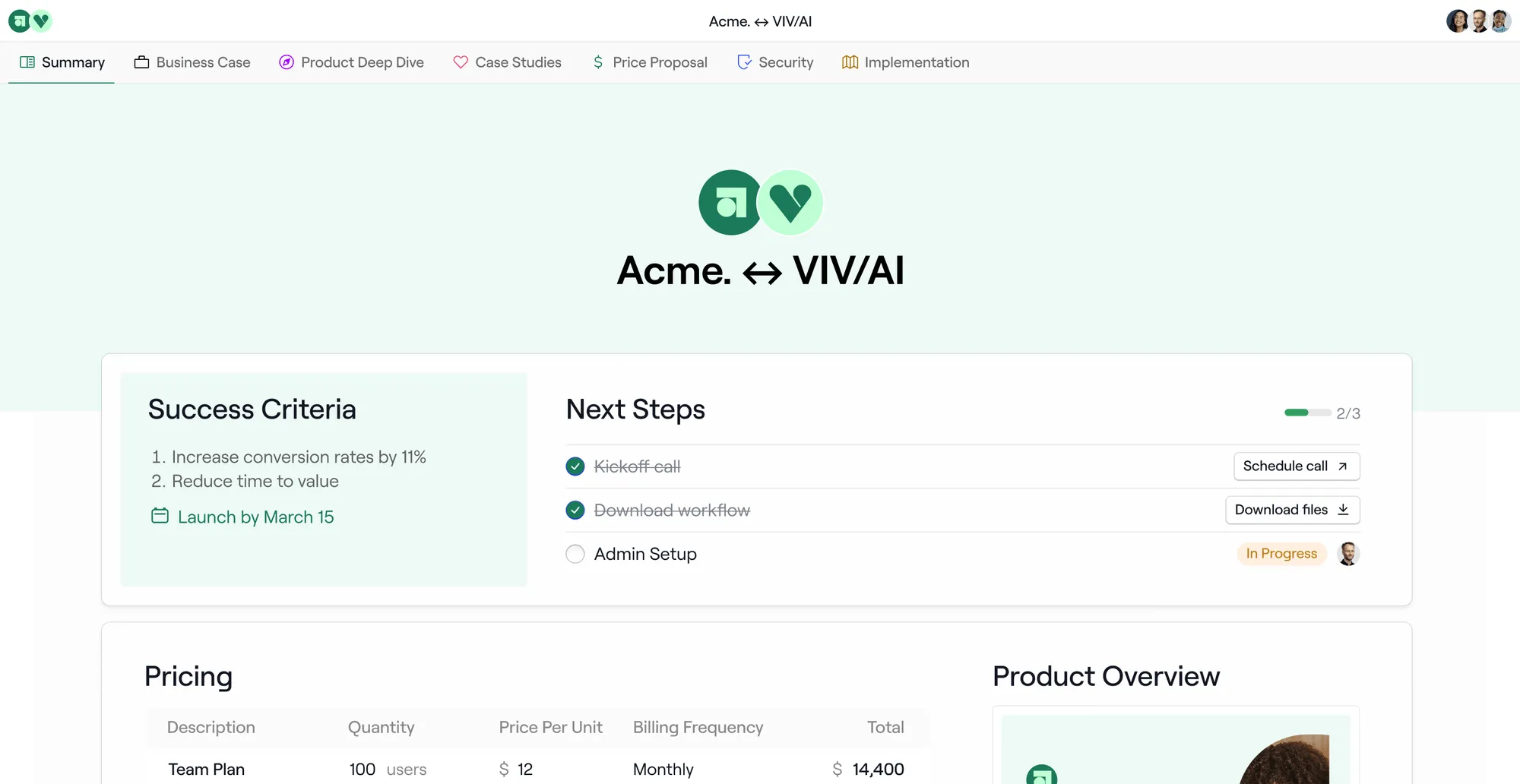
Collaborative Workspaces That Support Buyers
Dock's deal rooms give buyer champions a single destination to find everything they need to evaluate your solution and build internal consensus.
Sales reps can embed content, share pricing, create mutual action plans, and track which stakeholders are engaging.
These workspaces transition seamlessly from sales to Customer Success using the same link, eliminating messy handoffs and creating continuity throughout the customer journey.
AI-Powered Content Management
Dock's content library eliminates the manual work of organizing sales materials. AI automatically tags assets, making content searchable across teams.
And when marketing updates a resource, it automatically syncs across all customer workspaces where it's shared, ensuring reps never send outdated materials.
The platform also tracks which assets Sales and Customer Success teams use most, which content customers engage with, and how materials impact deal outcomes.
AI Documents for Instant Content Generation
Rather than forcing reps to search through content libraries or create materials from scratch, Dock's AI Documents generate personalized sales content in seconds.
The platform pulls data from your CRM and call transcripts to create custom business cases, executive summaries, meeting recaps, and proposals tailored to each prospect.
This eliminates the blank page problem and ensures every piece of content is relevant to the specific deal context. Reps spend less time creating documents and more time selling, while maintaining consistency and quality across all customer-facing materials.
Downsides of Dock
- Built for high-growth and mid-market companies that want flexibility, not for enterprises that require complex content governance features
- Requires the use of deal rooms to get the most value out of the platform
- Doesn’t have a full LMS yet
4. HubSpot Content Hub - Sales CMS
HubSpot Content Hub is primarily a website and marketing content platform with CRM-connected content creation, personalization, and analytics. It is an adjacent option for teams that already use HubSpot, rather than a direct replacement for a dedicated sales enablement content management system.

By pulling data from your CRM, it can help your team understand how customers engage with content at every stage of their journey.
Key features include:
Create and Optimize Content with AI
HubSpot makes content creation easier with its AI-powered tools. These tools suggest relevant topics, refine messaging, and optimize content for SEO based on CRM data.
Instead of guessing what works, you get data-driven recommendations that can help you create high-quality content.
Since it integrates directly with your CRM, the platform also personalizes content based on customer data.
This means you can tailor your messaging to different buyer personas.
You can also track key engagement metrics, such as views, click-through rates, and time spent on each post to understand what resonates with your audience.
Increase Organic Traffic with SEO and Strategy Tools
HubSpot Content Hub helps you drive more organic traffic to your site (which can generate more leads for your business) by optimizing your content for search engines.
Also, HubSpot’s AI-powered tools take the guesswork out of SEO.
They suggest the best keywords, analyze content performance, and group related topics to improve your rankings.
Turn Customer Wins into Case Studies with AI
Case studies are powerful, but creating them takes time.
HubSpot Content Hub speeds up the process by turning raw customer success stories into polished case studies.
Simply upload your notes with key details, and the AI will generate an engaging case study.
Instead of spending hours writing, your team can quickly create compelling proofs of success that help close more deals.
Downsides
- New users may need time to learn HubSpot Content Hub’s advanced features.
- Higher-tier plans unlock more tools, but some features are limited to enterprise users.
- Since it’s part of the HubSpot ecosystem, it works best for businesses already using other HubSpot tools.
5. Seismic
Merger notice: Seismic completed its merger with Highspot on August 18, 2026. The combined company operates under the Seismic name. Seismic and Highspot remain commercially available as products, so they are evaluated separately here. Buyers should consider the impact on roadmap, support, and product direction post-merger.
Seismic is an enterprise sales enablement platform that combines sales content management, AI-driven personalization, and advanced analytics.
It helps align sales and marketing teams by making sure reps always have the most relevant content at every stage of the buyer journey.
Seismic is ideal for enterprise-level organizations with large sales teams, complex sales cycles, and a need for robust content management.
Some top features include:
Personalized Content Automation
Seismic automatically selects the right sales materials based on prospect data and deal stages.

With AI-powered recommendations, reps can quickly create customized presentations and messages. This makes it easier to engage prospects and improve sales conversations.
Content Intelligence & Analytics
Seismic tracks how prospects interact with sales content. It shows which materials are most effective and which ones need improvement.
Sales leaders can use this data to focus on high-performing content that helps close deals faster.
Streamlined Content Workflows
Seismic keeps all sales materials in one place, making it easy to manage and share content.
With built-in version control and approval processes, reps always have the latest, most accurate materials—reducing the risk of using outdated content.
Downsides
- Too complex and expensive for smaller teams.
- Manual tagging and SFDC integration require significant effort.
- Hard to navigate and disconnected from sales workflows.
- Limited customization with a rigid user interface.
- Redundant and counterintuitive search functionality.
6. Highspot CMS - Enterprise sales content management software
Merger notice: Seismic completed its merger with Highspot on August 18, 2026. The combined company operates under the Seismic name. Highspot is commercially available at this time, so we include it in the evaluation. Buyers should consider impact on roadmap, support and product direction post-merger.
Highspot is designed for mid-to-large enterprises with complex sales processes, extensive content libraries, and a need for in-depth content analytics.
It helps sales teams organize, share, and track content efficiently.
With all sales materials in one place, its AI-powered tools allow reps to quickly find and share the right content at the right time.
Below are some key features:
Intelligent Content Organization & Search
Highspot's AI-powered search and intelligent content tagging enable reps to quickly find the right materials based on keywords, deal stage, or customer persona.

This reduces search time and ensures reps are always equipped with relevant content.
Personalized Content Delivery & Guidance
Highspot provides personalized content recommendations and guided selling paths.
This can help reps tailor their presentations and follow-ups to each prospect.
By delivering the most relevant materials at the right time, reps can increase engagement and potentially increase conversion rates.
Actionable Content Analytics & Performance Tracking
To help teams identify top-performing sales content, Highspot provides detailed analytics on content usage, prospect interactions, and sales outcomes.
These insights can help you refine your sales enablement content strategy and double-down on content that delivers the best results.
Downsides
- Uploading custom files is slow.
- Content search is unnecessarily difficult.
- Frustrating pop-ups block users during login.
Read: 10 Best Highspot Alternatives for Sales Enablement
7. Showpad Sales CMS
Showpad and Bigtincan completed their combination in October 2025, and the combined business operates under the Showpad brand.
Showpad is a sales content management platform that helps sales and marketing teams store, manage, and deliver content seamlessly.

It makes sure reps have easy access to the right materials while also providing insights into content performance and buyer engagement.
Key features include:
Interactive Presentations
Reps can tailor sales presentations and materials to match each prospect’s needs.
With Showpad’s interactive content features, they can create dynamic presentations, guided selling experiences, and personalized follow-ups that increase engagement and conversions.
Centralized Content Management & Smart Search
Showpad keeps all sales and marketing content in one place. This makes it easy to organize, search, and access.
With AI-powered search and content tagging, reps can quickly find the most relevant materials based on keywords, topics, or deal stage.
Content Analytics and Insights
Showpad offers in-depth analytics on content usage, prospect engagement, and sales outcomes.
Use this to pinpoint top-performing content, optimize your content marketing strategy, and demonstrate the ROI of your enablement initiatives.
Downsides
- Content is hard to find if not properly organized.
- Slow loading times affect usability.
- Certain file types, like .txt and .rtf, cannot be previewed in-app.
- Uploading content involves too many steps.
How to improve your sales content management system
Finding the right sales content management software is only part of the process.
Even the best tool won’t deliver results if your content management practices are ineffective.
To get the most out of your sales content, follow these best practices:
- Gather insights from your sales team: Regularly collect feedback through surveys, interviews, or discussions to understand their challenges and content needs.
- Keep your sales materials up-to-date: Review and refresh your sales content regularly to remove outdated or irrelevant materials.
- Sync your content with your CRM: Integrate your content management system with your CRM. This can help you get valuable insights into how prospects interact with sales materials.
- Use analytics to fine-tune your content: Track engagement metrics to measure content performance. Identify top-performing materials and improve underperforming content to maximize impact.
- Choose a platform that fits your needs: Evaluate different content management tools based on features, ease of use, and how well they support your sales team’s goals. Make sure the platform aligns with your team’s size, budget, and workflow.
The right sales content management software doesn’t just store documents, it makes content instantly accessible, actionable, and trackable so your reps can sell smarter, not harder.
Spekit ensures your team always has the latest, most relevant content exactly where they need it, inside the tools they already use. With real-time insights, trackable engagement, and seamless integrations, your sales team can focus on what matters: closing deals.
How to choose the top sales CMS platform
Here’s how to choose a sales CMS that aligns with your business’s needs:
1. Ease of use
An easy-to-use sales CMS can reduce training demands and help reps work more efficiently. The platform should have a low learning curve, clear support materials, and strong integrations with the tools reps use every day. If finding content in the new system takes longer than asking a colleague or searching a shared drive, adoption will suffer.
Spekit, for example, has a simple, user-friendly interface that can be embedded directly in sales reps' workflows and tools. Using Speks, you can create sales content in seconds and upload and organize sales content in a few clicks. Reps can also universally access and share sales materials while on the applications they’re working in.
2. Content governance
Look for clear content ownership, role-based permissions, version history, approval workflows, and a way to identify stale or duplicate material. A sales CMS should help teams keep one approved source current and prevent reps from sharing outdated content.
Also consider how easily admins can organize content for different roles, regions, products, and deal stages without creating unnecessary copies.
3. Workflow and repository integrations
A sales CMS should connect to the systems where content is stored and the applications where reps work. Review integrations with your CRM, email, browser, conversation intelligence platform, collaboration tools, and repositories such as Google Drive or SharePoint.
Strong integrations reduce context switching and make it easier to deliver approved content at the moment a rep needs it. Confirm how the platform handles syncing, permissions, and updates before you buy.
4. Customer support
Great customer support can speed up the integration and adoption of a sales CMS. During the integration process, you might need technical assistance to troubleshoot any issues. Having responsive customer support ensures that setting up does not take longer than it should.
Customer support can also guide your sales reps through onboarding by providing learning materials, answering questions, or even providing tips and shortcuts to navigate the platform faster. Before deciding to use a sales CMS, you can engage its customer service to see its responsiveness or check out review sites like G2 and Capterra to see what other people say about its customer support.
5. Pricing
The best sales CMS solution for your business should meet your needs and provide all the features and functionalities you need while aligning with your budget. CMS platforms have various pricing options, the most common being tiered pricing, custom pricing, subscription-based pricing, and a one-time licensing fee.
Evaluate pricing based on the capabilities your team will actually use, the administrative effort required, and the likely level of adoption. A long feature list has little value if reps cannot quickly access the right approved content in their workflow.
What is the biggest challenge sales teams face with their sales CMS?
Hear from Spekit's founder, Melanie Fellay:
"One of the most pressing challenges sales teams face today is the difficulty in quickly accessing and utilizing the most current and relevant content during the sales process. Often, this content is scattered across multiple repositories, leading to inefficiencies and the risk of using outdated information. This not only hampers productivity but also affects the ability to engage effectively with prospects.
At Spekit, we've addressed this by developing a sales CMS that centralizes content storage and offers robust search capabilities. Our platform integrates seamlessly with the tools sales teams use daily, ensuring that the right content is accessible when and where it's needed.
But we didn't stop there. Recognizing the need for real-time, contextual support, we've developed the concept of just-in-time enablement. This approach delivers bite-sized, relevant information directly within the applications your sales team already uses, such as Salesforce, Slack, or Chrome. By embedding learning into the flow of work, Spekit reduces the time reps spend searching for information and increases their productivity.
If you're interested in learning more about how Spekit can help streamline your sales content management and enablement strategy, feel free to reach out or schedule a demo."
FAQs when buying a sales content management system
1. What features should we prioritize for our specific sales team size and structure?
When evaluating sales content management features, focus on what drives revenue, not what demos well. We recommend starting with contextual delivery systems (ie. getting information to reps in the tools they already use daily).
For smaller teams, prioritize platforms with minimal administrative overhead. You need solutions that don't require technical expertise or dedicated resources to maintain. The administrative burden of complex systems often outweighs their benefits.
Larger enterprise teams should invest in robust analytics and governance features that prevent content decay while making it easy to demonstrate sales enablement ROI. The ability to track content engagement and correlate it with performance outcomes becomes crucial at scale.
Regardless of size, choose platforms supporting modular, bite-sized content over monolithic documents. This approach makes updates simpler and content more digestible for reps who need answers quickly during customer interactions.
Finally, avoid feature bloat and endless customization. many platforms offer essentially the same core functionality with different packaging. Identify your team's specific challenges and select a solution addressing those fundamentals rather than one promising endless customization options that will never be used.
2. How can we ensure sales team adoption once we implement a new content management system?
Sales reps prioritize activities directly contributing to closing deals. Anything perceived as a distraction will be abandoned, regardless of its potential value.
First, minimize friction with a "one-click" philosophy. Each additional step in accessing information dramatically reduces adoption rates. Your system should deliver answers faster than asking a colleague on Slack—otherwise, reps will default to what's easiest.
Secure executive sponsorship beyond initial implementation. Have sales leaders actively reference and use the system in their communications and meetings. Create a champions program with influential reps who can advocate for the system and provide ongoing feedback.
Content quality is non-negotiable. Nothing kills adoption faster than outdated or inaccurate information. Implement systematic content review processes and leverage AI where possible to identify knowledge gaps and conflicts.
Finally, plan for continuous reinforcement. Most organizations focus intensely on launch but neglect ongoing enablement. Integrate system use into coaching sessions, team meetings, and regular communications. Recognition programs highlighting successful adoption can create positive momentum and demonstrate the system's tangible value to the entire sales organization.