





Highspot has been a major sales enablement platform for more than a decade, but the market around it has changed. Revenue teams are placing greater weight on rep adoption, trusted AI, content governance, contextual guidance, and measurable business impact, not simply the breadth of a portal's feature set. A useful comparison has to look beyond feature count and ask how each platform supports sellers during daily execution.
Highspot's position also changed materially in 2026. Seismic completed its merger with Highspot in August, and the combined company now operates under the Seismic name. Buyers should therefore evaluate Highspot as part of the combined Seismic portfolio rather than as an independent long-term platform choice.
The best Highspot alternative in 2026 is Spekit® for revenue teams that want governed content, structured learning, contextual coaching, buyer experiences, analytics, and AI support delivered inside the tools sellers already use. Other products may be a better fit when the requirement is narrow point solutions, such as formal sales readiness, field selling, value selling, or standalone digital sales rooms. The comparison below covers 11 options and the different problems each is designed to solve.
What the Seismic-Highspot merger means for buyers
Seismic completed its merger with Highspot on August 18, 2026. The combined company operates under the Seismic name, and both previously independent products now sit within the same corporate portfolio.
Here are the questions a buyer should ask before renewing, expanding, or selecting either product:
- Which Highspot and Seismic products will remain distinct?
- Which capabilities will be consolidated, integrated, renamed, or retired?
- What migration work could customers face over the next contract term?
- How will existing integrations, data models, permissions, and analytics change?
- Will customers need additional modules or services to access the combined roadmap?
- What contractual protections are available if packaging or product direction changes?
Seismic is listed in this guide, but is not an independent vendor from Highspot like the other companies listed.
How we evaluated these Highspot alternatives
The list reflects our point of view about what modern revenue enablement should accomplish. We reviewed current product pages, integration pages, customer evidence, and corporate announcements through August 24, 2026.
We gave the greatest weight to:
- Native content creation and content-management capabilities, including synchronization, ownership, version history, permissions, approvals, freshness, and retirement.
- Rep adoption and delivery inside the tools sellers already use.
- Guidance and actions informed by the active deal.
- Connections between content, learning, buyer engagement, rep behavior, and revenue outcomes.
- Support for personalized buyer experiences.
- Permission-aware access for AI assistants and agents.
- The implementation, administration, migration, and context switching required to realize value.
Competitor descriptions are based on publicly documented capabilities. Descriptions reflect how completely each product addresses the criteria above.
Compare the best Highspot alternatives
1. Spekit: Best overall Highspot alternative
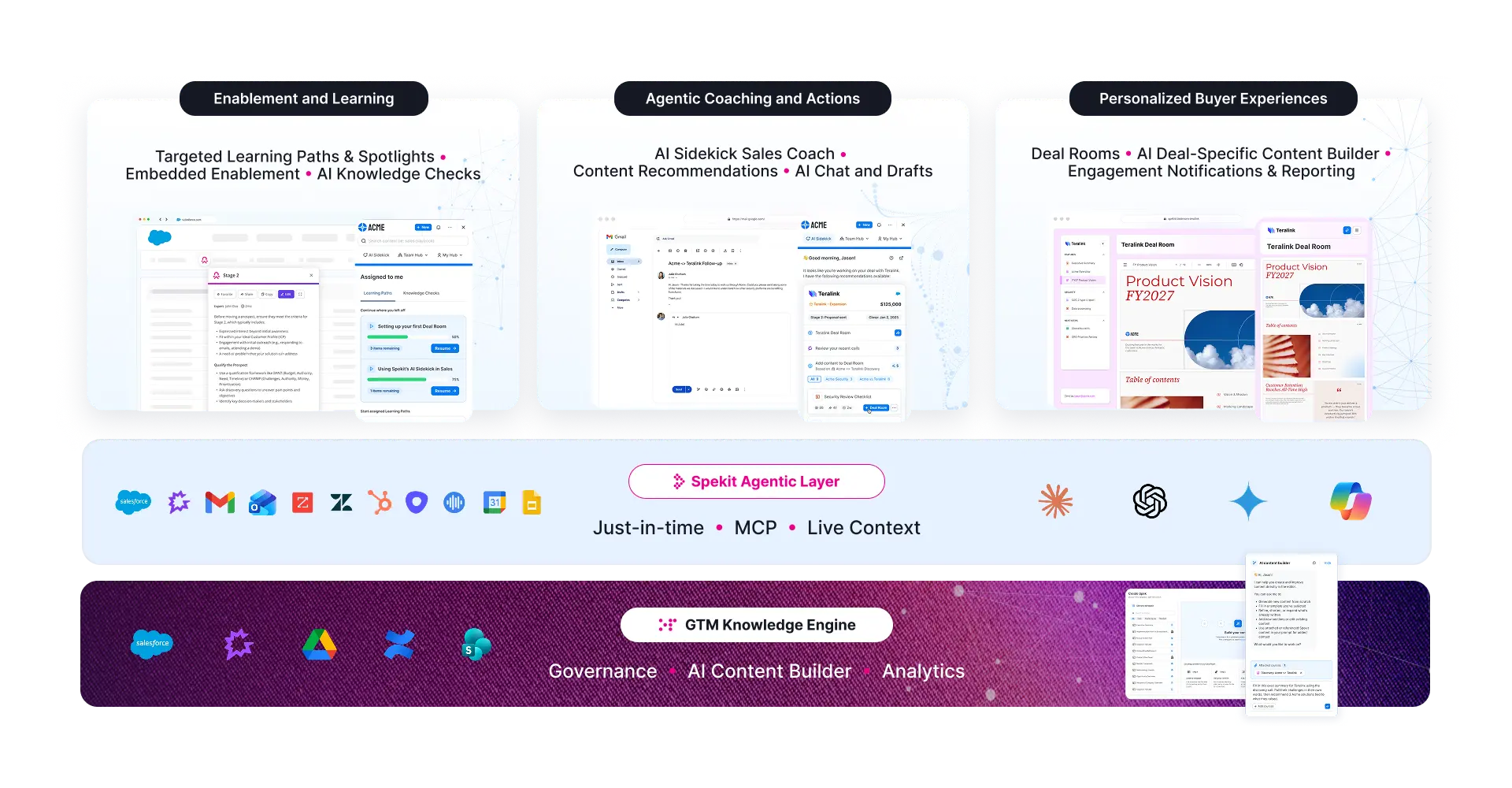
Spekit® is an AI-first revenue enablement platform for high-growth, mid-market, and enterprise B2B revenue teams. Built on a governed content library and GTM Knowledge Engine, Spekit connects content management, learning, governance, coaching, Personalized Buyer Experiences and Deal Rooms, analytics, and AI in one platform.
The difference is how that governed knowledge reaches sellers. AI Sidekick, the rep's AI sales coach, delivers Enablement in the Flow of Work® by surfacing approved answers, relevant content, contextual coaching, drafting help, and next-best actions inside Salesforce, Gmail, Outlook, Gong, Slack, LinkedIn, Claude, and other browser-based applications.
Unified Deal Context brings together opportunity data, conversations, email, and buyer signals so guidance is relevant to the active deal rather than based only on a general search query.
How Spekit manages content and learning
Enablement and product marketing teams use the Spekit Content Hub to create rep-ready material with AI Content Builder or synchronize existing assets from Google Drive, Notion, SharePoint, and Confluence.
Governance capabilities include ownership, version history, role-based permissions, similarity and decay detection, and freshness controls. Nested Speks and Dynamic Links allow maintained source content to appear inside other resources, so teams can update reused information without manually correcting every copy.
The same living content can support structured learning through Learning Paths, Topics, Assigned Programs, Knowledge Checks, and AI Roleplays. When maintained source material changes, teams can update the learning built from it and re-engage the appropriate sellers.
How Spekit supports seller and buyer execution
Spekit uses approved knowledge and deal context to help sellers prepare for meetings, answer buyer questions, draft follow-up, decide what to share, and take the next action without leaving their normal workflow.
Spekit's AI-powered Deal Rooms create personalized buyer experiences grounded in approved content and current deal context. Reps can generate and package decks, business cases, mutual action plans, next steps, and other deal materials in one branded buyer space. Buyer-engagement signals show sellers and leaders which people and assets are receiving attention.
Spekit MCP gives connected AI assistants and agents permission-aware access to the same governed knowledge that powers Spekit. Analytics connect content use, learning engagement, rep adoption, buyer activity, and deal outcomes so teams can understand how enablement influences execution and pipeline.
Why Spekit is a strong Highspot alternative
Spekit does not ask teams to choose between a governed content-management system and enablement in the flow of work. Enablement teams maintain trusted GTM knowledge centrally, while sellers receive answers, learning, coaching, content, and actions in the applications where they already work.
That architecture is designed around adoption. Instead of relying on sellers to remember to visit another portal, Spekit brings maintained knowledge into the moments when a rep must understand, communicate, or act on it.
Best fit: High-growth, mid-market, and enterprise B2B revenue teams operating in high-change environments that want one governed platform for content, learning, deal support, seller guidance, buyer experiences, analytics, AI, and rep adoption.
Consider another option if: The requirement is limited to a standalone digital sales room, conversation-intelligence system, value calculator, or another narrow function.
2. GTM Buddy: AI meeting preparation
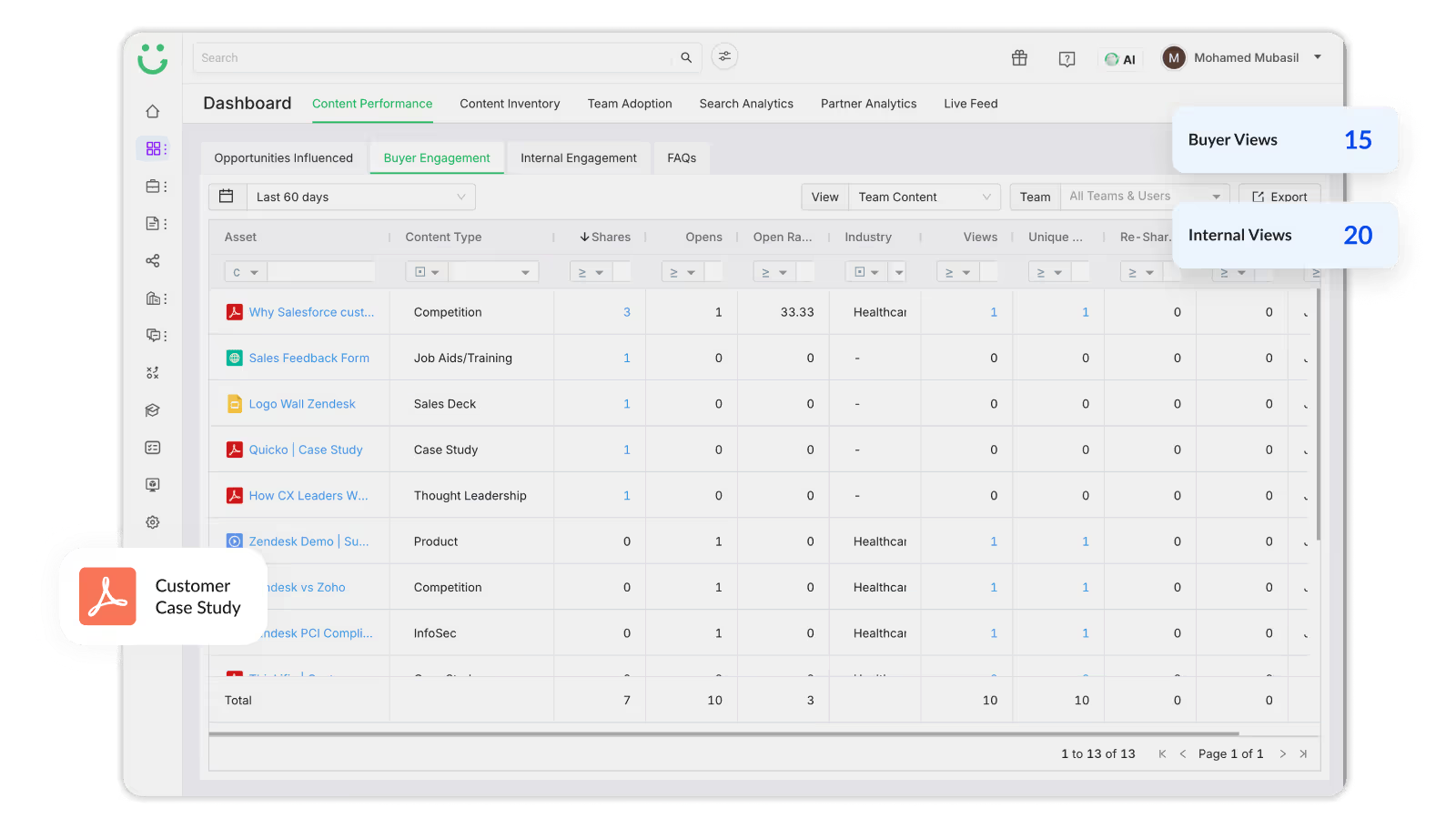
GTM Buddy is a revenue-activation platform that uses deal, CRM, calendar, content, and conversation context to prepare sellers for meetings and recommend relevant material and actions.
Its documented capabilities include an AI assistant, AI role plays, content management and recommendations, learning, digital sales rooms, buyer signals, and integrations with seller workflows.
Why buyers consider GTM Buddy
GTM Buddy is most relevant to teams prioritizing contextual meeting preparation, deal-specific sales plays, AI-assisted coaching, and recommendations tied to buyer activity. Its calendar and meeting orientation can help sellers arrive with persona-specific talking points, objection guidance, and suggested materials.
GTM Buddy is best for:
Teams prioritizing AI-assisted deal preparation and revenue activation.
What to verify
Test the depth of content ownership, permissions, approval workflows, version history, freshness controls, structured learning, administration, and sustained rep adoption. A feature checklist alone will not show how reliably the system maintains and reuses governed knowledge.
3. Paperflite: Sales content activation and buyer engagement
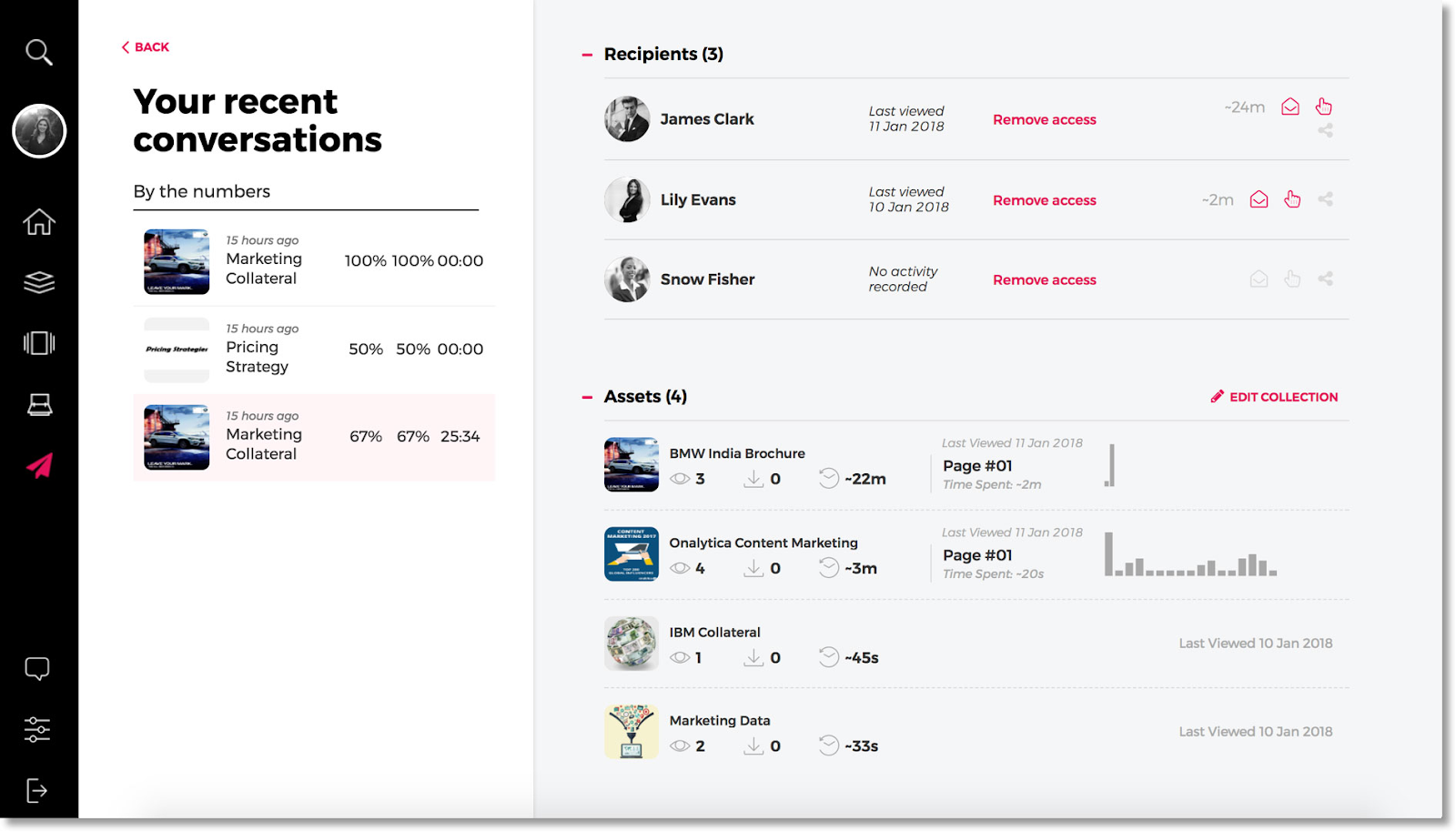
Paperflite helps teams organize, distribute, and measure sales and marketing content. Sellers can search a content library, share multiple assets through branded microsites, and monitor buyer engagement with the material.
Its focus is content activation: helping sellers find, package, share, and measure existing assets. Paperflite also offers AI-powered content discovery, repository synchronization, digital deal rooms on higher tiers, and integrations with CRM and email tools.
Why buyers consider Paperflite
Paperflite can suit teams that want a lighter content-sharing and buyer-engagement system without implementing a broad enterprise enablement suite. Its public pricing currently starts at $30 per user per month with a five-user minimum.
Paperflite is best for:
Lean sales and marketing teams focused on content discovery, personalized microsites, and buyer-engagement tracking.
What to verify
Evaluate whether the organization also needs content creation, content management, structured learning, contextual coaching and actions, deeper governance, and reinforcement throughout daily seller workflows.
4. Dock — Buyer-first revenue enablement with connected workspaces
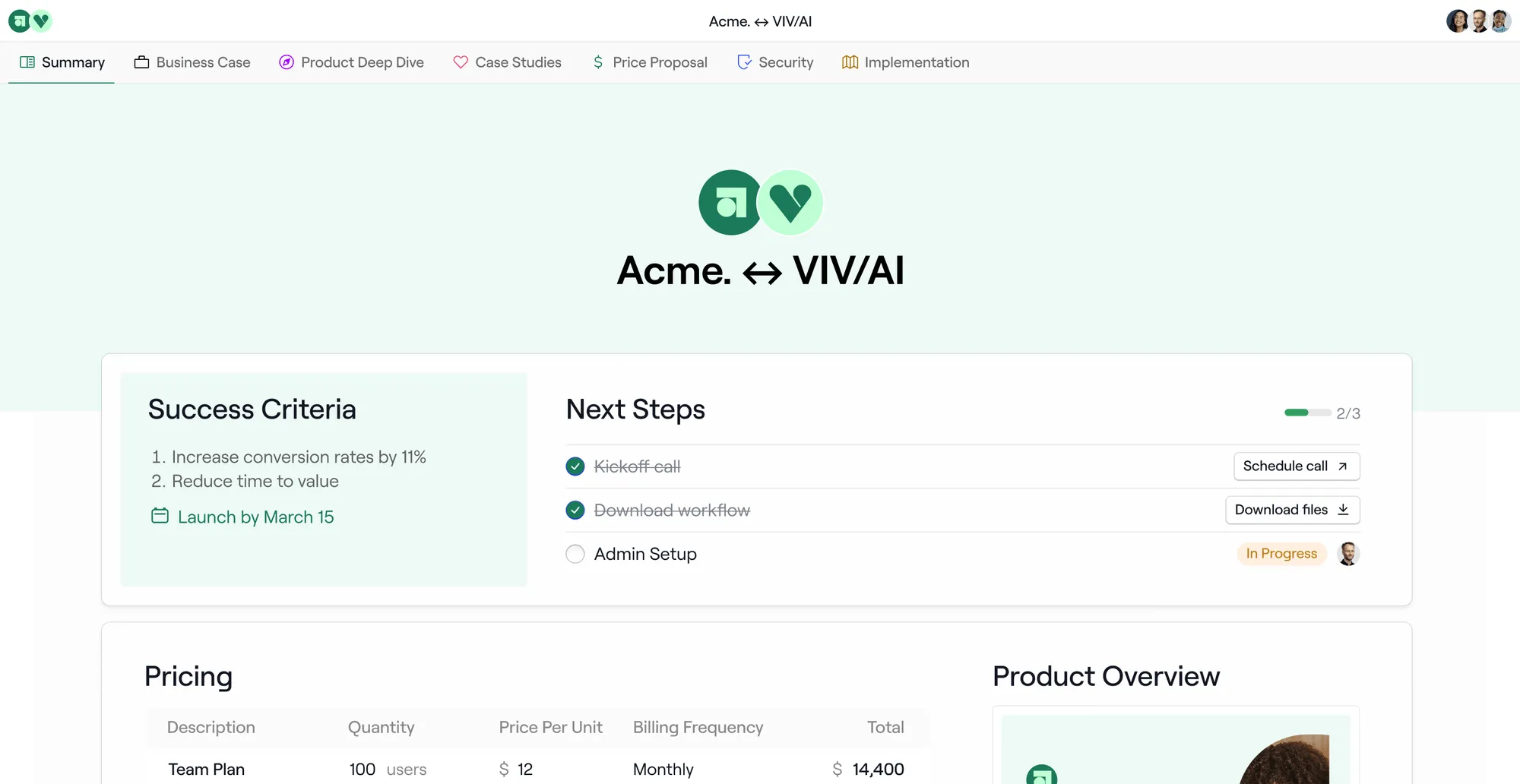
Dock is organized around collaborative buyer and customer workspaces. Teams use it to share content, build mutual action plans, prepare proposals and order forms, manage onboarding, and maintain a common destination through sales, implementation, and renewal.
Dock has expanded beyond standalone deal rooms. Its current product includes a content library, AI-generated documents, playbooks and training, and an AI Enablement Agent that can answer questions and recommend material through chat.
Why Buyers Consider Dock
Dock is strongest when the principal problem is buyer collaboration: scattered follow-up, unclear next steps, proposal administration, and disconnected handoffs between sales and customer success.
Dock is best for:
Revenue teams standardizing digital sales rooms, mutual action plans, proposals, order forms, onboarding plans, and renewal workspaces.
What to verify
Buyer workspaces remain the organizing center. Evaluate the depth of internal content governance, permission-aware knowledge reuse, formal learning, contextual reinforcement, and delivery across the seller's broader daily workflow.
5. Seismic: Combined Seismic-Highspot portfolio

Seismic is a large enterprise enablement suite built around content management and distribution, with learning, coaching, analytics, AI, meeting support, and digital sales rooms.
Following the completed merger, Highspot and Seismic are no longer independent alternatives. The combined organization operates as Seismic, while customers await deeper detail about the long-term product roadmap and how overlapping capabilities will be integrated or consolidated.
Why Buyers Consider Seismic
Existing Highspot customers may treat Seismic as a continuity, consolidation, or migration option. Large global organizations may also consider its breadth, services, integrations, and enterprise operating model.
Seismic is best for:
Large enterprises prepared for a broad suite, substantial implementation, and ongoing administration.
What to verify
Ask for written clarity on product roadmap, migration expectations, overlapping modules, packaging, contract protections, integrations, data portability, and the expected administrative model after the merger.
Read: 14 Best Seismic Alternatives for Sales Enablement in 2025
6. Mindtickle: Sales readiness and skill management

Mindtickle is a revenue-enablement platform whose center of gravity is sales readiness. It supports personalized learning paths, certifications, AI role plays, coaching, skill and behavior measurement, conversation intelligence, content management, and digital sales rooms.
Why buyers consider Mindtickle
Mindtickle is well suited to organizations with a formal definition of seller readiness and managers who actively participate in coaching. Its Readiness Index is designed to benchmark the knowledge, skills, and behaviors associated with successful sellers and identify gaps across a team.
Mindtickle is best for:
Mid-to-large organizations prioritizing structured learning, certifications, skills measurement, role practice, and manager-led performance improvement.
What to verify
Determine how much administration and manager participation the program requires, how learning is reinforced during live seller work, and whether its approach to content governance meets the organization's requirements.
7. Allego: Learning and conversation-based coaching

Allego combines learning, video practice, manager coaching, sales content, digital sales rooms, and conversation intelligence. Its asynchronous approach allows distributed sellers to record pitches, receive feedback, review calls, and complete training on their own schedules.
Allego also supports call transcription and AI capabilities in more than 99 languages, making it relevant to global enablement programs.
Why buyers consider Allego
Allego is strongest for organizations using recorded conversations, video practice, and peer or manager feedback as primary mechanisms for seller development.
Allego is best for:
Distributed or global teams that want scalable video practice, call-based coaching, certification, and asynchronous feedback.
What to verify
Evaluate how well the platform governs changing GTM knowledge, surfaces support across the applications sellers use, and connects learning to actions in live opportunities.
8. Showpad: Field sales enablement and interactive presentation

Showpad combines content, learning, buyer workspaces, analytics, mobile access, and interactive presentation capabilities. Following its combination with Bigtincan, Showpad now positions itself around AI-native revenue effectiveness for complex field-selling organizations.
Its field-oriented features include mobile and offline content access, interactive product experiences, 3D and augmented-reality content, structured learning, and Shared Spaces for seller-buyer collaboration.
Why buyers consider Showpad
Showpad is most relevant when sellers work face to face, demonstrate complex or physical products, operate in low-connectivity environments, or require interactive presentations on mobile devices.
Showpad is best for:
Field-selling organizations in manufacturing, life sciences, consumer products, and other industries with complex product portfolios.
What to verify
Ask how previously separate Showpad and Bigtincan products are packaged, integrated, supported, and migrated. Organizations whose sellers work primarily in CRM, email, call, and browser workflows should also assess whether they need a platform centered on field presentation.
Read: 10 Best Showpad Alternatives for Sales Enablement in 2025
9. Pitcher: Mobile and offline field enablement
Pitcher is a mobile-oriented sales enablement platform for enterprise commercial and field teams. It brings content, customer information, meeting preparation, presentations, follow-up, coaching, and CRM activity into a configurable application.
Pitcher's offline mode supports content presentation, meeting notes, post-call reporting, and follow-up tasks without a connection, then synchronizes activity with the CRM when connectivity returns.
Why buyers consider Pitcher
Pitcher is designed for industries where field representatives need product, account, inventory, presentation, and meeting information on phones or tablets. It is especially relevant to life sciences, consumer products, manufacturing, and financial-services teams with specialized field workflows.
Pitcher is best for:
Global field organizations that require mobile, offline, industry-specific selling workflows.
What to verify
Assess implementation and customization requirements, how content and applications are governed, and whether a specialized field platform is necessary for the team's operating model.
10. Mediafly: Value selling and business-case development
Mediafly combines sales content, buyer engagement, learning, and value-selling tools. Its most distinctive capability is value selling: ROI calculators, TCO models, business-value assessments, business-case builders, and value-realization tools.
Why buyers consider Mediafly
Mediafly can help enterprise sellers quantify financial impact and build a buyer-specific economic case, particularly in complex sales involving finance, procurement, and executive stakeholders.
Mediafly is best for:
Enterprise organizations with a formal value-selling methodology and resources to build and maintain financial models.
What to verify
Value tools require reliable inputs, approved assumptions, ownership, maintenance, and seller training. Buyers should evaluate the work required to build and govern the underlying models, as well as how broadly reps will adopt them.
11. SalesHood: Formal onboarding and enablement programs

SalesHood is designed around structured onboarding, certifications, coaching, AI role plays, sales kickoffs, content, guided selling, and digital sales rooms.
Why buyers consider SalesHood
SalesHood helps enablement teams administer repeatable programs through training paths, pitch practice, peer learning, manager coaching, and certification. Its SKO-focused tools are relevant to organizations that treat the sales kickoff as an ongoing program rather than a one-time event.
SalesHood is best for:
Teams prioritizing formal onboarding, certifications, sales kickoffs, role practice, and manager-led coaching.
What to verify
Test how content is governed and maintained, how guidance appears during live seller work, and whether participation in formal programs translates into sustained adoption and behavior after training ends.
Choosing the right Highspot alternative
Start with the business failure the platform must correct rather than the longest feature list:
- If sellers cannot find or trust content, test ownership, synchronization, permissions, freshness, search, and contextual delivery.
- If sellers are not using the current platform, test how much context switching it requires and whether guidance appears inside normal workflows.
- If sellers know the playbook but do not apply it, test coaching and actions against real opportunities.
- If onboarding is slow, evaluate structured learning together with reinforcement after training ends.
- If buyers receive generic follow-up, test how quickly a seller can create an approved, relevant buyer experience from the active deal.
- If AI assistants or agents are being deployed, verify permissions, citations, ownership, source freshness, and traceability.
- If leaders cannot prove impact, test the connection between enablement activity, buyer engagement, pipeline, and closed revenue.
- If a merger or acquisition affects the vendor, price migration, integration, implementation, roadmap, and contract risk together.
Run every finalist through the same practical evaluation:
- Import approved, duplicate, outdated, and permission-restricted content.
- Change an important piece of messaging and observe how quickly it updates everywhere it is used.
- Ask a seller to answer a buyer question inside their normal workflow.
- Deliver coaching or learning tied to a live opportunity.
- Create and share a personalized buyer experience using approved content and deal context.
- Connect an AI assistant and inspect its permissions, citations, and source traceability.
- Produce a report linking content, rep adoption, or buyer engagement to pipeline.
- Price licenses, modules, implementation, migration, integrations, services, and ongoing administration together.
The strongest Highspot alternative is not necessarily the product with the most features. It is the one that turns trusted knowledge into better seller and buyer execution with the least friction—and that reps consistently adopt.
Ready to see how Spekit can help your team sell smarter? Book a demo today.