



.svg)
.svg)



Sales Enablement
14 Best Sales Pipeline Management Tools
A comparison of 14 sales pipeline management tools that help teams generate leads, track deals, and report results, with CRM integration.
Updated
October 16, 2025


A comparison of 14 sales pipeline management tools that help teams generate leads, track deals, and report results, with CRM integration.
Your sales pipeline is a set of repeatable steps/processes that convert potential leads or customers into paying clients. Effectively managing your pipeline is important if you want to grow your customer base and scale your business. But, it can be difficult to keep track of prospects and deals progress without a sales pipeline management tool.
Adopting a pipeline tool can cut down a business’s sales cycle length by 8-14%! You can maintain a defined sales process, generate and create a database of leads, shorten your sales cycle, improve follow-ups, and much more!
So, what sales pipeline management tool should you be using? In this article, you’ll learn how to streamline your sales pipeline and the best tools you can use to do this.
A sales pipeline visually represents how prospects move through your sales process. Therefore, sales pipeline management involves ensuring your pipeline is healthy by tracking how leads get into and through the pipeline.
Managing one lead is relatively easy. You’ll only need to track where the lead is in the pipeline, their pain points/needs, and what’s necessary to progress them to the next stage (for example, the right sales content). But your business won’t have only one lead. On average, businesses generate about 500 to a thousand leads per month.
Sales pipeline management is how you’ll handle selling to all 500 or 1,000 of your leads, and to supercharge the process and make more revenue, you need a pipeline management tool.
A sales pipeline management tool is a sales enablement software or platform designed specifically to help you nurture leads, track potential customers, and analyze your sales efforts. It enables you to handle activities within your pipeline like:
This tool offers sales process automation features and also helps you track pipeline metrics to determine what you’re doing right and what processes should be optimized. A revenue operations software can further enhance these efforts by aligning sales processes, data insights, and forecasting in a single platform.
Before investing in a sales pipeline management tool, you should already have an established and streamlined sales pipeline because the tool can only optimize what already exists.
Here’s how to do that:
The typical sales pipeline stage starts with lead generation and progresses through lead qualification, nurturing, negotiation, sale closing, and post-sale follow-up. However, this structure is not a one-size-fits-all.
Your pipeline stages are very specific to your business and should clearly visualize what activities your sales team will do to prospect leads and close deals. For example, if you’re a financial services startup, your pipeline stage might focus on application, underwriting, approval, and funding.
You can build the best sales pipeline, but without a sales team that can champion it, the pipeline will fail. Your sales reps, especially new hires, should be given sales training on how your business pipeline works, how they’ll navigate it, and how to use the pipeline management tool you adopt.
But, you mustn’t slow down their selling efforts. Use an AI-powered enablement platform like Spekit to deliver real-time guidance and training directly in the rep’s workflow. Instead of leaving LinkedIn to find a lesson or document, reps can access contextual guidance instantly—powered by AI Sidekick. It surfaces the next best action, content, or play based on what the rep is doing, helping them stay productive and focused.

You can define your sales pipeline stages using all the information you’ve gathered and then tie in acceptance criteria, activities, metrics, and forecasts. To make it easier for yourself, you can use customizable sales templates and free sales tools from Spekit to plan the activities for each stage.
Spekit’s prospecting template, for example, coaches sales reps through all the processes they should follow to effectively execute the prospecting and qualification stage of the sales pipeline.
Good sales content, such as product comparisons, testimonials, and sales decks, can move a prospect toward making a purchase. When selling, your sales reps need to know what content to send at every stage of the prospect’s buying journey.
Rather than have your sales reps sift through unending sales content and waste time deciding which one is appropriate, you can use Spekit AI to offer smart content recommendations. Spekit’s AI Sidekick automatically delivers deal-accelerating content, coaching, and insights based on real-time context—from opportunity stage to meeting notes—right inside Salesforce, Slack, Gmail, and more. Reps don’t have to search for resources; AI Sidekick brings them the answers.
After streamlining your sales pipeline, you can check out sales pipeline management tools and choose one with features that align with your pipeline structure. Here are the best tools to choose from:

Gong is an AI-powered revenue enablement platform for revenue teams. It allows them to capture customer interactions via any medium, including emails, phone calls, video calls, etc., and analyze conversations later to uncover insights needed to move prospects down the sales pipeline.
Gong also offers a centralized platform for managing customers and integrates with other tools like CRMs, automation, and customer support software. Its integration with SpekitAI enables sales reps to access AI-powered smart content recommendations right in their workflow.

Key Features:
Pricing: Pricing is not available on Gong.io’s website.

Pipedrive is a CRM for sales teams to automate their selling process, manage leads, and track the sales pipeline. It enables users to customize their pipeline using a Kanban-style dashboard to visualize their sales funnel and adjust pipelines to align with their sales process.
Pipedrive lets users import customer data from other pipeline management software or spreadsheets. It integrates with tools like Slack, Zoom, Zapier, and HubSpot.

Key Features:
Pricing:

Zendesk is a sales enablement and customer service solution that enables salespeople to provide personalized buying experiences to clients. It is a configurable platform that lets users build their own solutions with their code or configure the platform through Zendesk’s API.
The company’s pipeline management tools for sales teams support lead generation, contact and deal management, and activity tracking.

Key Features:
Pricing:
Salesforce CRM enables businesses to use data to manage customer and prospect relationships. It gives users a centralized platform to store, track, and analyze customer/prospect information. It also lets users integrate data and contact information from any source, including Slack, Tableau, Mulesoft, and Spekit.
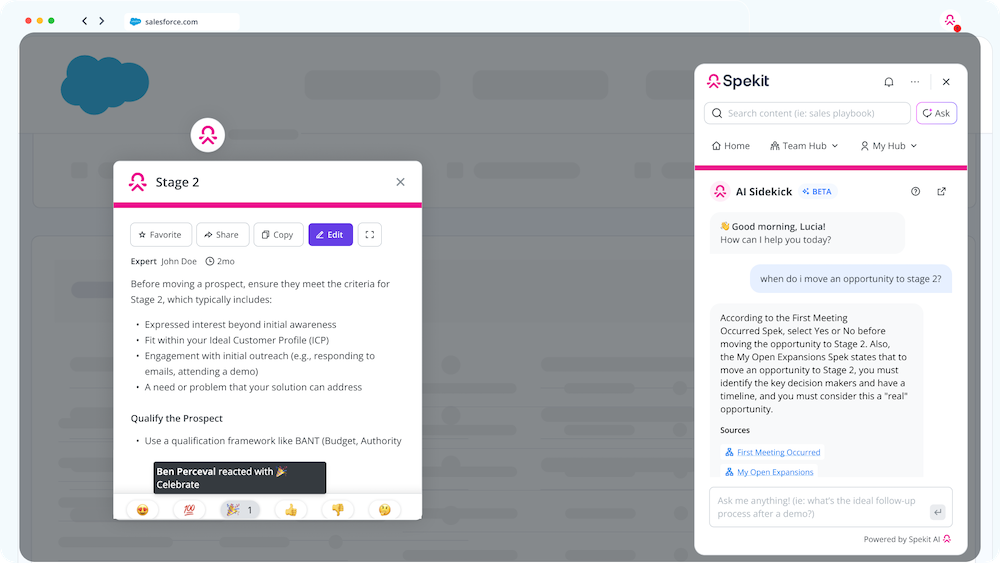
Spekit’s no-code, one-click Salesforce integration automatically embeds your guidance, training, and collateral directly into Salesforce, allowing you to onboard employees in Salesforce 50% faster. With Spekit, you have a 60 % reduction in Salesforce documentation time, a 35% reduction in inbound Salesforce support tickets, and 50% less time communicating new initiatives and changes.
Key Features:
Pricing:

Hubspot CRM software gives sales teams a real-time view of their sales pipeline through a visual dashboard. Users can generate detailed reports on sales productivity metrics, sales activity, and individual performance of sales reps. Its pipeline management tool enables sales reps to prioritize leads and customize the pipeline around their buyer’s needs.
HubSpot integrates with platforms like Spekit, Gong, Vimeo, Dialpad, and Asana.

Key Features:
Pricing:

Monday is a CRM for centralizing and tracking customer communication. It offers a sales dashboard for users to keep track of their pipelines and targets. The dashboard can be customized to reflect deal progress, team performance, and sales figures. It also provides a sales forecasting tool for users to set deal value in their pipeline and track it against actual sales.
Monday integrates with Zoom, Slack, and Microsoft Teams.

Key Features:
Pricing:

Lusha is a sales intelligence platform for sales reps to target the right customers with the right products. It enables users to assess buyer intent based on behavioral signals so they can qualify and prioritize leads in their pipeline. Lusha integrates with CRMs so that users can export prospects lists. It also provides an API for custom database integrations.

Key Features:
Pricing:

ActiveCampaign is an automation, email marketing, and sales enablement platform for sales teams to connect with prospects and customers on their preferred channels. It lets users build email and marketing flows via multiple platforms and deliver personalized messages to prospects. ActiveCampaign integrates with platforms like Shopify, Stripe, Square, and Salesforce.

Key Features:
Pricing:

Insightly is a CRM platform that helps salespeople streamline their sales processes and support long-term customer relationships through the sales pipeline. Users can create and track custom sales pipelines, route leads, and run marketing campaigns at scale. Insightly provides users with a mobile app and also integrates with tools like Asana, BambooHR, Calendly, and DocuSign.

Key Features:
Pricing:
Freshsales is an AI-powered sales CRM for sales teams to grow their pipeline and increase conversions. Its sales pipeline tool lets users build multiple custom sales pipelines and track deal progress. It gives sales reps a 360-degree view of their customers with buyer intent so users can better target leads and also supports multi-channel targeting. Freshsales integrates with Shopify, Quickbooks, HubSpot, and Stripe.

Key Features:
Pricing:

Zapier is a workflow automation tool that enables sales teams to automate manual, repetitive processes like lead capturing, lead management, sending emails to contacts, and summarizing sales calls.
Users can build pipeline workflows with drag-and-drop visual builders and add custom filters, logic, and control. Zapier integrates with HubSpot, Salesforce, Slack, and OpenAI.

Key Features:
Pricing:

Salesmate allows users to build multiple custom pipelines, identify strong leads, and visualize their sales cycle. It lets users prioritize leads using lead scoring so they can target the right leads and maintain a constant sales pipeline flow. Salesmate offers an API for building custom integrations and also integrates with ActiveCampaign, Clearbit, Gmail, and Dialpad.

Key Features:
Pricing:

Zoho CRM enables businesses to automate workflows, campaigns, processes, and customer journeys. It offers advanced analytics for users to create custom dashboards and reports, gain actionable insights, and measure operations. It lets sales teams capture leads, automate lead scoring, and prioritize prospects.
Zoho integrates with Google Workspace and Microsoft 365.

Key Features:
Pricing:

Keap is an automation and CRM software that enables small businesses to automate their processes using a drag-and-drop workflow builder. Its pipeline management tool lets sales teams create multiple customizable pipelines, sync leads with the CRM, and visualize their sales funnels. Keap integrates with Zapier, WooCommerce, Dropbox, and Shopify.

Key Features:
Pricing:
Now that you know how to manage your sales pipeline, let’s look at other frequently asked questions:
There are five stages of the sales pipeline:
To track your sales pipeline, you’ll need to set a goal (the number of leads you want to reach out to in a month) and collect data to track where your leads come from and how they move through the pipeline stages.
You can establish specific metrics to analyze your sales pipeline in depth. Metrics like:
To track these metrics effectively, you’ll need a sales pipeline analysis tool like Spekit Analytics. Spekit helps you turn raw data drawn from these metrics into easy-to-review informative visuals to identify trends and patterns in your sales pipeline.
You can create a sales pipeline in Excel by setting up information like the deal title, contact person, deal stage, amount, win probability, weighted forecasts, and deal activity. You should also assign a sales rep to each deal and what quarter of the year the deal falls into.
Potential deals fall through when your sales pipeline isn’t healthy. Build your pipeline with the intention of making it easy for your sales team to see where potential customers are at all times of their buyer journey, and the best way to do this is with a sales pipeline management tool.
The right tool will give your sales team a bird ' s-eye view of the entire sales pipeline so they can target and prioritize the right leads. If your sales reps have trouble adopting the pipeline management tool you choose, you can integrate an easy-to-use platform like Spekit and give them just-in-time lessons and walkthroughs that guide them through the sales pipeline tool.
Spekit enables you to guide sales reps step by step as they navigate new tools, reinforcing knowledge and best practices in real time—without disrupting their workflow. With AI Sidekick, reps get personalized recommendations and next-step guidance that keeps deals moving. Ready to transform how your team sells?
A funnel shows conversion percentages at each stage, usually from a marketing or revenue lens. A pipeline shows active deals and next steps by stage, usually from a sales execution lens. Use both together to understand volume, conversion, and where to focus coaching.
Start with win rate, average sales cycle, stage-by-stage conversion, pipeline coverage (pipeline value divided by quota), and age in stage. Add quality checks such as next step date, next step description, and contact reach within the account.
Keep the setup simple, align fields to your stage exit criteria, and deliver training in the flow of work. If you use Spekit, AI Sidekick can surface the right guidance and content inside tools like Salesforce or Gmail, so reps learn as they sell without leaving their workflow.