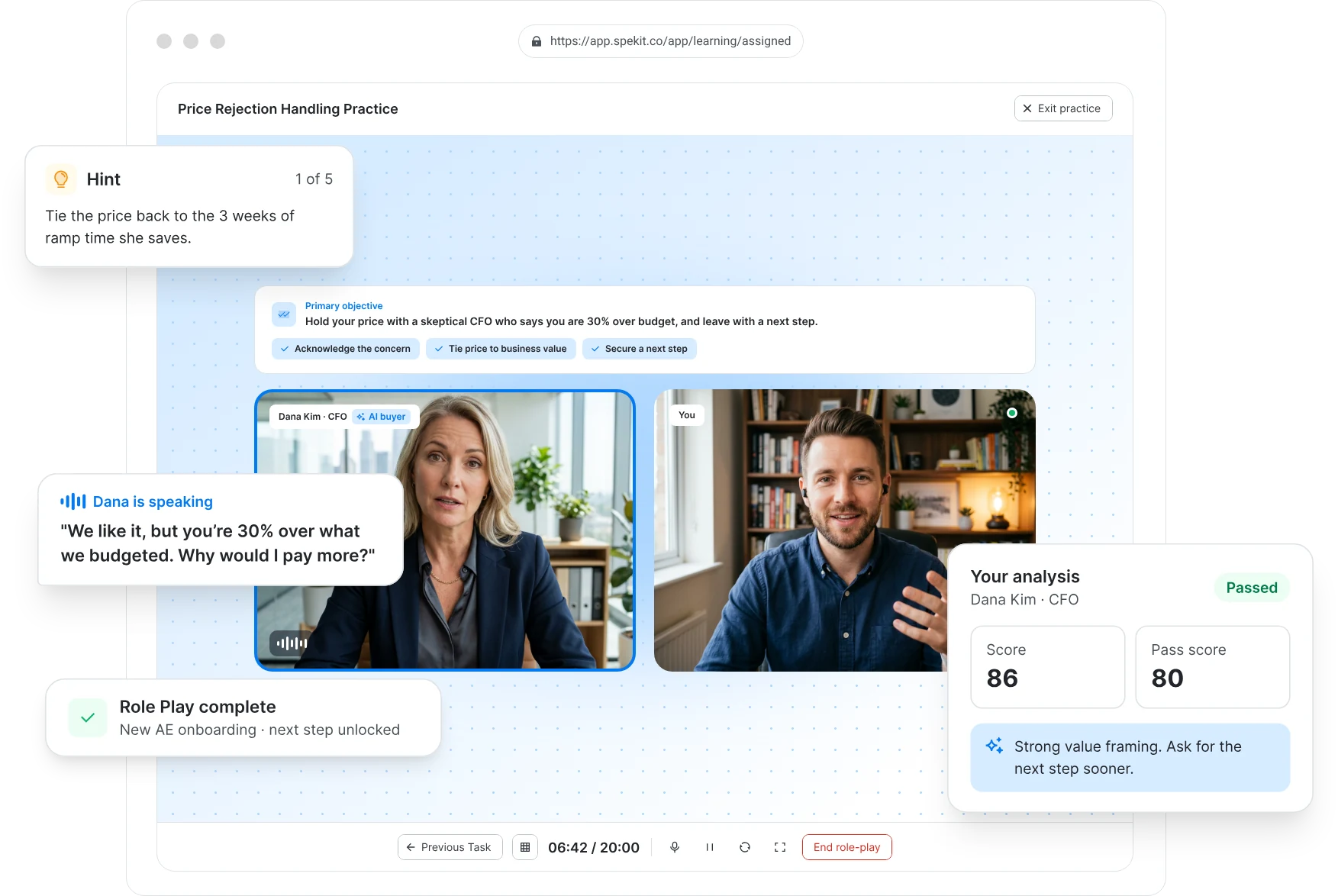













Employee Onboarding & Training
Best Sales Playbook Software and How to Build One
Improve your sales content management, CMS, and sales playbook organization to drive revenue growth with this 2026 guide.
Updated
September 3, 2026



Improve your sales content management, CMS, and sales playbook organization to drive revenue growth with this 2026 guide.
Now that complex buyer journeys are becoming the status quo, it’s important to equip sales teams with the right tools and skills to navigate the ever-changing landscape. One of the best ways to help your reps improve sales performance? Creating a sales playbook.
Even though companies with a sales playbook are 33% more likely to be high performers, 40% of sales teams don’t have one. One survey found that companies avoid the process because of how difficult it can be to create a sales playbook that’s both easy for reps to navigate and companies to keep up-to-date.
This article will walk you through the process of creating and maintaining an effective sales playbook of your own sans difficulties—and even includes a roundup of the best sales playbook software to help you get the job done.
A sales playbook acts as the ultimate instruction manual for your sales team. It outlines your company’s sales processes, techniques, and best practices, and is designed to help reps adapt to a variety of sales scenarios.
The most effective sales playbooks guide reps through any given scenario that can transpire across all sales pipeline stages, and provide the necessary intel (think: buyer personas, sales plays, sales scripts, and email templates) to navigate them with confidence.
Companies that take the time to define their go-to sales methodologies and best practices—and document them in a centralized location—experience an 18% difference in revenue growth, compared to companies that don’t.
Creating a sales playbook from scratch can be daunting, but you don’t have to start the process with a blank page. Sales playbook templates are a great way to reduce overwhelm, save time, and ensure your sales enablement materials are as on-point and effective as possible.
Spekit, an AI-powered just-in-time sales enablement platform, offers free, out-of-the-box sales playbook templates on sales stages, MEDDIC, and BANT, among others. From sales training content to sales plays to best practices, use Spekit’s templates to create top-tier sales playbooks so your reps have the help they need when and where sales plays happen, including Salesforce, HubSpot, LinkedIn, and more.
Sales playbook software streamlines the process of creating an effective sales playbook, keeping it up-to-date, and ensuring reps always have the latest version at their fingertips.
Traditional playbooks, which typically include PDFs or slides, make it difficult for reps to find the exact content they need on the fly. They’re also difficult to update—so much so that 31% of organizations only update their playbook once a year, and 12% never do.
On the flipside, sales playbook software lets you create an interactive and collaborative playbook that’s easy to navigate, allowing sellers to find exactly what they need at every stage of the pipeline—and allowing you to make regular updates as you refine your sales processes.
Using sales playbook software unifies your sales team and keeps everyone on the same page, promoting the same message. Never again will you have to wonder if reps are working with outdated iterations of your sales playbook (or, worse, not working with one at all).
Even though the content of a sales playbook is unique to its specific company, there are a handful of must-have sections every playbook should contain. Let’s explore each of them.
Sales playbooks typically start off with a company overview. This section provides reps with a bird’s eye view of what your company does, what it hopes to achieve, a deep dive into its products or services, and its value proposition.
Your company overview should also include a sales organization chart that outlines the company hierarchy—names and titles, individual roles and responsibilities, who reports to whom, and how your sales organization fits together.
The sales process section should explain which sales methodologies you use, why you chose them for your team, and how they align with your company’s ultimate goals. Next, outline the series of steps that salespeople should take to move prospects through the sales funnel, including what to do and say in every potential scenario.
With this information, reps will have a clear understanding of what success looks like at every touchpoint—from first contact to deal closing.
Clearly defining your short- and long-term goals provides your sales team with precise targets and timeframes to focus on. It can also be helpful to include a snapshot of where your goals currently stand in this section, both as a source of motivation and a convenient way for reps to monitor their progress.
The best KPIs and metrics to track are the ones that act as measurements for the goals you want to reach. These might include sales cycle length, win rate, time to close, and quota attainment, among others. This data can be used to pinpoint what’s working about your sales enablement strategy, as well as opportunities for continual improvement.
Customer profiles are fictional representations of your company’s target markets, and typically include details like industry, company size, job title, pain points, goals, and buying behaviors.
Including these profiles in your sales playbook helps reps understand the various personas they’ll encounter, anticipate their needs, answer questions, and develop effective conversation starters and strategies for overcoming objections at any stage of the sales cycle.
This section of your sales playbook should provide a complete list of the software and tools your reps will be using, such as sales content management software, CRM tools and integrations, and automation processes.
Include a deep-dive of what each tool is used for, exactly how they support the sales team in moving deals forward, and detailed user guides to make sure reps are using the right software in the right way at every touchpoint.
In this section, you’ll round up all of the internal and external content your reps need to effectively nurture leads and close deals.
Internal resources support your sales team’s work behind-the-scenes, such as:
External resources support sales pitches and educate prospects, and might include:
As you continue refining your sales enablement strategy, you might spot useful information along the way that can help reps better allocate their time too. For example, you might notice specific sales sequences are especially effective for your target markets or that top performers are streamlining certain tasks in genius ways.
Including a time management section means reps can conveniently discover new ways of streamlining their individual working style and focus more on what they do best—closing deals.
Using sales playbook software can help you create an effective sales playbook for your team in a fraction of the time. Read on to discover the best sales playbook software options available.
For teams choosing sales playbook software, Spekit® is an AI-first revenue enablement platform built on a governed content management and learning system powered by an AI-first GTM Knowledge Engine. In the Spekit Content Hub, enablement and product marketing teams create playbooks, talk tracks, and battlecards natively with the AI Content Builder or sync existing assets from Google Drive, Notion, SharePoint, and Confluence. Governance runs at creation, with Spekit surfacing overlapping content the moment someone starts writing, so a second version of a play never gets published, and a play nested inside another updates everywhere it appears the instant the source changes.
AI Sidekick, the rep’s AI sales coach, is how the playbook reaches the deal. It delivers Enablement in the Flow of Work® through approved content, contextual coaching, deal intelligence, and next-best actions inside tools reps already use, including Salesforce, Gong, Slack, Gmail, Claude and every other web app, so the right play is recommended in context instead of looked up in a document.
Granular analytics close the loop, tracking which reps use which plays, in what part of their workflow, in which deals, and tying every asset directly to pipeline and revenue impact. Leaders can see which plays move deals forward and which parts of the playbook are not landing, then update once and have the change reach every rep.
Key features of Spekit:
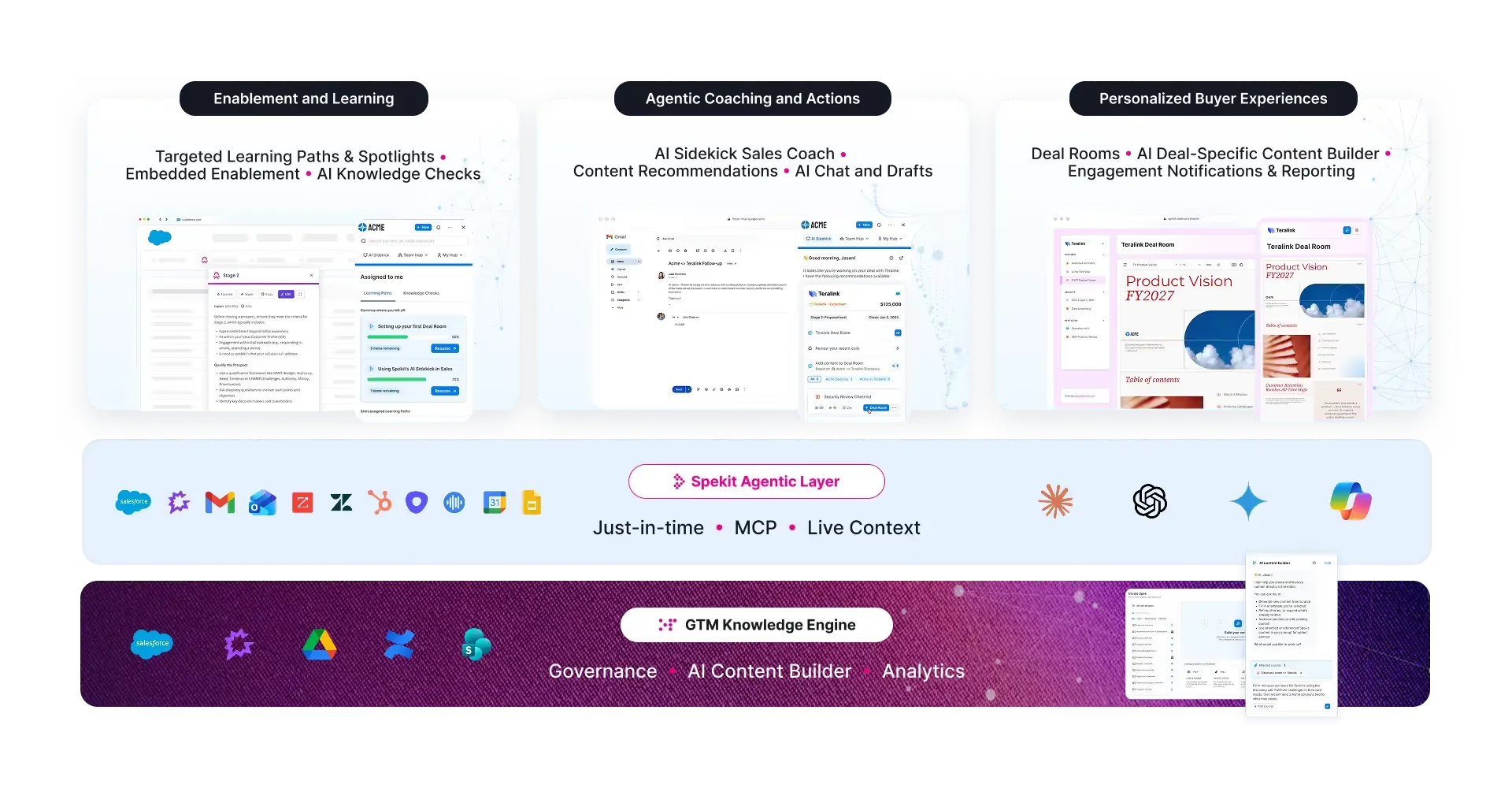
Best for: High-growth, mid-market, and enterprise B2B revenue teams that want governed playbooks that stay current and reach reps in the moment of the deal, grounded in a GTM Knowledge Engine.
💡 Spekit acts as the connective tissue of your sales enablement stack. See how Spekit helps teams like yours spend 90% less time searching for answers.
Real customer quote:
"This morning I found three assets, generated the links, and had the email out within 2 minutes start to finish. This would’ve taken me a good 20 minutes in a previous sales content management platform and a high likelihood that I would’ve grabbed the wrong asset” - Anthony Panvini, Director Enterprise New Logos | InMoment

HubSpot’s Playbooks tool provides sales teams with a clear and repeatable roadmap to follow at every stage of the sales process, offering step-by-step instructions, checklists, best practices, and more. Whether prospecting, negotiating, or following up, reps can access interactive cards for guidance across the HubSpot platform, which takes the hesitation out of your sales process and allows reps to adapt quickly on the fly.

Key Features:
Pricing:

Canva makes it easy for your sales team to connect with prospects, build relationships, and close deals faster with world-class visual content—no design experience required. From playbooks to pitch decks to demo walkthrough videos, Canva’s Sales Work Kit features a library of professionally designed templates that can quickly be made brand-ready.
With Canva, reps can create visually impactful sales collateral as needed and in a fraction of the time.

Key Features:
Pricing:

Visme is an all-in-one visual content creation and collaboration platform that empowers your sales team to create branded sales materials, even without design experience. Browse through a wide range of sales playbook templates and customize them with your brand’s colors, fonts, images, icons, even videos and audio. Transform dry data into dynamic graphs and colorful charts using Visme’s data visualization tools. Then download your playbook as a high-quality PDF for printing or send the digital version to your team with a link.

Key Features:
Pricing:

Dialpad is an AI-powered sales intelligence software that collects real-time transcriptions of sales calls and generates call summaries at the end of each conversation. Its AI Playbooks feature captures user responses and uses them to provide real-time insights to sales reps based on your preferred sales methodology.
This ensures reps are always asking prospects the right questions at the right time, while staying aligned with your company’s sales processes.

Key Features:
Pricing:

Lemlist is a cloud-based sales outreach tool that uses AI to help you find leads with verified emails, write and personalize at scale, and send cold emails that actually get replies. It also helps you avoid deliverability issues by staggering how your email campaigns are sent to mimic a human touch.
Plus, you can kick your sales playbook up a notch with Lemlist’s playbooks library. Get free access to actionable playbooks with proven strategies and tips for signing more deals, including, “How to Find and Close Leads with Cold Outreach,” “How to Write Cold Emails That Get Replies,” and more.

Key Features:
Pricing:
There’s a lot that goes into choosing the best sales playbook software for your team. Below is additional intel to help you make an informed decision.
If you’re looking for a way to instantly generate baseline content for sales playbooks, Spekit AI is where it’s at. Not only does the just-in-time sales enablement tool allow you to turn a single sentence into a revenue-generating playbook, but surface the playbooks reps need when they need them to close deals faster—all without disrupting productivity.
Create contextual, agile playbooks that surface across every sales touchpoint, and make them instantly accessible in Salesforce, Chorus, Outreach, or wherever your reps are working.
Traditionally, sales playbooks are formatted as an ebook, PDF, or a collection of slides. But long-form documents like these are hard for reps to navigate when they need specific content in the moment. They’re also inconvenient for companies to update, which puts sales teams at risk of working with playbooks that are ineffective, inaccurate, and obsolete.
With the buyer journey becoming more complex by the day, sales playbooks need to keep up. With Spekit, you can create contextual, agile playbooks that surface across every sales touchpoint wherever your reps are working.
Watch how Spekit brings sales playbooks to life
A sales play is a set of repeatable steps, actions, and best practices for sales reps to use during specific selling situations. Plays guide reps through what to know, say, share, and do during each customer interaction to move deals forward, no matter the buyer persona or where they are in the sales cycle.
A sales playbook is a collection of sales plays. The document also outlines a company’s sales processes, techniques, and best practices, so that reps can easily adapt to any sales scenario.
The best sales playbooks are comprehensive and provide clear, precise, step-by-step instructions to increase sales velocity and win rates. Today’s sales playbooks need to be agile enough to keep up with increasingly complex buyer journeys, accessible enough for reps to find exactly what they need in the moment of need, and flexible enough for companies to make updates as strategies evolve.
The best sales playbook software to help you get the job done is Spekit. Using Spekit’s generative AI sales tool, Spekit AI, you can instantly generate baseline content for sales playbooks and make them instantly accessible in Salesforce, Gong, Chorus, or wherever your reps are working.
What makes Spekit such a game-changer is that it supports just-in-time learning in the flow of work. With Spekit, your sales playbooks go from static to interactive, adaptable, and reinforceable right where your sales team lives and sells.
Prospecting happens in real-time–your playbooks and processes should too.